

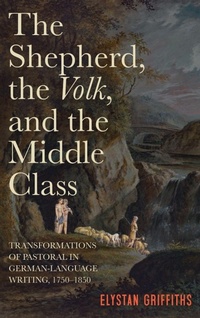
The Shepherd, the Volk, and the Middle Class
Transformations of Pastoral in German-Language Writing, 1750-1850
Will be published approx. on 15. May 2020
Book
Hardback
300 pages
978-1-64014-064-6 (ISBN)
Description
Analyzes the transformation of German-language pastoral from a portrayal of the idyllic lives of herdsmen into a vehicle for the concerns and aspirations of the middle class.
European pastoral tradition traces its roots to Theocritus's Idylls and Virgil's Eclogues, which portrayed herdsmen pursuing love and art. While the lives of shepherds, or of country folk generally, remain the ostensible subject of pastoral, Elystan Griffiths argues that in the German context after 1750 its central concerns were those of an emergent, nationally minded, creative middle class. These concerns became increasingly urgent in the face of the upheaval of the French Revolution and the need to respond to the rise of capitalist modernity. The Shepherd, the Volk, and the Middle Class traces how pastoral was transformed in the work of major German-language authors, including Gessner, "Maler" Mueller, J. H. Voss, Goethe, Kleist, Moerike, and Nestroy, into a vehicle for serious moral, political, and social questions. Debates raged about whether present-day shepherds were fit to appear in literature, or whether the objects of pastoral should, rather, be the idealized shepherds of Arcadian prehistory or early Biblical times. Pastoral was thus bound up with cultural and political questions surrounding the relationships between the classes, the state of the peasantry, the nature of art, and most fundamentally the social constraints of the thinking subject amid the emancipatory promise of the Enlightenment.
European pastoral tradition traces its roots to Theocritus's Idylls and Virgil's Eclogues, which portrayed herdsmen pursuing love and art. While the lives of shepherds, or of country folk generally, remain the ostensible subject of pastoral, Elystan Griffiths argues that in the German context after 1750 its central concerns were those of an emergent, nationally minded, creative middle class. These concerns became increasingly urgent in the face of the upheaval of the French Revolution and the need to respond to the rise of capitalist modernity. The Shepherd, the Volk, and the Middle Class traces how pastoral was transformed in the work of major German-language authors, including Gessner, "Maler" Mueller, J. H. Voss, Goethe, Kleist, Moerike, and Nestroy, into a vehicle for serious moral, political, and social questions. Debates raged about whether present-day shepherds were fit to appear in literature, or whether the objects of pastoral should, rather, be the idealized shepherds of Arcadian prehistory or early Biblical times. Pastoral was thus bound up with cultural and political questions surrounding the relationships between the classes, the state of the peasantry, the nature of art, and most fundamentally the social constraints of the thinking subject amid the emancipatory promise of the Enlightenment.
Reviews / Votes
With his multilayered analysis, Griffiths has made the idyll newly accessible for social-historical readings. His book reminds us emphatically that it is still worthwhile to read this only apparently apolitical genre with precise attention to its social significance. -- Annika Hildebrandt * ZEITSCHRIFT FUER GERMANISTIK *More details
Series
Language
English
Place of publication
Columbia, MD
United States
Publishing group
Boydell & Brewer Ltd
Target group
Professional and scholarly
Product notice
Cloth over boards
Dimensions
Height: 235 mm
Width: 157 mm
Thickness: 21 mm
Weight
591 gr
ISBN-13
978-1-64014-064-6 (9781640140646)
Copyright in bibliographic data and cover images is held by Nielsen Book Services Limited or by the publishers or by their respective licensors: all rights reserved.
Schweitzer Classification
Other editions
Additional editions
Elystan Griffiths
The Shepherd, the <I>Volk</I>, and the Middle Class
Transformations of Pastoral in German-Language Writing, 1750-1850
E-Book
05/2020
1st Edition
De Gruyter
€48.99
Available for download
Person
ELYSTAN GRIFFITHS is Senior Lecturer (Associate Professor) in German Studies at the University of Birmingham. He is the author of the monographs Political Change and Human Emancipation in the Works of Heinrich von Kleist (2005) and The Shepherd, the Volk, and the Middle Class: Transformations of Pastoral in German-Language Writing, 1750-1850 (2020). Along with David Hill, he published the first complete edition of J.M.R. Lenz's writings on social and military reform, based on extensive manuscript holdings in Krakow, Berlin and Riga. He is currently working on a project on the relationship between obedience and agency in German culture of the eighteenth and nineteenth centuries.
Content
Introduction: Pastoral as a Way of Not Looking at the Country
Pastoral in the Enlightenment: Salomon Gessner's Idylls
"Wo giebts dann Schaefer wie diese?": Friedrich "Maler" Mueller's Idylls of Cultural Renewal
Johann Heinrich Voss's Experiments with an Enlightened Idyll
Goethe and Schiller's Engagements with Pastoral: Facing the Post-Revolutionary World
Heinrich von Kleist: The Promises and Illusions of Pastoral
Pastoral in the Age of Capital: Eduard Moerike and Johann Nestroy
Conclusion
Pastoral in the Enlightenment: Salomon Gessner's Idylls
"Wo giebts dann Schaefer wie diese?": Friedrich "Maler" Mueller's Idylls of Cultural Renewal
Johann Heinrich Voss's Experiments with an Enlightened Idyll
Goethe and Schiller's Engagements with Pastoral: Facing the Post-Revolutionary World
Heinrich von Kleist: The Promises and Illusions of Pastoral
Pastoral in the Age of Capital: Eduard Moerike and Johann Nestroy
Conclusion