

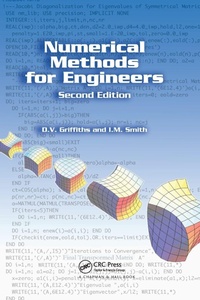
Numerical Methods for Engineers
2nd Edition
Published on 19. September 2019
Book
Paperback/Softback
492 pages
978-0-367-39066-2 (ISBN)
Description
Although pseudocodes, Mathematica (R), and MATLAB (R) illustrate how algorithms work, designers of engineering systems write the vast majority of large computer programs in the Fortran language. Using Fortran 95 to solve a range of practical engineering problems, Numerical Methods for Engineers, Second Edition provides an introduction to numerical methods, incorporating theory with concrete computing exercises and programmed examples of the techniques presented.
Covering a wide range of numerical applications that have immediate relevancy for engineers, the book describes forty-nine programs in Fortran 95. Many of the programs discussed use a sub-program library called nm_lib that holds twenty-three subroutines and functions. In addition, there is a precision module that controls the precision of calculations.
Well-respected in their field, the authors discuss a variety of numerical topics related to engineering. Some of the chapter features include...
The numerical solution of sets of linear algebraic equations
Roots of single nonlinear equations and sets of nonlinear equations
Numerical quadrature, or numerical evaluation of integrals
An introduction to the solution of partial differential equations using finite difference and finite element approaches
Describing concise programs that are constructed using sub-programs wherever possible, this book presents many different contexts of numerical analysis, forming an excellent introduction to more comprehensive subroutine libraries such as the numerical algorithm group (NAG).
Covering a wide range of numerical applications that have immediate relevancy for engineers, the book describes forty-nine programs in Fortran 95. Many of the programs discussed use a sub-program library called nm_lib that holds twenty-three subroutines and functions. In addition, there is a precision module that controls the precision of calculations.
Well-respected in their field, the authors discuss a variety of numerical topics related to engineering. Some of the chapter features include...
The numerical solution of sets of linear algebraic equations
Roots of single nonlinear equations and sets of nonlinear equations
Numerical quadrature, or numerical evaluation of integrals
An introduction to the solution of partial differential equations using finite difference and finite element approaches
Describing concise programs that are constructed using sub-programs wherever possible, this book presents many different contexts of numerical analysis, forming an excellent introduction to more comprehensive subroutine libraries such as the numerical algorithm group (NAG).
More details
Edition
2nd edition
Language
English
Place of publication
Oxford
United Kingdom
Publishing group
Taylor & Francis Ltd
Target group
Professional and scholarly
Academic and Professional Practice & Development
Dimensions
Height: 234 mm
Width: 156 mm
Thickness: 26 mm
Weight
740 gr
ISBN-13
978-0-367-39066-2 (9780367390662)
Copyright in bibliographic data and cover images is held by Nielsen Book Services Limited or by the publishers or by their respective licensors: all rights reserved.
Schweitzer Classification
Other editions
Additional editions
D. Vaughan Griffiths | I.M. Smith
Numerical Methods for Engineers
Book
06/2006
2nd Edition
Chapman & Hall/CRC
€263.80
Shipment within 15-20 days
D. Vaughan Griffiths | I.M. Smith
Numerical Methods for Engineers
E-Book
06/2006
2nd Edition
Chapman & Hall/CRC
€89.99
Available for download
D. Vaughan Griffiths | I.M. Smith
Numerical Methods for Engineers
E-Book
06/2006
2nd Edition
Chapman and Hall
€89.99
Available for download
Persons
Griffiths, D. Vaughan; Smith, I.M.
Content
Introduction and Programming Preliminaries. Linear Algebraic Equations. Nonlinear Equations. Eigenvalue Equations. Interpolation and Curve Fitting. Numerical Integration. Numerical Solution of Ordinary Differential Equations. Introduction to Partial Differential Equations. Appendix A: Descriptions of Library Subprograms. Appendix B: Fortran 95 Listings of Library Subprograms. Appendix C: References and Additional Reading.