

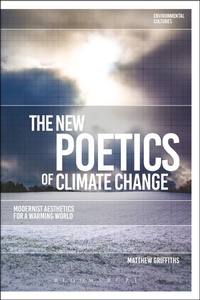
The New Poetics of Climate Change
Modernist Aesthetics for a Warming World
Published on 27. July 2017
Book
Hardback
224 pages
978-1-4742-8209-3 (ISBN)
Description
Climate change is the greatest issue of our time - and yet too often literature on the subject is considered only in the bracket of 'environmental' writing, divorced from culture, society and politics. The New Poetics of Climate Change argues instead that the emergence of global warming presents a fundamental challenge to the way we read and write poetry - the way we think - in the modern age.
In this important new book, Matthew Griffiths demonstrates that Modernism's radical reinvigorations of literary form over the last century represent an engagement with key intellectual questions that we still need to address if we are to comprehend the scale and complexity of climate change. Through an extended examination of Modernist poetry, including the work of T. S. Eliot, Wallace Stevens, Basil Bunting and David Jones, and their influence on present-day poets including Jorie Graham, Griffiths explores how Modernist modes can help us describe and engage with the terrifying dynamics of a warming world and offer a poetics of our climate.
In this important new book, Matthew Griffiths demonstrates that Modernism's radical reinvigorations of literary form over the last century represent an engagement with key intellectual questions that we still need to address if we are to comprehend the scale and complexity of climate change. Through an extended examination of Modernist poetry, including the work of T. S. Eliot, Wallace Stevens, Basil Bunting and David Jones, and their influence on present-day poets including Jorie Graham, Griffiths explores how Modernist modes can help us describe and engage with the terrifying dynamics of a warming world and offer a poetics of our climate.
Reviews / Votes
The most exciting aspects of The New Poetics of Climate Change are its linking of climate change to texts that do not focus primarily on 'nature', and the comparison of lesser-known environmental poets with major canonical figures. Twenty-seventeen was the third warmest year on record; this book is uncannily topical. * Times Literary Supplement * Griffiths's beautifully written and clever book is full of provocations to think harder about the climate. * The Modernist Review * A challenging and thought-provoking work. * The Year's Work in English Studies * Matthew Griffiths offers some lucid and exciting reappraisals of Modernist poets, including some less often discussed (David Jones and Basil Bunting). He traces in these innovative texts the emergent forms of a global environmental ethic. Once fully recognised, the inventiveness of these modernist poets offers a gauge for the possibilities, limitations and strengths of climate change poetry in our own time. * Professor Tim Clark, Professor in the Department of English Studies, Durham University, UK * A thoughtful and searching book which looks back as well as forward to think about the poems and poets of our climate. By exploring how Modernism and global warming disrupt our cherished conceptions of the world, Griffiths shows how poetic experiment and formal innovation can help articulate humanity's entanglements with its changing environment. * Dr Samuel Solnick, William Noble Research Fellow in English, University of Liverpool *More details
Series
Language
English
Place of publication
London
United Kingdom
Publishing group
Bloomsbury Publishing PLC
Target group
College/higher education
Illustrations
1 b/w illustration
Dimensions
Height: 240 mm
Width: 161 mm
Thickness: 17 mm
Weight
505 gr
ISBN-13
978-1-4742-8209-3 (9781474282093)
Copyright in bibliographic data and cover images is held by Nielsen Book Services Limited or by the publishers or by their respective licensors: all rights reserved.
Schweitzer Classification
Other editions
Additional editions
E-Book
07/2017
1st Edition
Bloomsbury Academic
€38.49
Available for download
E-Book
07/2017
1st Edition
Bloomsbury Academic
€38.49
Available for download
Person
Content
1. Introduction: Climate Changes Everything
i. The Climate Change Poem
ii. Criticism and Climate Change
iii. Modernism Matters
2. A New Climate for Modernism
i. The Modes of Modernism
ii. The Changing Climate of The Waste Land
3. Wallace Stevens's Fictions of Our Climate
i. Some Poems of Our Climate
ii. Models for Atmospheric Apprentices
iii. Notes Towards a Climatic Poetics
iv. The Poetics of our Climate
4. Basil Bunting and Nature's Discord
i. Nature in Bunting's Romantic Modernism
ii. An Economy of the Elements, the Poetics of Entropy
iii. Bunting Unbound
iv. Mapping the Order
5. David Jones's Anathemata and the Gratuitous Environment
i. Poetry versus Progressivism
ii. The Fractal Form
iii. The Associative Anthropocene
iv. Contingent Culture
6. The Poems of Our Climate Change
i. Warming to the theme
ii. Sea Change: Modernist Poetics and Climate Change
7. Conclusion: The New Poetics of Climate Change
References
Notes
Index
i. The Climate Change Poem
ii. Criticism and Climate Change
iii. Modernism Matters
2. A New Climate for Modernism
i. The Modes of Modernism
ii. The Changing Climate of The Waste Land
3. Wallace Stevens's Fictions of Our Climate
i. Some Poems of Our Climate
ii. Models for Atmospheric Apprentices
iii. Notes Towards a Climatic Poetics
iv. The Poetics of our Climate
4. Basil Bunting and Nature's Discord
i. Nature in Bunting's Romantic Modernism
ii. An Economy of the Elements, the Poetics of Entropy
iii. Bunting Unbound
iv. Mapping the Order
5. David Jones's Anathemata and the Gratuitous Environment
i. Poetry versus Progressivism
ii. The Fractal Form
iii. The Associative Anthropocene
iv. Contingent Culture
6. The Poems of Our Climate Change
i. Warming to the theme
ii. Sea Change: Modernist Poetics and Climate Change
7. Conclusion: The New Poetics of Climate Change
References
Notes
Index