

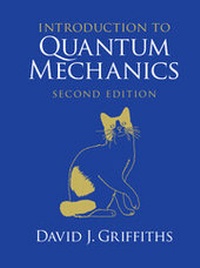
Introduction to Quantum Mechanics
2nd Edition
Published on 16. August 2016
Book
Hardback
465 pages
978-1-107-17986-8 (ISBN)
Description
This bestselling undergraduate quantum mechanics textbook is now available in a re-issued, affordable edition from Cambridge University Press. The text first teaches students how to do quantum mechanics, and then provides them with a more insightful discussion of what it means. The author avoids the temptation to include every possible relevant topic, instead presenting students with material that they can easily focus on in a complete treatment with few distractions and diversions. Fundamental principles are covered, quantum theory is presented, and special techniques are developed for attacking realistic problems. The innovative two-part coverage is entertaining and informative, organizing topics under basic theory and assembling an arsenal of approximation schemes with illustrative applications linked closely to the text.
More details
Edition
2nd Revised edition
Language
English
Place of publication
Cambridge
United Kingdom
Target group
College/higher education
Edition type
Revised edition
Illustrations
Worked examples or Exercises; 14 Tables, black and white; 125 Halftones, black and white
Dimensions
Height: 255 mm
Width: 183 mm
Thickness: 25 mm
Weight
1130 gr
ISBN-13
978-1-107-17986-8 (9781107179868)
Copyright in bibliographic data and cover images is held by Nielsen Book Services Limited or by the publishers or by their respective licensors: all rights reserved.
Schweitzer Classification
Other editions
New editions
David J. Griffiths | Darrell F. Schroeter
Introduction to Quantum Mechanics
Book
08/2018
3rd Edition
Cambridge University Press
€68.50
Available immediately
Person
David J. Griffiths is a retired Professor from Reed College, Oregon, where he taught physics for over 30 years. He received his BA and PhD from Harvard University, where he studied elementary particle theory.
Content
Part I. Theory: 1. The wave function; 2. Time-independent Schroedinger equation; 3. Formalism; 4. Quantum mechanics in three dimensions; 5. Identical particles; Part II. Applications: 6. Time-independent perturbation theory; 7. The variational principle; 8. The WKB approximation; 9. Time-dependent perturbation theory; 10. The adiabatic approximation; 11. Scattering; 12. Afterword; Appendix. Linear algebra.