

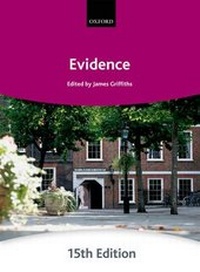
Evidence
15th Edition
Published on 12. August 2010
Book
Paperback/Softback
344 pages
978-0-19-959407-8 (ISBN)
Description
Drawing on the authors' own extensive experience of practice at the Bar, Evidence provides an excellent introduction to the essential principles underpinning the law of evidence in both civil and criminal litigation. Adopting a highly practical approach to the subject, the manual examines not only the key principles of evidence but also considers their application in practice equipping the trainee barrister with the ability to apply their knowledge during pupillage. Realistic examples, problems, case studies, questions, and diagrams are featured throughout, enhancing the pragmatic approach of the manual and ensuring that the reader develops a full understanding of the laws governing the use of evidence in both civil and criminal proceedings. Evidence is essential reading for all trainee barristers, and is also a useful source of reference for junior practitioners wishing to refresh their knowledge of the rules of evidence applicable during litigation.
More details
Series
Edition
15th Revised edition
Language
English
Place of publication
Oxford
United Kingdom
Target group
Professional and scholarly
Edition type
Revised edition
Dimensions
Height: 292 mm
Width: 208 mm
Thickness: 17 mm
Weight
778 gr
ISBN-13
978-0-19-959407-8 (9780199594078)
Copyright in bibliographic data and cover images is held by Nielsen Book Services Limited or by the publishers or by their respective licensors: all rights reserved.
Schweitzer Classification
Other editions
New editions
The City Law School
Evidence
Book
10/2012
16th Edition
Oxford University Press
€43.39
Article is exhausted; no reprint
Content
1. Fundamentals of evidence; 2. Burden and standard of proof; 3. Presumptions; 4. Witnesses; 5. Corroboration and suspect witnesses; 6. Examination-in-chief; 7. Cross-examination and re-examination; 8. Character evidence: civil proceedings; 9. Character evidence: the defendant in criminal proceedings; 10. Character evidence: persons other than the defendant in criminal proceedings; 11. The rule against hearsay: defining hearsay; 12. Hearsay evidence in civil proceedings; 13. Hearsay evidence in criminal proceedings; 14. Confessions and illegally or improperly obtained evidence; 15. Lies and silence; 16. Identification evidence; 17. Opinion evidence; 18. Judgments as evidence of the facts on which they are based; 19. Privilege and public policy