

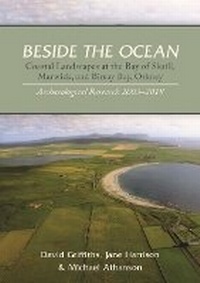
Beside the Ocean
Coastal Landscapes at the Bay of Skaill, Marwick, and Birsay Bay, Orkney: Archaeological Research 2003-18
Published on 31. March 2019
Book
Hardback
376 pages
978-1-78925-096-1 (ISBN)
Description
The Bay of Skaill, Marwick Bay, and Birsay Bay form openings in the high sandstone cliffs of Orkney's Atlantic coast. These west-facing bays have long been favoured locations for settlement, with access to the ocean, to fresh water, to land and to resources for cultivation. The coastline of Orkney's North-West Mainland is recognised worldwide as a location of exceptional archaeological importance, dominated by the Neolithic world heritage site of Skara Brae, and the Viking-Norse remains on the tidal Brough of Birsay. Many of its archaeological sites have been exposed by coastal erosion, a serious problem which continues its destructive progress with every oceanic storm.
Rescue excavation has contributed essential data, but its resources have concentrated on the zone of immediate threat, and until recently less has been understood about the archaeology of the landscape that lies behind the eroding shore. From 2003, a new archaeological research project began to investigate the hinterlands of the three bays. Using the rapidly-developing applications of archaeological geophysics, coupled with topographical survey, it has sought to create a broader and better-informed landscape context. Much of the land is dominated by windblown sand, at the Bay of Skaill and Birsay Bay in particular, reflecting centuries of environmental change, and requiring adaptive methodologies and approaches. Several new areas of archaeological interest have been identified, and many previously-known sites are now better-understood.
Excavation was used selectively to test the survey results. In one area in particular, a cluster of large settlement mounds on the northern side of the Bay of Skaill, two major Viking-Norse settlement clusters were identified and investigated. These held exceptionally well-preserved deposits, which have required detailed dating and analysis. The artefact assemblages include evidence for ferrous metalworking along with iron and copper alloy objects, combs, glass and amber beads, worked stone, ceramics and a range of archaeobotanical and archaeozoological remains. A Viking silver hoard discovered in 1858 and a Viking grave uncovered in 1888 are revisited. This monograph brings together the survey and excavation results, and tells a new story of an ancient landscape.
Rescue excavation has contributed essential data, but its resources have concentrated on the zone of immediate threat, and until recently less has been understood about the archaeology of the landscape that lies behind the eroding shore. From 2003, a new archaeological research project began to investigate the hinterlands of the three bays. Using the rapidly-developing applications of archaeological geophysics, coupled with topographical survey, it has sought to create a broader and better-informed landscape context. Much of the land is dominated by windblown sand, at the Bay of Skaill and Birsay Bay in particular, reflecting centuries of environmental change, and requiring adaptive methodologies and approaches. Several new areas of archaeological interest have been identified, and many previously-known sites are now better-understood.
Excavation was used selectively to test the survey results. In one area in particular, a cluster of large settlement mounds on the northern side of the Bay of Skaill, two major Viking-Norse settlement clusters were identified and investigated. These held exceptionally well-preserved deposits, which have required detailed dating and analysis. The artefact assemblages include evidence for ferrous metalworking along with iron and copper alloy objects, combs, glass and amber beads, worked stone, ceramics and a range of archaeobotanical and archaeozoological remains. A Viking silver hoard discovered in 1858 and a Viking grave uncovered in 1888 are revisited. This monograph brings together the survey and excavation results, and tells a new story of an ancient landscape.
Reviews / Votes
The production quality of the monograph is splendid, with lots of colour plans, and it is an altogether welcome addition to our understanding of the area. * Medieval Archaeology * Beside the Ocean is replete with references to previous excavations and provides an extended context for these well-known individual sites, in an effort 'to re-contextualise past discoveries'. Indeed 'an extensive data capture is a more productive means of characterising archaeological potential in sand landscapes than an intensive one'.The director of research, David Griffiths, and all of the contributors to this impressive volume are to be congratulated on their capacity for carefully nuanced interpretations of minute details and on their meticulous presentation of the data. Exquisitely drawn site plans and profiles are colour-coded in a consistent schema (depicted in Fig.4.43) and there is a helpful summary of the basic archaeological findings in the penultimate chapter. This book points as much towards the future of a multifaceted academic discipline as it does towards the past of the dramatic if somewhat forbidding Orcadian Mainland. * Early Medieval Europe * The volume reflects the sustained effort of a 15-year campaign and the enthusiasm of the authors for this island landscape. As Andrew Greig states in the Foreword: "It pulls together many excavations, a multiplicity of sites, markers and human stories, landscape, deep time and folk history. It is the science of archaeology raised to a humanist level" (p. vii). * Antiquity *
More details
Language
English
Place of publication
Oxford
United Kingdom
Target group
Professional and scholarly
Dimensions
Height: 297 mm
Width: 210 mm
ISBN-13
978-1-78925-096-1 (9781789250961)
Copyright in bibliographic data and cover images is held by Nielsen Book Services Limited or by the publishers or by their respective licensors: all rights reserved.
Schweitzer Classification
Other editions
Additional editions
Griffiths David Griffiths | Harrison Jane Harrison | Athanson Michael Athanson
Beside the Ocean
Coastal Landscapes at the Bay of Skaill, Marwick, and Birsay Bay, Orkney: Archaeological Research, 2003-18
E-Book
05/2019
Oxbow Books
€32.99
Available for download
Griffiths David Griffiths | Harrison Jane Harrison | Athanson Michael Athanson
Beside the Ocean
Coastal Landscapes at the Bay of Skaill, Marwick, and Birsay Bay, Orkney: Archaeological Research, 2003-18
E-Book
05/2019
OXBOW BOOKS
€32.99
Available for download
Persons
David Griffiths is Professor of Archaeology, University of Oxford, PI of Archeox Project. Jane Harrison is Research Associate and Tutor at the Department for Continuing Education, Oxford University. A graduate of Cambridge and Oxford universities, she completed her D.Phil at Kellogg College, Oxford in 2016, on Norse settlement mounds in the North Atlantic zone. A specialist in public engagement in Archaeology, she is a member of a number of interdisciplinary research networks covering northern world topics. Michael Athanson is Deputy Map Librarian at the Bodleian Library Map Room, Oxford University. A geospatial data specialist in the applications of geographic information systems to landscape archaeology, he combines mapping and data analysis with extensive field survey skills. He completed his D.Phil at St Cross College, Oxford, in 2010.
Content
Foreword
Andrew Greig
Preface
David Griffiths
Acknowledgements
Contributors
List of figures
List of tables
1. Introduction
David Griffiths
2. Past archaeological research
David Griffiths
3. Landscape surveys 2003-2015
David Griffiths, Michael Athanson and Susan Ovenden
4. Excavations
Jane Harrison and David Griffiths
5. Dating and chronology
Derek Hamilton, Anthony M. Krus, Jean-Luc Schwenninger, Jane Harrison and David Griffiths
6. Geoarchaeology
Helen Lewis
7. Geochemical intra-site mapping: Inorganic and organic
Roger C. Doonan and Alexandre Lucquin
8. Archaeobotanical evidence: Carbonised plant macrofossils and charcoal
Diane Alldritt
9. Archaeozoological evidence: The faunal assemblages
Ingrid Mainland, Vicky Ewens and Cecily Webster
10. Fish remains
Rebecca A. Nicholson
11. Ferrous metalworking: Vitrified material
Dawn McLaren
12. Iron and lead finds
Colleen E. Batey
13. Copper-alloy finds
David Griffiths
14. Combs
Steven P. Ashby
15. Worked bone
Colleen E. Batey
16. Glass and amber beads
Birgitta Hoffmann and Colleen E. Batey
17. Glass linen smoother
Colleen E. Batey, with a contribution from Justine Bayley
18. Worked stone (non-steatite)
Dawn McLaren, with geological identifications by Fiona McGibbon
19. Steatite
Amanda K. Forster, with a contribution from Richard Jones
20. Ceramics
Derek Hall and Michael J. Hughes
21. The 1858 Skaill Viking-Age silver hoard
James Graham-Campbell
22. The 1888 Skaill Viking grave
James Graham-Campbell
23. A Viking-Age bone strap-end from St Peter's Kirk
Caroline Paterson
24. The 'Fin King' folktale
Tom Muir
25. Synthesis and discussion
David Griffiths
26. Conclusion
David Griffiths and Jane Harrison
27. Bibliography
28. Index
Online archive
Andrew Greig
Preface
David Griffiths
Acknowledgements
Contributors
List of figures
List of tables
1. Introduction
David Griffiths
2. Past archaeological research
David Griffiths
3. Landscape surveys 2003-2015
David Griffiths, Michael Athanson and Susan Ovenden
4. Excavations
Jane Harrison and David Griffiths
5. Dating and chronology
Derek Hamilton, Anthony M. Krus, Jean-Luc Schwenninger, Jane Harrison and David Griffiths
6. Geoarchaeology
Helen Lewis
7. Geochemical intra-site mapping: Inorganic and organic
Roger C. Doonan and Alexandre Lucquin
8. Archaeobotanical evidence: Carbonised plant macrofossils and charcoal
Diane Alldritt
9. Archaeozoological evidence: The faunal assemblages
Ingrid Mainland, Vicky Ewens and Cecily Webster
10. Fish remains
Rebecca A. Nicholson
11. Ferrous metalworking: Vitrified material
Dawn McLaren
12. Iron and lead finds
Colleen E. Batey
13. Copper-alloy finds
David Griffiths
14. Combs
Steven P. Ashby
15. Worked bone
Colleen E. Batey
16. Glass and amber beads
Birgitta Hoffmann and Colleen E. Batey
17. Glass linen smoother
Colleen E. Batey, with a contribution from Justine Bayley
18. Worked stone (non-steatite)
Dawn McLaren, with geological identifications by Fiona McGibbon
19. Steatite
Amanda K. Forster, with a contribution from Richard Jones
20. Ceramics
Derek Hall and Michael J. Hughes
21. The 1858 Skaill Viking-Age silver hoard
James Graham-Campbell
22. The 1888 Skaill Viking grave
James Graham-Campbell
23. A Viking-Age bone strap-end from St Peter's Kirk
Caroline Paterson
24. The 'Fin King' folktale
Tom Muir
25. Synthesis and discussion
David Griffiths
26. Conclusion
David Griffiths and Jane Harrison
27. Bibliography
28. Index
Online archive