

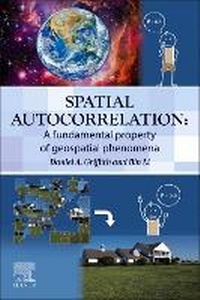
Spatial Autocorrelation
A Fundamental Property of Geospatial Phenomena
Published on 14. August 2025
Book
Paperback/Softback
338 pages
978-0-443-41743-6 (ISBN)
Description
Spatial Autocorrelation: A Fundamental Property of Geospatial Phenomena offers a state-of-the-art exploration of one of the most pivotal spatial analysis concepts. Beginning with foundational theories and clear definitions, it sets out the concepts and basic theory of spatial autocorrelation through elaborated conceptualizations and practical examples. In-depth case studies reveal the pervasive influence of spatial patterns in scientific inquiry while anticipating emerging research and innovative techniques. It offers practical methods for quantifying spatial autocorrelation, complete with step-by-step instructions and real-world examples.
Spatial Autocorrelation equips graduate students, researchers, and professionals with the knowledge and tools to confidently comprehend, navigate, and apply spatial analysis in their respective domains, making it an ideal companion for technical reference books, and a vital addition to the libraries of any discipline utilizing spatial analysis.
Spatial Autocorrelation equips graduate students, researchers, and professionals with the knowledge and tools to confidently comprehend, navigate, and apply spatial analysis in their respective domains, making it an ideal companion for technical reference books, and a vital addition to the libraries of any discipline utilizing spatial analysis.
More details
Language
English
Place of publication
Philadelphia
United States
Target group
Professional and scholarly
College/higher education
Dimensions
Height: 229 mm
Width: 152 mm
Weight
540 gr
ISBN-13
978-0-443-41743-6 (9780443417436)
Copyright in bibliographic data and cover images is held by Nielsen Book Services Limited or by the publishers or by their respective licensors: all rights reserved.
Schweitzer Classification
Other editions
Additional editions
E-Book
08/2025
Elsevier
€167.99
Available for download
Persons
Dr. Daniel A. Griffith is an Ashbel Smith Professor Emeritus of Geospatial Information Sciences at
the University of Texas at Dallas, United States; a past affiliated Professor in the College of Public
Health at the University of South Florida, United States; and an Adjunct Professor in the Department
of Resource Economics and Environmental Sociology at the University of Alberta, Canada. He
specializes in spatial statistics, quantitative-urban-economic geography, and urban public health. Dr. Bin Li is a Professor at Central Michigan University, United States, where he previously
served as the Chair of the Department of Geography and Environmental Studies. Prior to this role, he was a faculty member at the University of Miami. He specializes in Geographic Information
Science, with extensive research and teaching experience in spatial statistics, geographic information
science, and cartography.
the University of Texas at Dallas, United States; a past affiliated Professor in the College of Public
Health at the University of South Florida, United States; and an Adjunct Professor in the Department
of Resource Economics and Environmental Sociology at the University of Alberta, Canada. He
specializes in spatial statistics, quantitative-urban-economic geography, and urban public health. Dr. Bin Li is a Professor at Central Michigan University, United States, where he previously
served as the Chair of the Department of Geography and Environmental Studies. Prior to this role, he was a faculty member at the University of Miami. He specializes in Geographic Information
Science, with extensive research and teaching experience in spatial statistics, geographic information
science, and cartography.
Content
1. What is spatial autocorrelation? A conceptualization
2. Spatial autocorrelation is everywhere!
3. Quantifying spatial autocorrelation: an intuitive approach with few equations
4. Reflections on spatial autocorrelation model specifications for beginners
5. Geographic distributions: univariate spatial autocorrelation
6. Areal associations: multivariate spatial autocorrelation
7. Spatial autocorrelation and spatial interaction
8. Some spatial autocorrelation final frontiers: a partial future research agenda
9. Summary and concluding remarks
2. Spatial autocorrelation is everywhere!
3. Quantifying spatial autocorrelation: an intuitive approach with few equations
4. Reflections on spatial autocorrelation model specifications for beginners
5. Geographic distributions: univariate spatial autocorrelation
6. Areal associations: multivariate spatial autocorrelation
7. Spatial autocorrelation and spatial interaction
8. Some spatial autocorrelation final frontiers: a partial future research agenda
9. Summary and concluding remarks