

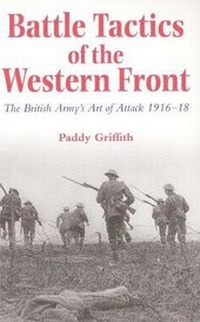
Battle Tactics of the Western Front
The British Army`s Art of Attack, 1916-18
Published on 24. April 1996
Book
Paperback/Softback
302 pages
978-0-300-06663-0 (ISBN)
Description
Historians have portrayed British participation in World War I as a series of tragic debacles, with lines of men mown down by machine guns, with untried new military technology, and incompetent generals who threw their troops into improvised and unsuccessful attacks. In this book a renowned military historian studies the evolution of British infantry tactics during the war and challenges this interpretation, showing that while the British army's plans and technologies failed persistently during the improvised first half of the war, the army gradually improved its technique, technology, and, eventually, its' self-assurance. By the time of its successful sustained offensive in the fall of 1918, says Paddy Griffith, the British army was demonstrating a battlefield skill and mobility that would rarely be surpassed even during World War II.
Evaluating the great gap that exists between theory and practice, between textbook and bullet-swept mudfield, Griffith argues that many battles were carefully planned to exploit advanced tactics and to avoid casualties, but that breakthrough was simply impossible under the conditions of the time. According to Griffith, the British were already masters of "storm troop tactics" by the end of 1916, and in several important respects were further ahead than the Germans would be even in 1918. In fields such as the timing and orchestration of all-arms assaults, predicted artillery fire, "Commando-style" trench raiding, the use of light machine guns, or the barrage fire of heavy machine guns, the British led the world. Although British generals were not military geniuses, says Griffith, they should at least be credited for effectively inventing much of the twentieth-century's art of war.
Evaluating the great gap that exists between theory and practice, between textbook and bullet-swept mudfield, Griffith argues that many battles were carefully planned to exploit advanced tactics and to avoid casualties, but that breakthrough was simply impossible under the conditions of the time. According to Griffith, the British were already masters of "storm troop tactics" by the end of 1916, and in several important respects were further ahead than the Germans would be even in 1918. In fields such as the timing and orchestration of all-arms assaults, predicted artillery fire, "Commando-style" trench raiding, the use of light machine guns, or the barrage fire of heavy machine guns, the British led the world. Although British generals were not military geniuses, says Griffith, they should at least be credited for effectively inventing much of the twentieth-century's art of war.
More details
Language
English
Place of publication
United States
Target group
College/higher education
Professional and scholarly
Product notice
Paperback (trade)
Dimensions
Height: 235 mm
Width: 156 mm
Weight
476 gr
ISBN-13
978-0-300-06663-0 (9780300066630)
Copyright in bibliographic data and cover images is held by Nielsen Book Services Limited or by the publishers or by their respective licensors: all rights reserved.
Schweitzer Classification
Other editions
Additional editions
E-Book
05/1994
1st Edition
Yale University Press
€21.53
Available for download
Person
Paddy Griffith is the author of numerous other books on military subjects, including Battle Tactics of the Civil War. Formerly a senior lecturer in war studies at the Royal Military Academy at Sandhurst, England, he is now a freelance author and publisher.