

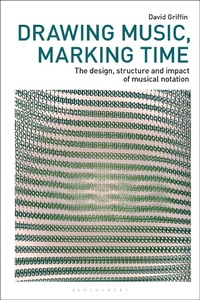
Drawing Music, Marking Time
The design, structure and impact of musical notation
Published on 20. February 2025
Book
Hardback
168 pages
978-1-350-44748-6 (ISBN)
Description
Marking down the complexities of musical pieces on paper allows them to become portable, shareable, and eminently teachable, but how are the simple geometries of a music notation unfolded into space and time?
A music notation is an almost impossibly complicated bit of drawing. Calling it a map or a diagram does not quite do the trick. Its tracery supplies mechanisms for planning, composition, analysis, annotation, and performance of music. But how is it that we read that simple, strategic two-dimensional geometry and make such complex, four-dimensional performances? In this book David Griffin guides readers to a comprehensive understanding of the structural properties of music notations, with a particular focus on the standard Western staff notation system, looking at composers such as Bach, John Cage, Earle Brown and Stockhausen.
Developed over a thousand years ago, the staff notation is a geometrical drawing method using dots and lines on a horizontal timeline for explaining the structure of a musical piece. The system behaves a bit like a picture, but it is also like a diagram, and a bit like writing in its structure. In the hands of an experienced user, the notation's complex of marks and phatic elements allows us to leave behind the mere denotation of diagrams or pictures to become a connotative drawing system.
This book will attempt to de-code music drawings, untangling their strange knots of graphic and linguistic elements. Using a series of visual examples, Griffin presents background information on how the staff notation developed as an inter-linguistic inscription, a drawing that slips through the mere denotation of pictorial or diagrammatic graphics to become a connotative system, with which we may craft subtle and powerful elements of musical poetry.
A music notation is an almost impossibly complicated bit of drawing. Calling it a map or a diagram does not quite do the trick. Its tracery supplies mechanisms for planning, composition, analysis, annotation, and performance of music. But how is it that we read that simple, strategic two-dimensional geometry and make such complex, four-dimensional performances? In this book David Griffin guides readers to a comprehensive understanding of the structural properties of music notations, with a particular focus on the standard Western staff notation system, looking at composers such as Bach, John Cage, Earle Brown and Stockhausen.
Developed over a thousand years ago, the staff notation is a geometrical drawing method using dots and lines on a horizontal timeline for explaining the structure of a musical piece. The system behaves a bit like a picture, but it is also like a diagram, and a bit like writing in its structure. In the hands of an experienced user, the notation's complex of marks and phatic elements allows us to leave behind the mere denotation of diagrams or pictures to become a connotative drawing system.
This book will attempt to de-code music drawings, untangling their strange knots of graphic and linguistic elements. Using a series of visual examples, Griffin presents background information on how the staff notation developed as an inter-linguistic inscription, a drawing that slips through the mere denotation of pictorial or diagrammatic graphics to become a connotative system, with which we may craft subtle and powerful elements of musical poetry.
Reviews / Votes
We hear music; we see images. Musicians read staff notation as the rest of us read pictures - and we take such complex literacies - 'visualcies' is a better word - for granted. This book takes them apart; jolting our complacency by exploring the possibilities of alternative visual notation systems designed to bridge that sensory gap between hearing and seeing. A pioneering study of the graphic possibilities for the visual representation of music. * Howard Riley, University of Wales Trinity Saint David, UK *More details
Series
Language
English
Place of publication
London
United Kingdom
Publishing group
Bloomsbury Publishing PLC
Target group
Professional and scholarly
Product notice
sewn/stitched
Cloth over boards
With dust jacket
Illustrations
30 bw illustrations
Dimensions
Height: 239 mm
Width: 163 mm
Thickness: 16 mm
Weight
517 gr
ISBN-13
978-1-350-44748-6 (9781350447486)
Copyright in bibliographic data and cover images is held by Nielsen Book Services Limited or by the publishers or by their respective licensors: all rights reserved.
Schweitzer Classification
Person
David Griffin is Assistant Professor at OCAD University in Toronto, Canada. Born in Kingston, Jamaica, he holds a PhD from the Glasgow School of Art, an MFA from the Pratt Institute, and BFA from Parsons School of Design in New York.
Content
List of Figures
Chapter 1
Chapter 2
Chapter 3
Conclusion
Bibliography
Index
Chapter 1
Chapter 2
Chapter 3
Conclusion
Bibliography
Index