

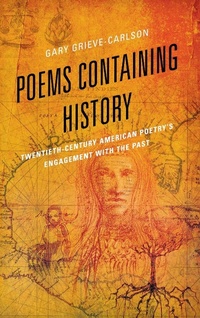
Poems Containing History
Twentieth-Century American Poetry's Engagement with the Past
Published on 8. November 2013
Book
Hardback
232 pages
978-0-7391-6755-7 (ISBN)
Description
Ezra Pound's definition of an epic as "a poem containing history" raises questions: how can a poem "contain" history? And if it can, does it help us to think about history in ways that conventional historiography cannot? Poems Containing History: Twentieth-Century American Poetry's Engagement with the Past, by Gary Grieve-Carlson, argues that twentieth-century American poetry has "contained" and helped its readers to think about history in a variety of provocative and powerful ways. Tracing the discussion of the relationship between poetry and history from Aristotle's Poetics to Norman Mailer's The Armies of the Night and Hayden White's Metahistory, the book shows that even as history evolves into a professional, academic discipline in the late nineteenth century, and as its practitioners emphasize the scientific aspects of their work and minimize its literary aspects, twentieth-century American poets continue to take history as the subject of their major poems. Sometimes they endorse the views of mainstream historians, as Stephen Vincent Benet does in John Brown's Body, but more often they challenge them, as do Robert Penn Warren in Brother to Dragons, Ezra Pound in The Cantos, or Charles Olson in The Maximus Poems. In Conquistador, Archibald MacLeish illustrates Aristotle's claim that poetry tells more philosophical truths about the past than history does, while in Paterson, William Carlos Williams develops a Nietzschean suspicion of history's value. Three major American poets-T. S. Eliot in Four Quartets, Hart Crane in The Bridge, and Carolyn Forche in The Angel of History-present different challenges to professional historiography's assumption that the past is best understood in strictly material terms. Poems Containing History devotes chapters to each of these poets and offers a clear sense of the seriousness with which American poetry has engaged the past, as well as the great variety of those engagements.
Reviews / Votes
Early on Grieve-Carlson asks, 'Can poetry help us think about the past?' He answers yes, and goes on to demonstrate the ways in which various 20th-century US poets include history in their work. In an overview he looks at poetry's engagement with history as revealed by writers from Aristotle and Herodotus through Jean-Paul Sartre and Norman Mailer. The remaining nine chapters consider poets both neglected (Stephen Vincent Benet, Archibald MacLeish, Robert Penn Warren) and canonical (T. S. Eliot, Hart Crane, Ezra Pound, William Carlos Williams). Treatments of Williams's prose book In the American Grain and his long poem Paterson and (in the final chapter) of Charles Olson's Maximus sequence are among the book's numerous highlights. . . .This book's great value is that it encourages readers to look at other poets who have illuminated history and their times. Grieve-Carlson has read widely and deeply on this fascinating, complex subject, and he presents his findings and ideas in a clear, unpretentious, convincing manner. Summing Up: Highly recommended. Upper-division undergraduates; graduate students. * CHOICE * This is a monumental study, and one that we have needed for a long time. The first chapter provides a comprehensive account of the centuries-old debate about the relationship between poetry and history, as well as an invaluable review of salient theories of history that have informed our sense of how we understand the past, and whether it is objectively 'real' or constructed. The chapter is unique and invaluable on its own, and offers a preview of the author's remarkable learning and judgment to follow. The subsequent chapters bring together for the first time a broad array of twentieth-century works, many (such as those by Benet, MacLeish, Warren) neglected in recent criticism, each extensively engaged with the historical record in some way, however subjectively. It thus reminds us how deeply American poetry has been a turning toward rather than a turning away from the muse of history, regardless of whether it finds cause for optimism or despair in her accounts. The book offers a stirring exposition and analysis, writer by writer, of how poetry selectively presents the characters and deeds of the past to the imagination. The cumulative effect is a profound sense of the achievement of American poetry, even as the ambition to represent an ordered vision of history often exceeds the capacities of even our best poets. Grieve-Carlson enters into conversation with major critics on each poet, but leaves his own indelible mark. Perhaps most importantly, he has shown how poets become historiographers in the process of transforming fact and legend into art. If poets tell us 'what happened,' it is in order to understand the meaning of what happened, and the human or transcendental shape of its happening. In a prose remarkable for its clarity and congenial, dialogical style, Grieve-Carlson has given us an indispensable guide to poetry's encounter with history. This is a book that every student of American literature will want to have by her side as enters, with the poets, into the labyrinth of the past. -- Bonnie Costello, Boston UniversityMore details
Language
English
Place of publication
United States
Publishing group
Bloomsbury Publishing Plc
Target group
College/higher education
Product notice
Laminated cover
Dimensions
Height: 235 mm
Width: 157 mm
Thickness: 18 mm
Weight
535 gr
ISBN-13
978-0-7391-6755-7 (9780739167557)
Copyright in bibliographic data and cover images is held by Nielsen Book Services Limited or by the publishers or by their respective licensors: all rights reserved.
Schweitzer Classification
Other editions
Additional editions
Gary Grieve-Carlson
Poems Containing History
Twentieth-Century American Poetry's Engagement with the Past
E-Book
11/2013
1st Edition
Lexington Books
€91.09
Available for download
Person
Gary Grieve-Carlson is professor of English and former director of general education at Lebanon Valley College in Annville, Pennsylvania, where he has taught for more than twenty years. The recipient of awards for teaching excellence at three colleges, he has been a Fulbright junior lecturer in the Federal Republic of Germany and has lectured at universities in the People's Republic of China and New Zealand. He is the editor of Olson's Prose and has published in such journals as Paideuma, The New England Quarterly, Modern Language Studies, and Soundings.
Content
Preface
Acknowledgments
Chapter 1: History and Poetry
Chapter 2: Stephen Vincent Benet: John Brown's Body and the Meaning of the Civil War
Chapter 3: MacLeish's Conquistador: History as Metaphor
Chapter 4: A Usable Past? Robert Penn Warren's Brother to Dragons
Chapter 5: T.S. Eliot: Awaking from the Nightmare of History
Chapter 6: The Varieties of History in Hart Crane's The Bridge
Chapter 7: Carolyn Forche: History and Theophany
Chapter 8: Ezra Pound and the Problem of History
Chapter 9: Getting the News from Poems: William Carlos Williams's In the American Grain and Paterson
Chapter 10: Charles Olson's Maximus: Looking for Oneself, Looking for the Evidence
Bibliography
Index
About the Author
Acknowledgments
Chapter 1: History and Poetry
Chapter 2: Stephen Vincent Benet: John Brown's Body and the Meaning of the Civil War
Chapter 3: MacLeish's Conquistador: History as Metaphor
Chapter 4: A Usable Past? Robert Penn Warren's Brother to Dragons
Chapter 5: T.S. Eliot: Awaking from the Nightmare of History
Chapter 6: The Varieties of History in Hart Crane's The Bridge
Chapter 7: Carolyn Forche: History and Theophany
Chapter 8: Ezra Pound and the Problem of History
Chapter 9: Getting the News from Poems: William Carlos Williams's In the American Grain and Paterson
Chapter 10: Charles Olson's Maximus: Looking for Oneself, Looking for the Evidence
Bibliography
Index
About the Author