

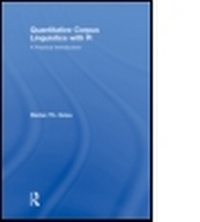
Quantitative Corpus Linguistics with R
A Practical Introduction
1st Edition
Published on 26. March 2009
Book
Hardback
248 pages
978-0-415-96271-1 (ISBN)
Description
The first textbook of its kind, Quantitative Corpus Linguistics with R demonstrates how to use the open source programming language R for corpus linguistic analyses. Computational and corpus linguists doing corpus work will find that R provides an enormous range of functions that currently require several programs to achieve - searching and processing corpora, arranging and outputting the results of corpus searches, statistical evaluation, and graphing.
Reviews / Votes
"This book is a must for every corpus linguist's desk right beside the computer - that's where it does its wonders." - International Journal of Corpus LinguisticsMore details
Language
English
Place of publication
London
United Kingdom
Publishing group
Taylor & Francis Ltd
Target group
College/higher education
Product notice
Paper over boards
Illustrations
18 s/w Tabellen
18 Tables, black and white
Dimensions
Height: 254 mm
Width: 178 mm
Weight
635 gr
ISBN-13
978-0-415-96271-1 (9780415962711)
Copyright in bibliographic data and cover images is held by Nielsen Book Services Limited or by the publishers or by their respective licensors: all rights reserved.
Schweitzer Classification
Other editions
New editions
Book
11/2016
2nd Edition
Routledge
€245.12
Shipment within 10-20 days
Additional editions
Book
03/2009
1st Edition
Routledge
€69.51
Article exhausted; check for reprint
Person
Stefan Th. Gries is Professor of Linguistics at the University of California, Santa Barbara, USA.
Content
Acknowledgments
1. Introduction
1.1 Why Another Introduction to Corpus Linguistics?
1.2 Outline of the Book
1.3 Recommendation for Instructors
2. Three Central Corpus-linguistic Methods
2.1 Corpora
2.2 Frequency Lists
2.3 Lexical Co-occurrence: Collocations
2.4 (Lexico-)Grammatical Co-occurence: Concordances
3. An Introduction to R
3.1 A few Central Notions: Data structures, Functions, and Arguments
3.2 Vectors
3.3 Factors
3.4 Data Frames
3.5 Lists
3.6 Elementary Programming Functions
3.7 Character/String Processing
3.8 File and Directory Operations
4. Using R in Corpus Linguistics
4.1 Frequency Lists
4.2 Concordances
4.3 Collocations
4.4 Excursus 1: Processing Multi-tiered Corpora
4.5 Excursus 2: Unicode
5. Some Statistics for Corpus Linguistics
5.1 Introduction to Statistical Thinking
5.2 Categorical Dependent Variables
5.3 Interval/Ratio Dependent Variables
5.4 Customizing Statistical Plots
5.5 Reporting Results
6. Case Studies and Pointers to Other Applications
6.1 Introduction to the Case Studies
6.2 Some Pointers to Further Applications
Appendix
References
Endnotes
Index
1. Introduction
1.1 Why Another Introduction to Corpus Linguistics?
1.2 Outline of the Book
1.3 Recommendation for Instructors
2. Three Central Corpus-linguistic Methods
2.1 Corpora
2.2 Frequency Lists
2.3 Lexical Co-occurrence: Collocations
2.4 (Lexico-)Grammatical Co-occurence: Concordances
3. An Introduction to R
3.1 A few Central Notions: Data structures, Functions, and Arguments
3.2 Vectors
3.3 Factors
3.4 Data Frames
3.5 Lists
3.6 Elementary Programming Functions
3.7 Character/String Processing
3.8 File and Directory Operations
4. Using R in Corpus Linguistics
4.1 Frequency Lists
4.2 Concordances
4.3 Collocations
4.4 Excursus 1: Processing Multi-tiered Corpora
4.5 Excursus 2: Unicode
5. Some Statistics for Corpus Linguistics
5.1 Introduction to Statistical Thinking
5.2 Categorical Dependent Variables
5.3 Interval/Ratio Dependent Variables
5.4 Customizing Statistical Plots
5.5 Reporting Results
6. Case Studies and Pointers to Other Applications
6.1 Introduction to the Case Studies
6.2 Some Pointers to Further Applications
Appendix
References
Endnotes
Index