

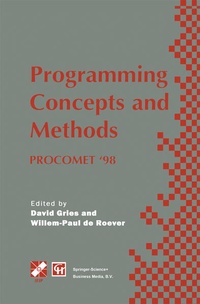
Programming Concepts and Methods PROCOMET '98
IFIP TC2 / WG2.2, 2.3 International Conference on Programming Concepts and Methods (PROCOMET '98) 8-12 June 1998, Shelter Island, New York, USA
Published on 31. May 1998
Book
Hardback
X, 486 pages
978-0-412-83760-9 (ISBN)
Description
This book constitutes the Proceedings of the IFIP Working Conference PRO COMET'98, held 8-12 June 1998 at Shelter Island, N.Y. The conference is organized by the t'wo IFIP TC 2 Working Groups 2.2 Formal Description of Programming Concepts and 2.3 Programming Methodology. WG2.2 and WG2.3 have been organizing these conferences every four years for over twenty years. The aim of such Working Conferences organized by IFIP Working Groups is to bring together leading scientists in a given area of computer science. Participation is by invitation only. As a result, these conferences distinguish themselves from other meetings by extensive and competent technical discus sions. PROCOMET stands for Programming Concepts and Methods, indicating that the area of discussion for the conference is the formal description of pro gramming concepts and methods, their tool support, and their applications. At PROCOMET working conferences, papers are presented from this whole area, reflecting the interest of the individuals in WG2.2 and WG2.3.
More details
Series
Edition
1998 ed.
Language
English
Place of publication
New York
United States
Target group
Professional and scholarly
Research
Illustrations
X, 486 p.
Dimensions
Height: 241 mm
Width: 160 mm
Thickness: 32 mm
Weight
910 gr
ISBN-13
978-0-412-83760-9 (9780412837609)
DOI
10.1007/978-0-387-35358-6
Schweitzer Classification
Other editions
Additional editions
David Gries | Willem-Paul de Roever
Programming Concepts and Methods PROCOMET '98
IFIP TC2 / WG2.2, 2.3 International Conference on Programming Concepts and Methods (PROCOMET '98) 8-12 June 1998, Shelter Island, New York, USA
Book
01/2013
Springer
€213.99
Shipment within 15-20 days
Persons
Content
1 Invited lecture Extended static checking.- 2 Invited lecture From lattices to practical formal hardware verification.- 3 Invited lecture Programming with tabling in XSB.- 4 Invited lecture Verifying electronic control units: today and tomorrow.- 5 Educational session Teaching calculational logic.- 6 Types for trees.- 7 Structures for lazy semantics.- 8 A proof theory of asynchronously communicating sequential processes.- 9 Bisimulations in the join-calculus.- 10 Using state space exploration and a natural deduction style message derivation engine to verify security protocols.- 11 Programming language semantics in foundational type theory.- 12 An algebraic approach to the specification of stochastic systems.- 13 Refinement types for specification.- 14 An extension of the program derivation format.- 15 Deadlines are termination.- 16 The design of a linearization of a concurrent data object.- 17 Final semantics for the pi-calculus.- 18 Comparing CTL and PCTL on labeled Markov chains.- 19 Reactive functional programming.- 20 Imperative objects and mobile processes.- 21 Relating linear and branching model checking.- 22 Verifying duration properties of timed transition systems.- 23 Towards squiggly refinement algebra.- 24 Towards a theory of sequential hybrid programs.- 25 Test selection for object-oriented software based on formal specifications.- 26 Logical foundations for typed object-oriented languages.- 27 Verifying a self-stabilizing mutual exclusion algorithm.- 28 A combination of interval logic and linear temporal logic.- 29 A model of real-time distributed systems.- Index of contributors.- Keyword index.