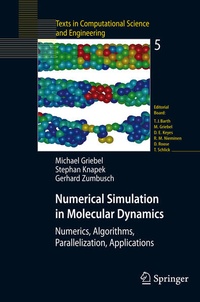
Particle models play an important role in many applications in physics, chemistry and biology. They can be studied on the computer with the help of molecular dynamics simulations. This book presents in detail both the necessary numerical methods and techniques (linked-cell method, SPME-method, tree codes, multipole technique) and the theoretical background and foundations. It illustrates the aspects modelling, discretization, algorithms and their parallel implementation with MPI on computer systems with distributed memory. Furthermore, detailed explanations are given to the different steps of numerical simulation, and code examples are provided. With the description of the algorithms and the presentation of the results of various simulations from the areas material science, nanotechnology, biochemistry and astrophysics, the reader of this book will be able to write his own programs for molecular dynamics step by step and to run successful experiments.
Reviews / Votes
From the reviews:
"Authors' aim for this book was to present the necessary numerical techniques of molecular dynamics in a compact form, to enable readers to write their own programs in the programming language C, implement these programs on parallel computers using MPI, and be motivated to repeat the presented numerical experiments . . This goal has certainly been achieved and the book is strongly recommended both for individual study and as the basis for a graduate course for a wide range of computational mathematics and physics students." (Sebastian Reich, SIAM Review, Vol. 52 (1), 2010)
Series
Edition
1st ed. Softcover of orig. ed. 2007
Language
Place of publication
Publishing group
Target group
Professional and scholarly
Research
Illustrations
137 s/w Abbildungen, 43 farbige Abbildungen
XII, 476 p. 180 illus., 43 illus. in color.
Dimensions
Height: 235 mm
Width: 155 mm
Thickness: 27 mm
Weight
ISBN-13
978-3-642-08776-9 (9783642087769)
DOI
10.1007/978-3-540-68095-6
Schweitzer Classification
Michael Griebel received his education at the Technical University of Munich, Germany. He is a professor at the Institute for Numerical Simulation at the University of Bonn, Germany, where he holds the Chair of Scientific Computing and Numerical Simulation. Additionally, he is the director of Fraunhofer SCAI (Institute for Algorithms and Scientific Computing), Sankt Augustin, Germany. His research interests include numerical simulation, scientific computing, machine learning, and high-dimensional approximation. Since 2002, he has served as the Editor-in-Chief of the Springer journal Numerische Mathematik.
Peter Oswald received his education at Odessa State University and Moscow State University. He has held research, teaching, and professorship positions at various institutions, including TU Dresden, FSU Jena, Kuwait University, Texas A&M University, Bell Laboratories, Jacobs University Bremen, and the University of Bonn. His research interests include approximation theory, function spaces, and numerical analysis.
Computer Simulation - a Key Technology.- From the Schrödinger Equation to Molecular Dynamics.- The Linked Cell Method for Short-Range Potentials.- Parallelization.- Extensions to More Complex Potentials and Molecules.- Time Integration Methods.- Mesh-Based Methods for Long-Range Potentials.- Tree Algorithms for Long-Range Potentials.- Applications from Biochemistry and Biophysics.- Prospects.