

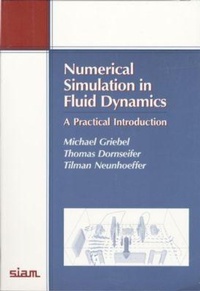
Numerical Simulation in Fluid Dynamics
A Practical Introduction
Will be published approx. on 31. December 1997
Book
Paperback/Softback
233 pages
978-0-89871-398-5 (ISBN)
Description
In this translation of the German edition, the authors provide insight into the numerical simulation of fluid flow. Using a simple numerical method as an expository example, the individual steps of scientific computing are presented:
The derivation of the mathematical model.
The discretization of the model equations.
The development of algorithms, - parallelization.
Visualization of the computed data.
In addition to the treatment of the basic equations for modeling laminar, transient flow of viscous, incompressible fluids - the Navier-Stokes equations - the authors look at the simulation of free surface flows, energy and chemical transport, and turbulence.
Detailed hints for the implementation of the various algorithms enable readers to write their own flow simulation program from scratch. The variety of applications is shown in several simulation results, including 92 black-and-white and 18 color illustrations. Moreover, after reading this book, readers should be able to understand more enhanced algorithms of computational fluid dynamics and to apply their new knowledge of modeling, discretization, parallelization, and visualization to other scientific fields, where numerical simulation has established itself, in addition to theoretical investigations and practical experiments, as a new path for uncovering the laws of nature. Among these fields are the examination of elastic solids, combustion, melting and coating processes, and crystal growth, as well as weather prediction.
The derivation of the mathematical model.
The discretization of the model equations.
The development of algorithms, - parallelization.
Visualization of the computed data.
In addition to the treatment of the basic equations for modeling laminar, transient flow of viscous, incompressible fluids - the Navier-Stokes equations - the authors look at the simulation of free surface flows, energy and chemical transport, and turbulence.
Detailed hints for the implementation of the various algorithms enable readers to write their own flow simulation program from scratch. The variety of applications is shown in several simulation results, including 92 black-and-white and 18 color illustrations. Moreover, after reading this book, readers should be able to understand more enhanced algorithms of computational fluid dynamics and to apply their new knowledge of modeling, discretization, parallelization, and visualization to other scientific fields, where numerical simulation has established itself, in addition to theoretical investigations and practical experiments, as a new path for uncovering the laws of nature. Among these fields are the examination of elastic solids, combustion, melting and coating processes, and crystal growth, as well as weather prediction.
Reviews / Votes
'This book provides the basic techniques for solving many problems in incompressible fluid dynamics by numerical computations. It is mainly addressed to beginners in the subject, who seek a guide to solve such problems. However, it contains a wide class of subjects related to numerical computation in fluid dynamics that may help a specialist to better understand some specific subject not directly related with his domain of expertise.' Tomas Chacon Rebollo, Mathematical Reviews ' ... Keeping its limited scope in mind, Numerical Simulation in Fluid Dynamics provides a very readable introduction to the numerical solution of the incompressible Navier-Stokes equations which will be of interest to students and practising engineers concerned with incompressible flow problems.' Applied Mechanics Review '... Detailed hints for the implementation of various algorithms allow readers to write their own flow simulation program from scratch ...' SciTech Book News 'Mastery of numerical simulation will soon become indispensable in research and development as expensive experiments are replaced by computer simulations. This book, translated from German, provides a cross-disciplinary and application-oriented approach to training mathematicians, engineers and natural and computer scientists. ... Using a simple numerical method as an example, the individual steps of scientific computing are presented ...' Book NewsMore details
Series
Language
English
Place of publication
New York
United States
Target group
Professional and scholarly
College/higher education
Product notice
Paperback (trade)
Unsewn / adhesive bound
Illustrations
92 halftones 18 plates
Dimensions
Height: 228 mm
Width: 152 mm
Thickness: 12 mm
Weight
417 gr
ISBN-13
978-0-89871-398-5 (9780898713985)
Copyright in bibliographic data and cover images is held by Nielsen Book Services Limited or by the publishers or by their respective licensors: all rights reserved.
Schweitzer Classification
Content
Notation
Chapter 1: Numerical Simulation-a Key Technology of the Future. Physical Experiments, Mathematical Modeling, and Numerical Simulation
Fluids and Flows
Numerical Flow Simulation
Chapter 2: The Mathematical Description of Flows. The Mathematical Model: The Navier-Stokes Equations
The Derivation of the Navier-Stokes Equations
Dynamic Similarity of Flows
Chapter 3: The Numerical Treatment of the Navier-Stokes Equations. The Discretization
The Algorithm
Implementation
Treatment of General Geometries
Chapter 4: Visualization Techniques. Standard Techniques
Flow Visualization by Particle Tracing and Streaklines
Stream Function and Vorticity
Chapter 5: Example Applications. Lid-Driven Cavity
Flow over a Backward-Facing Step
Flow Past an Obstacle
Pipe Junction
Flow through Complex Geometries
Fluid-Structure Interaction
Chapter 6: Free Boundary Value Problems. Determination of the Domain Shape
Conditions along the Free Boundary
The Extended Algorithm
Implementation
Chapter 7: Example Applications for Free Boundary Value Problems. The Breaking Dam
The Splash of a Liquid Drop
Free-Surface Flow over a Step
Injection Molding
Curtain Coating
Chapter 8: Parallelization. Parallel Computers and Programming Environments
Domain Decomposition as a Parallelization Strategy
Parallelization of the Flow Code
Implementation on a Network of Workstations Using PVM
Measuring Performance
Chapter 9: Energy Transport. Extending the Mathematical Model by the Energy Equation
Derivation of the Energy Equation
On the Validity of the Boussinesq Approximation
Discretization of the Energy Equation and Extension of the Algorithm
Implementation
Visualization of Heat Flow
Example Applications
Chemical Transport
Chapter 10: Turbulence. Turbulent Flows
Turbulence Modeling
Discretization of the k-e Model
Implementation
Numerical Results
Chapter 11: Extension to Three Dimensions. The Continuous Equations
Discretization and Algorithm
Extensions and Modifications
Examples of 3D Simulations
Chapter 12: Concluding Remarks. Appendix A: Guidelines for Parallelization Using PVM
Appendix B: Physical Properties of Fluids
Bibliography
Index
Chapter 1: Numerical Simulation-a Key Technology of the Future. Physical Experiments, Mathematical Modeling, and Numerical Simulation
Fluids and Flows
Numerical Flow Simulation
Chapter 2: The Mathematical Description of Flows. The Mathematical Model: The Navier-Stokes Equations
The Derivation of the Navier-Stokes Equations
Dynamic Similarity of Flows
Chapter 3: The Numerical Treatment of the Navier-Stokes Equations. The Discretization
The Algorithm
Implementation
Treatment of General Geometries
Chapter 4: Visualization Techniques. Standard Techniques
Flow Visualization by Particle Tracing and Streaklines
Stream Function and Vorticity
Chapter 5: Example Applications. Lid-Driven Cavity
Flow over a Backward-Facing Step
Flow Past an Obstacle
Pipe Junction
Flow through Complex Geometries
Fluid-Structure Interaction
Chapter 6: Free Boundary Value Problems. Determination of the Domain Shape
Conditions along the Free Boundary
The Extended Algorithm
Implementation
Chapter 7: Example Applications for Free Boundary Value Problems. The Breaking Dam
The Splash of a Liquid Drop
Free-Surface Flow over a Step
Injection Molding
Curtain Coating
Chapter 8: Parallelization. Parallel Computers and Programming Environments
Domain Decomposition as a Parallelization Strategy
Parallelization of the Flow Code
Implementation on a Network of Workstations Using PVM
Measuring Performance
Chapter 9: Energy Transport. Extending the Mathematical Model by the Energy Equation
Derivation of the Energy Equation
On the Validity of the Boussinesq Approximation
Discretization of the Energy Equation and Extension of the Algorithm
Implementation
Visualization of Heat Flow
Example Applications
Chemical Transport
Chapter 10: Turbulence. Turbulent Flows
Turbulence Modeling
Discretization of the k-e Model
Implementation
Numerical Results
Chapter 11: Extension to Three Dimensions. The Continuous Equations
Discretization and Algorithm
Extensions and Modifications
Examples of 3D Simulations
Chapter 12: Concluding Remarks. Appendix A: Guidelines for Parallelization Using PVM
Appendix B: Physical Properties of Fluids
Bibliography
Index