

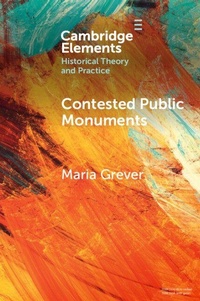
Contested Public Monuments
Global perspectives on landscapes of memory
Published on 13. November 2025
Book
Paperback/Softback
98 pages
978-1-009-51571-9 (ISBN)
Description
In the new millennium, many public monuments around the world have become the target of protests as part of social movements' struggles against inequality and discrimination. Despite research into the significance of toppled statues or damaged monuments and the motives of activists, little attention has been paid to the extent to which iconoclastic activism changes the narratives of public spaces or landscapes of memory. This Element approaches current conflicts over public monuments as an attempt to transform the mnemonic regime of public spaces. It examines global cases involving colonialism, Black slavery, world wars, and women's oppression. Using theoretical concepts, such as monumental narrativity, necropolitical space, white innocence, and the implicated subject, four current contexts of contestations will be highlighted: the fabric of landscapes of memory; the relationship between the living and the dead of a community; the power of visual language, iconography, and multiplication; the importance of dialogical monuments.
More details
Series
Language
English
Place of publication
Cambridge
United Kingdom
Target group
College/higher education
Product notice
Paperback (trade)
Illustrations
Worked examples or Exercises
Dimensions
Height: 229 mm
Width: 152 mm
Thickness: 6 mm
Weight
156 gr
ISBN-13
978-1-009-51571-9 (9781009515719)
Copyright in bibliographic data and cover images is held by Nielsen Book Services Limited or by the publishers or by their respective licensors: all rights reserved.
Schweitzer Classification
Other editions
Additional editions
Book
11/2025
Cambridge University Press
€75.30
Shipment within 15-20 days
Person
Content
1. Introduction; 2. Landscapes of memory and monumental narrativity; 3. Monuments and necropolitical space; 4. Iconography, visual language, and multiplication; 5. Dialogical monuments in a global media network; 6. Conclusion; References.