

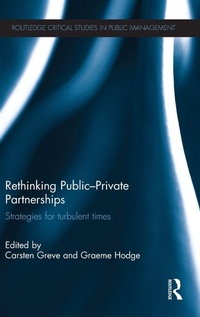
Rethinking Public-Private Partnerships
Strategies for Turbulent Times
1st Edition
Published on 6. December 2012
Book
Hardback
240 pages
978-0-415-53959-3 (ISBN)
Description
The global financial crisis hit the world in a remarkable way in late 2008. Many governments and private sector organizations, who had considered Public-Private Partnerships (PPPs) to be their future, were forced to rethink their strategy in the wake of the crisis, as a lot of the available private funding upon which PPPs relied, was suddenly no longer available to the same extent. At the same time, governments and international organizations, like the European Union, were striving to make closer partnerships between the public sector and the private sector economy a hallmark for future policy initiatives.
This book examines PPPs in the context of turbulent times following the global financial crisis (GFC). PPPs can come in many forms, and the book sets out to distinguish between the many alternative views of partnerships; a project, a policy, a symbol of the role of the private sector in a mixed economy, or a governance tool - all within a particular cultural and historical context.
This book is about rethinking PPPs in the wake of the financial crisis and aims to give a clearer picture of the kind of conceptual frameworks that researchers might employ to now study PPPs. The crisis took much of the glamour out of PPPs, but theoretical advances have been made by researchers in a number of areas and this book examines selected new research approaches to the study of PPPs.
This book examines PPPs in the context of turbulent times following the global financial crisis (GFC). PPPs can come in many forms, and the book sets out to distinguish between the many alternative views of partnerships; a project, a policy, a symbol of the role of the private sector in a mixed economy, or a governance tool - all within a particular cultural and historical context.
This book is about rethinking PPPs in the wake of the financial crisis and aims to give a clearer picture of the kind of conceptual frameworks that researchers might employ to now study PPPs. The crisis took much of the glamour out of PPPs, but theoretical advances have been made by researchers in a number of areas and this book examines selected new research approaches to the study of PPPs.
More details
Series
Language
English
Place of publication
London
United Kingdom
Publishing group
Taylor & Francis Ltd
Target group
College/higher education
Illustrations
11 s/w Abbildungen, 11 s/w Zeichnungen, 30 s/w Tabellen
30 Tables, black and white; 11 Line drawings, black and white; 11 Illustrations, black and white
Dimensions
Height: 240 mm
Width: 161 mm
Thickness: 18 mm
Weight
531 gr
ISBN-13
978-0-415-53959-3 (9780415539593)
Copyright in bibliographic data and cover images is held by Nielsen Book Services Limited or by the publishers or by their respective licensors: all rights reserved.
Schweitzer Classification
Other editions
Additional editions
Book
08/2016
1st Edition
Routledge
€78.90
Shipment within 10-20 days
E-Book
05/2013
1st Edition
Routledge
€72.49
Available for download
E-Book
05/2013
1st Edition
Routledge
€72.49
Available for download
Persons
Carsten Greve is Professor at the Department of Business and Politics, Copenhagen Business School, Denmark. His research focuses on public-private cooperation and partnerships and public management in a comparative perspective and he has contributed to, or published many books in these areas, including Contracting for Public Services (2007, Routledge)
Graeme Hodge is Professor at Monash University, Australia. He is the Director of the Monash Centre for Regulatory Studies in the Law Faculty at Monash, as well as the founding Director of the Monash Centre for Privatisation and Public Accountability. He has published extensively in areas such as privatisation of public sector enterprise, outsourcing of government services and public-private partnerships
Graeme Hodge is Professor at Monash University, Australia. He is the Director of the Monash Centre for Regulatory Studies in the Law Faculty at Monash, as well as the founding Director of the Monash Centre for Privatisation and Public Accountability. He has published extensively in areas such as privatisation of public sector enterprise, outsourcing of government services and public-private partnerships
Content
1. Introduction: Public-Private Partnerships in Turbulent Times 2. The Impact of the Global Financial Crisis on Public-Private Partnerships: A UK Perspective 3. What return for Risk?: The Price of Equity Capital in Public-Private Partnerships 4. Mind the Gap: Accountability and Value for Money in Public-Private Partnerships in Ireland 5. Enhancing Innovation in Public Organizations through Public-Private Partnerships: The Role of Public Managers 6. Incorporating Non-Profit Sector Perspectives in the Study of Public-Private Partnerships 7. A Foucault Perspective on Public-Private Partnership Mega Projects 8. The Public Management of Public-Private Partnerships: U.S. City-Level Structures for Brownfield Cleanup and Redevelopment 9. Beyond the Contract: The Challenge of Evaluating the Performance(s) of Public-Private Partnerships 10. A Theory Driven Approach to Public-Private Partnerships: The Dynamics of Complexity and Control 11. Conclusions: Rethinking Public-Private Partnerships