

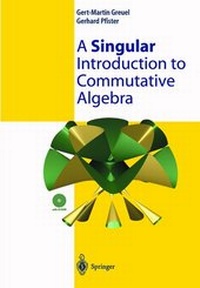
A Singular Introduction to Commutative Algebra
Description
Reviews / Votes
".It is certainly no exaggeration to say that Greuel and Pfister's A Singular Introduction to Commutative Algebra aims to lead a further stage in the computational revolution in commutative algebra, in which computational methods and results become central to how the subject is taught and learned. [.] Among the great strengths and most distinctive features of Greuel and Pfister's book is a new, completely unified treatment of the global and local theories. The realization that the two cases could be combined to this extent was decisive in the design of the Singular system, making it one of the most flexible and most efficient systems of its type. The authors present the first systematic development of this unified approach in a textbook here, and this aspect alone is almost worth the price of admission. Another distinctive feature of this book is the degree of integration of explicit computational examples into the flow of the text. Strictly mathematical components of the development (often quite terse and written in a formal "theorem-proof" style) are interspersed with parallel discussions of features of Singular and numerous Singular examples giving input commands, some extended programs in the Singular language, and output. [.] Yet another strength of Greuel and Pfister's book is its breadth of coverage of theoretical topics in the portions of commutative algebra closest to algebraic geometry, with algorithmic treatments of almost every topic. A synopsis of the table of contents will make this clear. [.] Greuel and Pfister have written a distinctive an highly useful book that should be in the library of every commutative algebrais and algebraic geometer, expert and novice alike. I hope that it achieves the educational impact it deserves."
John B. Little, Monthly of The Mathematical Association of America, March 2004
"... The authors' most important new focus is the presentation of non-well orderings that allow them the computational approach for local commutative algebra. The accompanying CD-ROM also contains all the examples of the book. ...
In fact the book provides an introduction to commutative algebra from a computational point of view. So it might be helpful for students and other interested readers (familiar with computers) to explore the beauties and difficulties of commutative algebra by computational experiences. In this respect the book is the one of the first samples of a new kind of textbooks in algebra."
P.Schenzel, Zentralblatt für Mathematik 1023.13001, 2003
"It is certainly no exaggeration to say that . A Singular Introduction to Commutative Algebra aims to lead a further stage in the computational revolution in commutative algebra . . Among the great strengths and most distinctive features . is a new, completely unified treatment of the global and local theories. . Greuel and Pfister have written a distinctive and highly useful book that should be in the library of every commutative algebraist and algebraic geometer, expert and novice alike."
John B. Little, MAA, March 2004
"The aim of the book is . an introduction to commutative algebra with a view towards to algorithmic aspects and computational practice. . The authors' most important new focus is the presentation of non-well orderings that allow them the computational approach for local commutative algebra. . It might be helpful for students and other interested readers . to explore the beauties and difficulties of commutative algebra . . The book is one of the first samples of a new kind of textbooks in algebra."
Peter Schenzel, Zentralblatt MATH, Vol. 1023, 2003
More details
Other editions
New editions
Additional editions
Persons
Content
2. Modules 2.1 Modules, Submodules and Homomorphisms 2.2 Graded Rings and Modules 2.3 Standard Bases for Modules 2.4 Exact Sequences and free Resolutions 2.5 Computing Resolutions and the Syzygy Theorem 2.6 Modules over Principal Ideal Domains 2.7 Tensor Product 2.8 Operations with modules 2.8.1 Module membership problem 2.8.2 Elimination of module components 2.8.3 Quotients of submodules 2.8.4 Kernel of a module homomorphism
3. Noether Normalization and Applications 3.1 Finite and Integral Extensions 3.2 The Integral Closure 3.3 Dimension 3.4 Noether Normalization 3.5 Applications 3.6 An Algorithm to Compute the Normalization 3.7 Procedures
4. Primary Decomposition and Related Topics 4.1 The Theory of Primary Decomposition 4.2 Zero--dimensional Primary Decomposition 4.3 Higher Dimensional Primary Decomposition 4.4 The Equidimensional Part of an Ideal 4.5 The Radical 4.6 Procedures
5. Hilbert Function 5.1 The Hilbert Function and the Hilbert Polynomial 5.2 Examples and Computation of the Hilbert--Poincare Series 5.3 Properties of the Hilbert Polynomial 5.4 Filtrations and the Lemma of Artin--Rees 5.5 The Hilbert--Samuel Function 5.6 Characterization of the Dimension of Local Rings 5.7 Singular Locus
6. Complete Local Rings 6.1 Formal Power Series Rings 6.2 Weierstrass Preparation Theorem 6.3 Completions 6.4 Standard bases
7. Homological Algebra 7.1 Tor 7.2 Fitting Ideals 7.3 Flatness 7.4 Local Criteria for Flatness 7.5 Flatness and Standard Bases 7.6 Koszul Complex 7.7 Cohen-Macaulay Rings 7.8 Further Characterization of Cohen-Macaulayness
A. Geometric Background A.1 Introduction by Pictures A.2 Affine algebraic varieties A.3 Spectrum and Affine Schemes A.4 Projective Varieties and Projective Schemes A.5 Morphisms between Varieties A.6 Projective Morphisms and elimination A.7 Local versus Global Properties A.8 Singularities
B. SINGULAR - A Short Introduction B.1 Downloading Instructions B.2 Getting Started B.3 Procedures and Libraries B.4 Data Types B.5 Functions B.6 Control Structures B.7 System variables
SINGULAR Reference Manual Index Glossary