

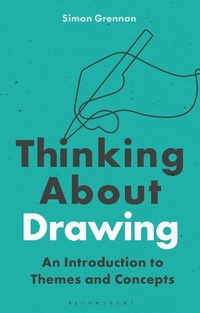
Thinking About Drawing
An Introduction to Themes and Concepts
Published on 7. April 2022
Book
Paperback/Softback
176 pages
978-1-350-26593-6 (ISBN)
Description
This accessible book explains the significance of relationships between the body and the mark, visual imitation, drawing and writing and visual storytelling, providing a simple guide to these key ideas. For millennia drawing has been conceived as an exploratory activity, mediating between the vision of the drafter and what they are drawing. Drawing reveals hidden relationships, directs attention, scrutinises the material world and provides plans for further action.
The book unpacks the key ideas that have shaped the rich, complex and foundational activity of drawing. It presents an unexpected, engaging and authoritative range of illustrated examples of drawings made by culturally and historically diverse people for different purposes, with different media, in widely different times and situations.
Educator, author and artist Simon Grennan builds together concepts to create a complete guide to ideas about drawing.
The book unpacks the key ideas that have shaped the rich, complex and foundational activity of drawing. It presents an unexpected, engaging and authoritative range of illustrated examples of drawings made by culturally and historically diverse people for different purposes, with different media, in widely different times and situations.
Educator, author and artist Simon Grennan builds together concepts to create a complete guide to ideas about drawing.
Reviews / Votes
This is an important summation about a lot of foundational ideas in drawing. Having a functional text, written by a practitioner, is what the field needs. -- Simon Downs, Lecturer in Graphic Communication, Loughborough University, UK Thinking About Drawing is a book that explores a broad range of approaches to drawing. This book situates drawing as an enduring form of visual communication in a globally connected world. A fascinating range of illustrations bring the subject to life and are presented in relation to clearly defined technical terms. For anyone wanting to give voice to their interest in drawing, this book is the go-to guide. -- Kelly Chorpening, Programme Director of Fine Art, Camberwell College of Arts, University of London, UK A refreshing take on the subject, Thinking About Drawing is well-suited to introducing the wonderful field of drawing to students in Fine Arts, Illustration, Communication Design, Architecture and related areas. The discussion is well-framed with intriguing themes and topics such as 'Imitation, Mark and Trace'. The thought provoking text is richly-illustrated with an exciting and refreshing range of images (from early maps and Japanese woodblocks to graphic novels and emojis). A very engaging read that serves well as a broad 'drawing survey' with enough depth for experienced artists and designers. -- Charles Parker, Associate Professor, Pratt Institute, USA Thinking About Drawing considers the act of drawing as an expansive, ever-evolving set of practices and legacies that often defy simple summary. Grennan thoughtfully examines foundational, contemporary drawing principles with equal attention to analog and digital processes, and presents a global perspective on how the methods and meanings of 'drawing' have developed in cultural isolation and conversation throughout history. -- Ryan Hartley Smith, Associate Professor of Illustration, Queens College, City University of New York, USA Simon Grennan's book presents a probing journey through the meaning and uses of drawing. An engaging compliment to support and extend the understanding of the role and nature of drawing for the student and practitioner alike. The examples demonstrate the pervasiveness of drawing across fields and to different ends. It would be a great accompaniment to practice-based art or design education, demonstrating the way drawing can be simultaneously reductive and expansive in its use. The reader finishes the book with an understanding of how drawing can be viewed as both a necessary practical tool and theoretical exercise. -- Sarah McLean Knapp, Assistant Professor, Queen's University, CanadaMore details
Language
English
Place of publication
London
United Kingdom
Publishing group
Bloomsbury Publishing PLC
Target group
College/higher education
Professional and scholarly
Illustrations
81 colour illus
Dimensions
Height: 139 mm
Width: 215 mm
Thickness: 12 mm
Weight
320 gr
ISBN-13
978-1-350-26593-6 (9781350265936)
Copyright in bibliographic data and cover images is held by Nielsen Book Services Limited or by the publishers or by their respective licensors: all rights reserved.
Schweitzer Classification
Other editions
Additional editions
E-Book
03/2022
1st Edition
Bloomsbury Visual Arts
€21.99
Available for download
E-Book
03/2022
1st Edition
Bloomsbury Visual Arts
€21.99
Available for download
Person
Simon Grennan is Leading Research Fellow at the University of Chester, UK. He is an awarded scholar of visual narrative, graphic novelist and cartoonist. He is the author of Drawing in Drag by Marie Duval (2019), A Theory of Narrative Drawing (2017) and Dispossession (2015), one of The Guardian Books of the Year 2015, which is a graphic adaptation of a novel by Anthony Trollope. He is co-author, with Roger Sabin and Julian Waite, of Marie Duval: Maverick Victorian Cartoonist (2020), Marie Duval (2018) and The Marie Duval Archive (2015), co-author of Key Terms in Comics Studies (2021) and co-editor, with Laurence Grove, of Transforming Anthony Trollope: 'Dispossession', Victorianism and 19th-century Word and Image (2015), among others. Since 1990, he has been half of international artists team Grennan & Sperandio, producer of over forty comics and books (www.kartoonkings.com).
Content
List of Illustrations
Introduction: what is drawing?
1. Imitation
The threshold of visualisation and the problem of media
Depiction and visualisation
Imitating vision and imitating drawing
Digital imitation
Analogue imitation
Imitating experience
2. Mark
Tone
Line
Planning
Mapping
Drawing systems representing three dimensions
Typification
Writing
Mark making across media
Introducing the body
3. Trace
The surface
The surface of the drawing as the skin of a body
The surface as a visualisation of an idea
The limits of the drawing
The significance of drawing media
Trace, media and body
Trace and style
Trace as evidence
Movement, mind and absence
Choreographing traces
Trace and depiction
4. Story
Story and point of view
The story of the drawing
Story and style
Drawing style and character
5. Drawing Today
Feeling
Technology old and new
Systematic drawings
Identity and power
Textiles and the line
Conjecture and hypothesis
Collaborative drawing
Performing drawing
Moving drawings
Contemporary drawing and public cultural institutions
Selective glossary
References
Further reading
Index
Introduction: what is drawing?
1. Imitation
The threshold of visualisation and the problem of media
Depiction and visualisation
Imitating vision and imitating drawing
Digital imitation
Analogue imitation
Imitating experience
2. Mark
Tone
Line
Planning
Mapping
Drawing systems representing three dimensions
Typification
Writing
Mark making across media
Introducing the body
3. Trace
The surface
The surface of the drawing as the skin of a body
The surface as a visualisation of an idea
The limits of the drawing
The significance of drawing media
Trace, media and body
Trace and style
Trace as evidence
Movement, mind and absence
Choreographing traces
Trace and depiction
4. Story
Story and point of view
The story of the drawing
Story and style
Drawing style and character
5. Drawing Today
Feeling
Technology old and new
Systematic drawings
Identity and power
Textiles and the line
Conjecture and hypothesis
Collaborative drawing
Performing drawing
Moving drawings
Contemporary drawing and public cultural institutions
Selective glossary
References
Further reading
Index