

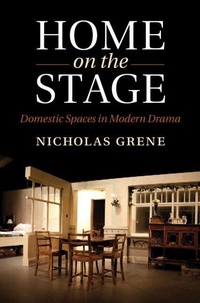
Home on the Stage
Domestic Spaces in Modern Drama
Published on 2. October 2014
Book
Hardback
250 pages
978-1-107-07809-3 (ISBN)
Description
As a serious drama set in an ordinary middle-class home, Ibsen's A Doll's House established a new politics of the interior that was to have a lasting impact upon twentieth-century drama. In this innovative study, Nicholas Grene traces the changing forms of the home on the stage through nine of the greatest of modern plays and playwrights. From Chekhov's The Cherry Orchard through to Williams' A Streetcar Named Desire, domestic spaces and personal crises have been employed to express wider social conditions and themes of class, gender and family. In the later twentieth century and beyond, the most radically experimental dramatists created their own challenging theatrical interiors, including Beckett in Endgame, Pinter in The Homecoming and Parks in Topdog/Underdog. Grene analyses the full significance of these versions of domestic spaces to offer fresh insights into the portrayal of the naturalistic environment in modern drama.
Reviews / Votes
'Suggestive and insightful.' Irish TimesMore details
Language
English
Place of publication
Cambridge
United Kingdom
Target group
Professional and scholarly
Product notice
sewn/stitched
Cloth over boards
Illustrations
14 Halftones, unspecified; 14 Halftones, black and white
Dimensions
Height: 231 mm
Width: 150 mm
Thickness: 23 mm
Weight
499 gr
ISBN-13
978-1-107-07809-3 (9781107078093)
Copyright in bibliographic data and cover images is held by Nielsen Book Services Limited or by the publishers or by their respective licensors: all rights reserved.
Schweitzer Classification
Other editions
Additional editions
Book
02/2018
Cambridge University Press
€44.00
Shipment within 15-20 days
E-Book
10/2014
Cambridge University Press
€21.99
Available for download
E-Book
09/2014
1st Edition
Cambridge University Press
€26.49
Available for download
Person
Nicholas Grene is Professor of English Literature at Trinity College, Dublin, a Senior Fellow of the College, a Member of the Royal Irish Academy and a Life Member of Clare Hall, Cambridge. He has published widely on Shakespeare, drama, and Irish literature, and his books include Bernard Shaw: A Critical View (1984), Shakespeare's Tragic Imagination (1992), The Politics of Irish Drama (Cambridge, 1999) and Shakespeare's Serial History Plays (Cambridge, 2002). Among his most recent books are Yeats's Poetic Codes (2008), the New Mermaids edition of Major Barbara (2008), Synge and Edwardian Ireland (co-edited with Brian Cliff, 2011), and a memoir Nothing Quite Like It: An American-Irish Childhood (2011). He has been invited to speak in over twenty countries and has been a visiting professor at the University of New South Wales, Dartmouth College and the University of Paris IV (Sorbonne).
Content
Introduction: Ibsen and after; 1. A Doll's House: the drama of the interior; 2. The Cherry Orchard: all Russia; 3. Heartbreak House: waiting for the Zeppelin; 4. Long Day's Journey into Night: the Tyrones at home in America; 5. A Streetcar Named Desire: see-through representation; 6. Endgame: in the refuge; 7. The Homecoming: men's room; 8. Arcadia: seeing double; 9. Topdog/Underdog: welcome to the family; Conclusion: home base.