

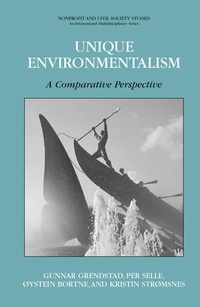
Unique Environmentalism
A Comparative Perspective
Published on 12. July 2006
Book
Hardback
VII, 190 pages
978-0-387-30524-0 (ISBN)
Description
their collective action. The more unique the case, the more we need to study it not only to understand the case itself but also to understand the structure and limits of environmentalism in general. We hope that we have been able to show the value of this research strategy. The way we have organized our study is different from the Rootes study (2003). This study emphasizes the importance of different environmental cultures and of political conjunctures in a single country of which different environm- tal groups take advantage. We are not arguing against the fact that branches of environmentalism have features in common across countries (e.g., animal rights and antinuclear movements). However, we would not go as far as the Rootes study. We argue that looking at political conjunctures, even if important, does not tell the whole story. Researchers need to understand the broader context in which political conjunctures and environmental culture operate.
More details
Series
Edition
2006 ed.
Language
English
Place of publication
New York
United States
Target group
Professional and scholarly
Researchers in sociology, social justice, economics, management, international studies, environmental studies and community movements
Product notice
sewn/stitched
Cloth over boards
Illustrations
VII, 190 p.
Dimensions
Height: 244 mm
Width: 162 mm
Thickness: 20 mm
Weight
401 gr
ISBN-13
978-0-387-30524-0 (9780387305240)
DOI
10.1007/978-0-387-30525-7
Schweitzer Classification
Other editions
Additional editions
Book
11/2010
Springer
€149.79
Shipment within 15-20 days
E-Book
11/2006
1st Edition
Springer
€96.29
Available for download
Content
Perspectives on Unique Environmentalism.- In Defense of Uniqueness.- The Two Anomalies.- The Organizational Setting: Early History and Later Developments.- The Environmentalists.- Who Are the Environmentalists?.- Environmentalists Without an Attitude.- Political and Environmental Behavior.- The Local Community Perspective in the State-Friendly Society.- The Local Community Perspective.- The State-Friendly Society.- Withering Uniqueness?.