

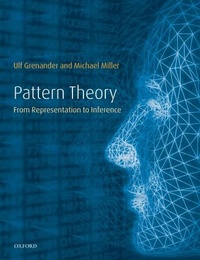
Pattern Theory
From representation to inference
Published on 14. December 2006
Book
Paperback/Softback
608 pages
978-0-19-929706-1 (ISBN)
Description
Pattern Theory: From Representation to Inference provides a comprehensive and accessible overview of the modern challenges in signal, data and pattern analysis in speech recognition, computational linguistics, image analysis and computer vision. Aimed at graduate students in biomedical engineering, mathematics, computer science and electrical engineering with a good background in mathematics and probability, the text includes numerous exercises and an extensive bibliography. Additional resources including extended proofs, selected solutions and examples are available on a companion website.
The book commences with a short overview of pattern theory and the basics of statistics and estimation theory. Chapters 3-6 discuss the role of representation of patterns via conditioning structure and Chapters 7 and 8 examine the second central component of pattern theory: groups of geometric transformation applied to the representation of geometric objects. Chapter 9 moves into probabilistic structures in the continuum, studying random processes and random fields indexed over subsets of Rn, and Chapters 10, 11 continue with transformations and patterns indexed over the continuum. Chapters 12-14 extend from the pure representations of shapes to the Bayes estimation of shapes and their parametric representation. Chapters 15 and 16 study the estimation of infinite dimensional shape in the newly emergent field of Computational Anatomy, and finally Chapters 17 and 18 look at inference, exploring random sampling approaches for estimation of model order and parametric representing of shapes.
The book commences with a short overview of pattern theory and the basics of statistics and estimation theory. Chapters 3-6 discuss the role of representation of patterns via conditioning structure and Chapters 7 and 8 examine the second central component of pattern theory: groups of geometric transformation applied to the representation of geometric objects. Chapter 9 moves into probabilistic structures in the continuum, studying random processes and random fields indexed over subsets of Rn, and Chapters 10, 11 continue with transformations and patterns indexed over the continuum. Chapters 12-14 extend from the pure representations of shapes to the Bayes estimation of shapes and their parametric representation. Chapters 15 and 16 study the estimation of infinite dimensional shape in the newly emergent field of Computational Anatomy, and finally Chapters 17 and 18 look at inference, exploring random sampling approaches for estimation of model order and parametric representing of shapes.
Reviews / Votes
"Patterns Theory: From Representations to Inference" provides a comprehensive and accessible overview of the modern challenges in signal, data and pattern analysis in speech recognition, computational linguistics, image analysis and computer vision. * L'enseignement Mathematique *More details
Language
English
Place of publication
Oxford
United Kingdom
Target group
College/higher education
Professional and scholarly
Illustrations
numerous halftones, colour plates, line drawings and mathematical examples
Dimensions
Height: 244 mm
Width: 188 mm
Thickness: 26 mm
Weight
1234 gr
ISBN-13
978-0-19-929706-1 (9780199297061)
Copyright in bibliographic data and cover images is held by Nielsen Book Services Limited or by the publishers or by their respective licensors: all rights reserved.
Schweitzer Classification
Other editions
Additional editions
Book
12/2006
Oxford University Press
€230.90
Shipment within 15-20 days
Persons
Ulf Grenander is the L. Herbert Ballou University Professor at Brown University. He is a member of the Royal Swedish Academy of Science and an honorary fellow of the Royal Statistical Society in London
Michael Miller is the Professor of Electrical and Computer Engineering, Director of the Center for Imaging Science, and Professor of Biomedical Engineering at Johns Hopkins University, Baltimore. He completed his Ph.D. in Biomedical Engineering at The Johns Hopkins University in 1983.
Michael Miller is the Professor of Electrical and Computer Engineering, Director of the Center for Imaging Science, and Professor of Biomedical Engineering at Johns Hopkins University, Baltimore. He completed his Ph.D. in Biomedical Engineering at The Johns Hopkins University in 1983.
Content
1. Introduction ; 2. The Bayes paradigm, estimation and information measures ; 3. Probabilistic directed acyclic graphs and their entropies ; 4. Markov random fields on undirected graphs ; 5. Gaussian random fields on undirected graphs ; 6. The canonical representations of general pattern theory ; 7. Matrix group actions transforming patterns ; 8. Manifolds, active modes, and deformable templates ; 9. Second order and Gaussian fields ; 10. Metrics spaces for the matrix groups ; 11. Metrics spaces for the infinite dimensional diffeomorphisms ; 12. Metrics on photometric and geometric deformable templates ; 13. Estimation bounds for automated object recognition ; 14. Estimation on metric spaces with photometric variation ; 15. Information bounds for automated object recognition ; 16. Computational anatomy: shape, growth and atrophy comparison via diffeomorphisms ; 17. Computational anatomy: hypothesis testing on disease ; 18. Markov processes and random sampling ; 19. Jump diffusion inference in complex scenes