

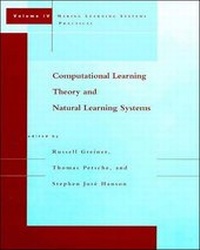
Computational Learning Theory and Natural Learning Systems
Making Learning Systems Practical
Published on 23. January 1997
Book
Paperback/Softback
431 pages
978-0-262-57118-0 (ISBN)
Description
This is the fourth and final volume of papers from a series of workshops called "Computational Learning Theory and `Natural' Learning Systems." The purpose of the workshops was to explore the emerging intersection of theoretical learning research and natural learning systems. The workshops drew researchers from three historically distinct styles of learning research: computational learning theory, neural networks, and machine learning (a subfield of AI).
Volume I of the series introduces the general focus of the workshops. Volume II looks at specific areas of interaction between theory and experiment. Volumes III and IV focus on key areas of learning systems that have developed recently. Volume III looks at the problem of "Selecting Good Models." The present volume, Volume IV, looks at ways of "Making Learning Systems Practical." The editors divide the twenty-one contributions into four sections. The first three cover critical problem areas: 1) scaling up from small problems to realistic ones with large input dimensions, 2) increasing efficiency and robustness of learning methods, and 3) developing strategies to obtain good generalization from limited or small data samples. The fourth section discusses examples of real-world learning systems.
ContributorsKlaus Abraham-Fuchs, Yasuhiro Akiba, Hussein Almuallim, Arunava Banerjee, Sanjay Bhansali, Alvis Brazma, Gustavo Deco, David Garvin, Zoubin Ghahramani, Mostefa Golea, Russell Greiner, Mehdi T. Harandi, John G. Harris, Haym Hirsh, Michael I. Jordan, Shigeo Kaneda, Marjorie Klenin, Pat Langley, Yong Liu, Patrick M. Murphy, Ralph Neuneier, E. M. Oblow, Dragan Obradovic, Michael J. Pazzani, Barak A. Pearlmutter, Nageswara S. V. Rao, Peter Rayner, Stephanie Sage, Martin F. Schlang, Bernd Schürmann, Dale Schuurmans, Leon Shklar, V. Sundareswaran, Geoffrey Towell, Johann Uebler, Lucia M. Vaina, Takefumi Yamazaki, Anthony M. Zador.
Volume I of the series introduces the general focus of the workshops. Volume II looks at specific areas of interaction between theory and experiment. Volumes III and IV focus on key areas of learning systems that have developed recently. Volume III looks at the problem of "Selecting Good Models." The present volume, Volume IV, looks at ways of "Making Learning Systems Practical." The editors divide the twenty-one contributions into four sections. The first three cover critical problem areas: 1) scaling up from small problems to realistic ones with large input dimensions, 2) increasing efficiency and robustness of learning methods, and 3) developing strategies to obtain good generalization from limited or small data samples. The fourth section discusses examples of real-world learning systems.
ContributorsKlaus Abraham-Fuchs, Yasuhiro Akiba, Hussein Almuallim, Arunava Banerjee, Sanjay Bhansali, Alvis Brazma, Gustavo Deco, David Garvin, Zoubin Ghahramani, Mostefa Golea, Russell Greiner, Mehdi T. Harandi, John G. Harris, Haym Hirsh, Michael I. Jordan, Shigeo Kaneda, Marjorie Klenin, Pat Langley, Yong Liu, Patrick M. Murphy, Ralph Neuneier, E. M. Oblow, Dragan Obradovic, Michael J. Pazzani, Barak A. Pearlmutter, Nageswara S. V. Rao, Peter Rayner, Stephanie Sage, Martin F. Schlang, Bernd Schürmann, Dale Schuurmans, Leon Shklar, V. Sundareswaran, Geoffrey Towell, Johann Uebler, Lucia M. Vaina, Takefumi Yamazaki, Anthony M. Zador.
More details
Series
Language
English
Place of publication
Cambridge, Mass.
United States
Publishing group
MIT Press Ltd
Target group
College/higher education
Professional and scholarly
Interest Age: From 18 years
Product notice
Paperback (trade)
Dimensions
Height: 226 mm
Width: 178 mm
Thickness: 23 mm
Weight
658 gr
ISBN-13
978-0-262-57118-0 (9780262571180)
Copyright in bibliographic data and cover images is held by Nielsen Book Services Limited or by the publishers or by their respective licensors: all rights reserved.
Schweitzer Classification