

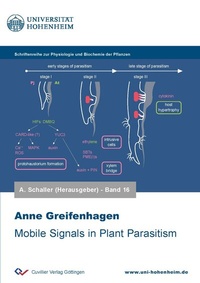
Mobile Signals in Plant Parasitism
1st Edition
Published on 30. January 2024
Book
162 pages
978-3-7369-7949-9 (ISBN)
Description
Land plants are sessile organisms that depend on their immediate surroundings throughout their lives. To survive, plants perceive and react to abiotic and biotic stimuli. Plants engaging with other organisms, such as symbiosis with mycorrhizal fungi or nitrogen-fixing bacteria, is an ancient concept. The symbionts provide the plant with nutrients and nitrogen, in return, the plant sends mostly sugars.
However, plants are also susceptible to pathogenic organisms, like parasitic nematodes that colonize and feed on the plant root, thereby benefiting from the host without killing it. Parasitism is a highly successful strategy, not only for nematodes but among all kingdoms of life. Plants also evolved parasitism. Parasitic plants satisfy their nutritional needs by infecting and parasitizing their host through a multicellular invasive organ, the haustorium. Some parasitic plants infect crop plants, resulting in severe yield loss. Parasitic weed
management options, however, are limited. Parasitism requires mobile signaling cues and their distribution within the parasite, as well as in-between parasite and the host. Plant parasitism-related signaling pathways show parallels to other plant developmental programs, such as lateral root development. This study aimed to uncover the biogenesis and function of mobile cues aiding parasitism of plants on host plants.