

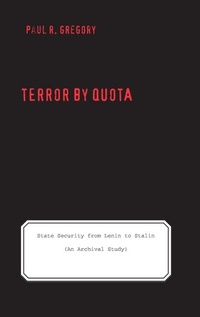
Terror by Quota
State Security from Lenin to Stalin (an Archival Study)
Will be published approx. on 16. January 2009
Book
Hardback
360 pages
978-0-300-13425-4 (ISBN)
Description
This original analysis of the workings of Soviet state security organs under Lenin and Stalin addresses a series of questions that have long resisted satisfactory answers. Why did political repression affect so many people, most of them ordinary citizens? Why did repression come in waves or cycles? Why were economic and petty crimes regarded as political crimes? What was the reason for relying on extra-judicial tribunals? And what motivated the extreme harshness of punishments, including the widespread use of the death penalty?
Through an approach that synthesizes history and economics, Paul Gregory develops systematic explanations for the way terror was applied, how terror agents were recruited, how they carried out their jobs, and how they were motivated. The book draws on extensive, recently opened archives of the Gulag administration, the Politburo, and state security agencies themselves to illuminate in new ways terror and repression in the Soviet Union as well as dictatorships in other times and places.
Through an approach that synthesizes history and economics, Paul Gregory develops systematic explanations for the way terror was applied, how terror agents were recruited, how they carried out their jobs, and how they were motivated. The book draws on extensive, recently opened archives of the Gulag administration, the Politburo, and state security agencies themselves to illuminate in new ways terror and repression in the Soviet Union as well as dictatorships in other times and places.
Reviews / Votes
"This book, the first to focus on the 'working arrangements' of security agencies under Stalin, unlocks a number of issues in Soviet history that have until now been classified as instances of the dictator's irrationality or excess."-Mark Harrison, University of Warwick -- Mark Harrison "In the vast and growing literature on Stalinism, this text stands out not only due to the extensive coverage of a complex subject matter but also due to its unique methodology. Paul Gregory applies the rational-choice paradigm to the policies, and, in particular, the infamous Great Terror of 1937-1938. This important study improves our understanding of dictatorship and broadens the scope of historical economic analysis in general."-Valery Lazarev, University of Houston and Hoover Institution -- Valery LazarevMore details
Series
Language
English
Place of publication
United States
Target group
College/higher education
Professional and scholarly
Product notice
Cloth over boards
Illustrations
28 b-w illus.
Dimensions
Height: 245 mm
Width: 164 mm
Thickness: 32 mm
Weight
649 gr
ISBN-13
978-0-300-13425-4 (9780300134254)
Copyright in bibliographic data and cover images is held by Nielsen Book Services Limited or by the publishers or by their respective licensors: all rights reserved.
Schweitzer Classification
Other editions
Additional editions
E-Book
01/2009
1st Edition
Yale University Press
€51.95
Available for download
Person
Paul Gregory is Cullen Distinguished Professor of Economics, University of Houston. As a research fellow at the Hoover Institution, he directs the Soviet Archives Working Group. He lives in Bellaire, TX.