

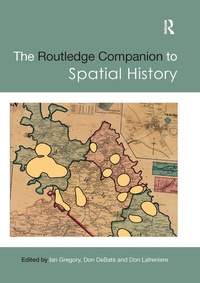
The Routledge Companion to Spatial History
1st Edition
Published on 18. December 2020
Book
Paperback/Softback
636 pages
978-0-367-73537-1 (ISBN)
Description
The Routledge Companion to Spatial History explores the full range of ways in which GIS can be used to study the past, considering key questions such as what types of new knowledge can be developed solely as a consequence of using GIS and how effective GIS can be for different types of research.
Global in scope and covering a broad range of subjects, the chapters in this volume discuss ways of turning sources into a GIS database, methods of analysing these databases, methods of visualising the results of the analyses, and approaches to interpreting analyses and visualisations. Chapter authors draw from a diverse collection of case studies from around the world, covering topics from state power in imperial China to the urban property market in nineteenth-century Rio de Janeiro, health and society in twentieth-century Britain and the demographic impact of the Second Battle of Ypres in 1915.
Critically evaluating both the strengths and limitations of GIS and illustrated with over two hundred maps and figures, this volume is an essential resource for all students and scholars interested in the use of GIS and spatial analysis as a method of historical research.
Global in scope and covering a broad range of subjects, the chapters in this volume discuss ways of turning sources into a GIS database, methods of analysing these databases, methods of visualising the results of the analyses, and approaches to interpreting analyses and visualisations. Chapter authors draw from a diverse collection of case studies from around the world, covering topics from state power in imperial China to the urban property market in nineteenth-century Rio de Janeiro, health and society in twentieth-century Britain and the demographic impact of the Second Battle of Ypres in 1915.
Critically evaluating both the strengths and limitations of GIS and illustrated with over two hundred maps and figures, this volume is an essential resource for all students and scholars interested in the use of GIS and spatial analysis as a method of historical research.
Reviews / Votes
"This wide-ranging, insightful and richly-illustrated volume provides a wealth of practical case studies elucidating the potential of GIS to enrich our understanding of the past, as well as incisive critical examination of its implications for and impact on historical scholarship. It will be invaluable for everyone interested in the use of new digital technologies and methods in historical research."Nick Baron, University of Nottingham, UK
"From the leading scholars in the use of historical GIS methods, these valuable essays give us a clear sense of the possibilities and challenges of spatial history. This is a groundbreaking edited volume that will inspire, guide, and teach anyone considering spatial history approaches in their own work."
William G. Thomas III, University of Nebraska, USA
More details
Series
Language
English
Place of publication
London
United Kingdom
Publishing group
Taylor & Francis Ltd
Target group
College/higher education
Postgraduate
Dimensions
Height: 246 mm
Width: 174 mm
Weight
1020 gr
ISBN-13
978-0-367-73537-1 (9780367735371)
Copyright in bibliographic data and cover images is held by Nielsen Book Services Limited or by the publishers or by their respective licensors: all rights reserved.
Schweitzer Classification
Other editions
Additional editions
Ian Gregory | Don DeBats | Don Lafreniere
The Routledge Companion to Spatial History
E-Book
01/2018
Routledge
€63.49
Available for download
Ian Gregory | Don DeBats | Don Lafreniere
The Routledge Companion to Spatial History
E-Book
01/2018
1st Edition
Routledge
€63.49
Available for download
Ian Gregory | Don DeBats | Don Lafreniere
The Routledge Companion to Spatial History
Book
01/2018
1st Edition
Routledge
€364.52
Shipment within 10-20 days
Persons
Ian Gregory is Professor of Digital Humanities at Lancaster University, UK. He has worked extensively on using GIS in the Humanities on topics ranging from nineteenth-century infant mortality to Lake District literature. He has published four books and numerous journal articles on the subject. He co-directs Lancaster's Digital Humanities Hub (http://wp.lancs.ac.uk/dighum).
Don DeBats, Head of American Studies at Flinders University, Australia, is also a visiting professor at the University of Virginia, and a Residential Fellow at the Virginia Foundation for the Humanities. His current research on individual level voting by whites and African-Americans in Kentucky from 1870 to the adoption of the Australian secret ballot in 1891 is supported by the Division of Research Programs of the National Endowment for the Humanities. His interactive data-driven website is: sociallogic.iath.virginia.edu
Don Lafreniere is Assistant Professor of Geography and GIS and Director of the Geospatial Research Facility at Michigan Technological University, USA. His research interests centre on creating GIS methodologies for recreating historical environments and spatializing populations. His recent work includes creating historical spatial data infrastructures for heritage preservation and education and using historical geospatial methods for uncovering the relationships between the built environment and life course health and wellbeing.
Don DeBats, Head of American Studies at Flinders University, Australia, is also a visiting professor at the University of Virginia, and a Residential Fellow at the Virginia Foundation for the Humanities. His current research on individual level voting by whites and African-Americans in Kentucky from 1870 to the adoption of the Australian secret ballot in 1891 is supported by the Division of Research Programs of the National Endowment for the Humanities. His interactive data-driven website is: sociallogic.iath.virginia.edu
Don Lafreniere is Assistant Professor of Geography and GIS and Director of the Geospatial Research Facility at Michigan Technological University, USA. His research interests centre on creating GIS methodologies for recreating historical environments and spatializing populations. His recent work includes creating historical spatial data infrastructures for heritage preservation and education and using historical geospatial methods for uncovering the relationships between the built environment and life course health and wellbeing.
Content
Introduction Part I: Population and demography Part II: Urban Part III: Economics Part IV: Rural and Environment Part V: Health Part VI: Social Dynamics Part VII: Political Dimensions Part VIII: The Emergence of Digital Humanities Conclusion