

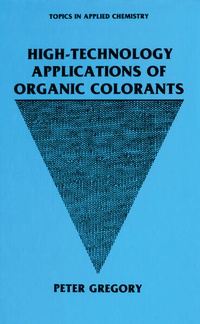
High-Technology Applications of Organic Colorants
Published on 31. August 1991
Book
Hardback
XV, 293 pages
978-0-306-43637-6 (ISBN)
Description
The traditional use of organic colorants is to impart color to a substrate such as textiles, paper, plastics, and leather. However, in the last five years or so organic colorants have become increasingly important in the high technology (hi-tech) industries of electronics and particularly reprographics. In some of these reprographics applications the organic colorant is used in its traditional role of imparting color to a substrate, typically paper or plastic. Examples are dyes for ink-jet printing, thermally transferable dyes for thermal transfer printing, and dyes and pigments for colored toners in photocopiers and laser printers. In other applications it is a special effect of an organic colorant that is utilized, not its color. Examples are electrical effects, such as photoconduction and the electrostatic charging of toners, both of which are essential features for the operation of photocopiers and laser printers, and the selective absorption of infrared radiation, which is utilized in optical data storage. In electronic applications the organic colorant is often employed in a device. Typical examples include liquid crystal dyes, laser dyes, electro chromic dyes, dyes for solar cells, dyes for micro color filters, and dyes for nonlinear optical applications.
More details
Series
Edition
1991 ed.
Language
English
Place of publication
New York
United States
Publishing group
Kluwer Academic Publishers Group
Target group
College/higher education
Professional and scholarly
Research
Illustrations
XV, 293 p.
Dimensions
Height: 235 mm
Width: 157 mm
Thickness: 23 mm
Weight
607 gr
ISBN-13
978-0-306-43637-6 (9780306436376)
DOI
10.1007/978-1-4615-3822-6
Schweitzer Classification
Other editions
Additional editions
Book
10/2012
Springer
€53.49
Shipment within 7-9 days
Content
I. Historical Perspectives.- I. Historical Perspective.- II. Colorants for Electronics.- 1. Liquid Crystal Dyes.- 2. Micro Color Filters.- 3. Laser Dyes.- 4. Colorants for Nonlinear Optics.- 5. Solar Cells.- 6. Electrochromic Dyes.- III. Colorants for Reprographics.- 7. Electrophotography.- 8. Thermography.- 9. Ink-Jet Printing.- 10. Electrography, Ionography, and Magnetography.- IV. Future Perspectives.- 11. Infrared Absorbers.- 12. Toxicology.- 13. Future Trends.