

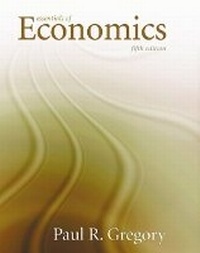
Essentials of Economics
5th Edition
Published on 4. March 2002
Book
Hardback
320 pages
978-0-321-08821-5 (ISBN)
Description
Essentials of Economics offers brief yet balanced coverage of basic microeconomic and macroeconomic principles. Designed for the one-semester course, the fifth edition provides students with a practical view of economic theories through thoroughly updated real-world examples, applications, and data. Gregory explores numerous modern topics in a non-technical manner, including modern industrial organization, information economics, public choice and adaptive and rational expectations. Coverage of modern microeconomics sets the stage for a discussion of macroeconomics, providing a logical sequence that parallels how the field evolved.
More details
Edition
5th edition
Language
English
Place of publication
United States
Publishing group
Pearson Education (US)
Target group
Professional and scholarly
Dimensions
Width: 235 mm
Thickness: 14 mm
Weight
516 gr
ISBN-13
978-0-321-08821-5 (9780321088215)
Copyright in bibliographic data and cover images is held by Nielsen Book Services Limited or by the publishers or by their respective licensors: all rights reserved.
Schweitzer Classification
Other editions
New editions
Book
06/2004
6th Edition
Pearson
€174.36
Article exhausted; check for reprint
Content
I. INTRODUCTION TO ECONOMICS.
1. Scarcity, Choice, and Opportunity Costs.
2. How a Market Economy Works: The Price System.
3. Market Demand, Supply, and Elasticity.
4. The Economics of Information.
II. ESSENTIALS OF MICROECONOMICS.
5. Costs and Productivity.
6. Competitive Markets.
7. Monopoly and Oligopoly.
III. MICROFOUNDATION OF MACROECONOMICS.
8. The Labor Market: Employment, Unemployment, and Wages.
9. Saving, Investment, and Interest Rates.
10. Government Spending, Taxation, and Deficits.
IV. ESSENTIALS OF MACROECONOMICS.
11. Macroeconomic Issues: Economic Growth and the Business Cycle.
12. Aggregate Supply and Aggregate Demand.
13. Money and Banking.
14. Inflation and Unemployment.
15. Stabilization.
V. INTERNATIONAL ECONOMICS.
16. International Trade and Globalization.
17. The International Monetary System.
1. Scarcity, Choice, and Opportunity Costs.
2. How a Market Economy Works: The Price System.
3. Market Demand, Supply, and Elasticity.
4. The Economics of Information.
II. ESSENTIALS OF MICROECONOMICS.
5. Costs and Productivity.
6. Competitive Markets.
7. Monopoly and Oligopoly.
III. MICROFOUNDATION OF MACROECONOMICS.
8. The Labor Market: Employment, Unemployment, and Wages.
9. Saving, Investment, and Interest Rates.
10. Government Spending, Taxation, and Deficits.
IV. ESSENTIALS OF MACROECONOMICS.
11. Macroeconomic Issues: Economic Growth and the Business Cycle.
12. Aggregate Supply and Aggregate Demand.
13. Money and Banking.
14. Inflation and Unemployment.
15. Stabilization.
V. INTERNATIONAL ECONOMICS.
16. International Trade and Globalization.
17. The International Monetary System.