

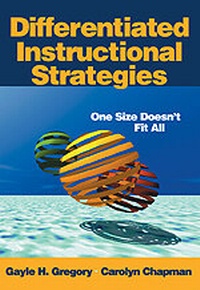
Differentiated Instructional Strategies
One Size Doesn't Fit All
1st Edition
Published on 17. January 2002
Book
Paperback/Softback
160 pages
978-0-7619-4551-2 (ISBN)
Description
Differentiated Instruction enables teachers to plan strategically in order to reach the needs of the diverse learners in classrooms today. In this volume, the authors share techniques for finding the strengths and uniqueness of each child, as well as identifying learning style theories and multiple intelligences along with tools to help teachers better know their students' styles and preferences. Suggestions and examples of effective pre-assessment tools are outlined, as well as ideas for grading and tools to use during and after the learning process.
A practical process is outlined that allows teachers to adjust learning based on students' knowledge, skills, past experiences, preferences and needs. Adjusting, compacting, and grouping are explored, and techniques to form groups and design interactions are examined. The authors discuss the most recent and best practices and pedagogy that make a difference in student achievement, and explore and outline brain-based strategies.
A practical process is outlined that allows teachers to adjust learning based on students' knowledge, skills, past experiences, preferences and needs. Adjusting, compacting, and grouping are explored, and techniques to form groups and design interactions are examined. The authors discuss the most recent and best practices and pedagogy that make a difference in student achievement, and explore and outline brain-based strategies.
Reviews / Votes
A teacher-friendly guide to differentiating instruction based on sound theory and best practice. -- Joanne Quinn, Director of Continuing Education A practical, persuasive, and useful guide. Differentiated Instructional Strategies is highly recommended reading for classroom educators and a seminal contribution to teacher education supplemental reading lists and academic reference collections. -- Midwest Book Review [The book] is highly recommended reading for classroom educators and a seminal contribution to Teacher Education supplemental reading lists and academic reference collections. -- Wisconsin Bookwatch Differentiated Instructional Strategies: One Size Doesn't Fit All provides information about strategies that will enable teachers to plan strategically so they can meet the needs of the wide variety of students in today's highly diverse classroom. Presented in an easy-to-use format, practical techniques and processes are shared that can be used to plan and adjust learning based on pre-assessment of individual students' knowledge, skills, experience, preferences, and needs. -- "Gifted Child Today," January 2003 * January 2003 * My principals use Differentiated Instructional Strategies to design appropriate strategies for evaluating whether the needs of all learners have been met. -- Linda S. Tafel, ProfessorMore details
Language
English
Place of publication
Thousand Oaks
United States
Publishing group
SAGE Publications Inc
Target group
Professional and scholarly
Dimensions
Height: 254 mm
Width: 178 mm
Weight
347 gr
ISBN-13
978-0-7619-4551-2 (9780761945512)
Copyright in bibliographic data and cover images is held by Nielsen Book Services Limited or by the publishers or by their respective licensors: all rights reserved.
Schweitzer Classification
Other editions
New editions
Gayle H. Gregory | Carolyn M. Chapman
Differentiated Instructional Strategies
One Size Doesn't Fit All
Book
10/2006
2nd Edition
Corwin Press Inc
€49.75
Article exhausted; check for reprint
Persons
Gayle H. Gregory is first and foremost a teacher, having experienced teaching and learning in elementary, middle, and secondary schools, community colleges, and universities. She has had extensive district-wide experience as a curriculum consultant and staff development coordinator. Gayle was principal/course director at York University for the Faculty of Education, teaching in the teacher education program.
Her areas of expertise include brain-compatible learning, differentiated instructional and assessment strategies, block scheduling, emotional intelligence, student motivation, RTI Tier One, collaborative learning, common core, renewal of secondary schools, enhancing teacher quality, coaching and mentoring, managing change, and building professional learning communities. She also a trainer for Visible Learning Plus with Corwin.
She is an author of numerous books related to educational neuroscience and differentiated instruction, assessment, and curriculum, including the following titles:
* Data Driven Differentiation in the Standards-Based Classroom, Second Edition (2014, with Lin Kuzmich)
* Differentiated Instructional Strategies: One Size Doesn't Fit All, Third Edition (2013, with Carolyn Chapman)
* Differentiated Instructional Strategies Professional Learning Guide: One Size Doesn't Fit All, Third Edition (2013)
* Differentiated Literacy Strategies for English Language Learners, Grades K-6 and Differentiated Literacy Strategies for English Language Learners, Grades 7-12 (2011, with Amy Burkman)
* Differentiated Instructional Strategies for the Block Schedule (2010, with Lynne E. Herndon)
* Student Teams That Get Results: Teaching Tools for the Differentiated Classroom (2009, with Lin Kuzmich)
* Teacher Teams That Get Results: 61 Strategies for Sustaining and Renewing Professional Learning Communities (2009, with Lin Kuzmich)
* Differentiated Instructional Strategies for Science, Grades K-8 (2009, with Elizabeth Hammerman)
* Differentiating Instruction With Style: Aligning Teacher and Learner Intelligences for Maximum Achievement (2005)
* The Activities for Differentiated Classroom series (2007, with Carolyn Chapman)
She is affiliated with organizations such as ASCD and Learning Forward. Her ASCD publication is The Motivated Brain: Improving Student Attention engagement and Perseverance (2015, with Martha Kaufeldt).
Gayle consults internationally with teachers, administrators, and staff developers.
She and her family of two daughters and two granddaughters all reside in Burlington, Ontario.
Gayle is committed to lifelong learning and professional growth for herself and others. She may be contacted at gregorygayle@netscape.net, www.gaylehgregory.com, and @gaylegregory6.
Carolyn Chapman is an international educational consultant, author, and teacher who has taught in kindergarten to college classrooms. Her interactive, hands-on professional development training sessions challenge educators to use strategies that ensure success for learners of all ages. Chapman has written many books about differentiated instruction, multiple intelligences, multiple assessments, and the brain-compatible classroom. She is coauthor with Gayle Gregory of the landmark Corwin Press book Differentiated Instructional Strategies: One Size Doesn't Fit All.
Her areas of expertise include brain-compatible learning, differentiated instructional and assessment strategies, block scheduling, emotional intelligence, student motivation, RTI Tier One, collaborative learning, common core, renewal of secondary schools, enhancing teacher quality, coaching and mentoring, managing change, and building professional learning communities. She also a trainer for Visible Learning Plus with Corwin.
She is an author of numerous books related to educational neuroscience and differentiated instruction, assessment, and curriculum, including the following titles:
* Data Driven Differentiation in the Standards-Based Classroom, Second Edition (2014, with Lin Kuzmich)
* Differentiated Instructional Strategies: One Size Doesn't Fit All, Third Edition (2013, with Carolyn Chapman)
* Differentiated Instructional Strategies Professional Learning Guide: One Size Doesn't Fit All, Third Edition (2013)
* Differentiated Literacy Strategies for English Language Learners, Grades K-6 and Differentiated Literacy Strategies for English Language Learners, Grades 7-12 (2011, with Amy Burkman)
* Differentiated Instructional Strategies for the Block Schedule (2010, with Lynne E. Herndon)
* Student Teams That Get Results: Teaching Tools for the Differentiated Classroom (2009, with Lin Kuzmich)
* Teacher Teams That Get Results: 61 Strategies for Sustaining and Renewing Professional Learning Communities (2009, with Lin Kuzmich)
* Differentiated Instructional Strategies for Science, Grades K-8 (2009, with Elizabeth Hammerman)
* Differentiating Instruction With Style: Aligning Teacher and Learner Intelligences for Maximum Achievement (2005)
* The Activities for Differentiated Classroom series (2007, with Carolyn Chapman)
She is affiliated with organizations such as ASCD and Learning Forward. Her ASCD publication is The Motivated Brain: Improving Student Attention engagement and Perseverance (2015, with Martha Kaufeldt).
Gayle consults internationally with teachers, administrators, and staff developers.
She and her family of two daughters and two granddaughters all reside in Burlington, Ontario.
Gayle is committed to lifelong learning and professional growth for herself and others. She may be contacted at gregorygayle@netscape.net, www.gaylehgregory.com, and @gaylegregory6.
Carolyn Chapman is an international educational consultant, author, and teacher who has taught in kindergarten to college classrooms. Her interactive, hands-on professional development training sessions challenge educators to use strategies that ensure success for learners of all ages. Chapman has written many books about differentiated instruction, multiple intelligences, multiple assessments, and the brain-compatible classroom. She is coauthor with Gayle Gregory of the landmark Corwin Press book Differentiated Instructional Strategies: One Size Doesn't Fit All.
Content
Acknowledgments
About the Authors
Introduction: One Size Doesn't Fit All
1. Creating a Climate for Learning
2. Knowing the Learner
3. Assessing the Learner
4. Adjusting, Compacting, and Grouping
5. Instructional Strategies for Student Success
6. Curriculum Approaches for Differentiated Classrooms
Bibliography
Index
About the Authors
Introduction: One Size Doesn't Fit All
1. Creating a Climate for Learning
2. Knowing the Learner
3. Assessing the Learner
4. Adjusting, Compacting, and Grouping
5. Instructional Strategies for Student Success
6. Curriculum Approaches for Differentiated Classrooms
Bibliography
Index