

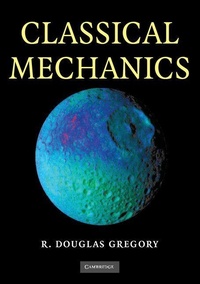
Classical Mechanics
Published on 13. April 2006
Book
Paperback/Softback
606 pages
978-0-521-53409-3 (ISBN)
Description
Gregory's Classical Mechanics is a major new textbook for undergraduates in mathematics and physics. It is a thorough, self-contained and highly readable account of a subject many students find difficult. The author's clear and systematic style promotes a good understanding of the subject: each concept is motivated and illustrated by worked examples, while problem sets provide plenty of practice for understanding and technique. Computer assisted problems, some suitable for projects, are also included. The book is structured to make learning the subject easy; there is a natural progression from core topics to more advanced ones and hard topics are treated with particular care. A theme of the book is the importance of conservation principles. These appear first in vectorial mechanics where they are proved and applied to problem solving. They reappear in analytical mechanics, where they are shown to be related to symmetries of the Lagrangian, culminating in Noether's theorem.
Reviews / Votes
'The writing here is a picture of clarity and directness ... The exercises include plenty of interesting and challenging problems ... an attractive and well-written exposition of classical mechanics. I wish it had been my textbook when I was a student.' Mathematical Association of America 'Gregory's style is clear and concise: his writing is neither overly condensed nor verbose, and the diagrams are clear and illustrative. This textbook should be required reading for any student embarking on an undergraduate course in engineering or physical sciences. I look forward to reading future works by this author.' Contemporary Physics 'I adopted Gregory's Classical Mechanics because it's clear, direct, and focused on what matters. It doesn't waste time with fluff and doesn't talk down to students; it shows the full steps and avoids vague arguments. The explanations build real physical understanding and make good use of geometry to help students picture what's going on. The examples and problems are actually worth doing: well-designed and challenging in a good way.' Munir Pirbhai, St Lawrence UniversityMore details
Language
English
Place of publication
Cambridge
United Kingdom
Target group
College/higher education
Product notice
Paperback (trade)
Illustrations
Worked examples or Exercises; 3 Tables, unspecified; 193 Line drawings, unspecified
Dimensions
Height: 246 mm
Width: 189 mm
Thickness: 33 mm
Weight
1162 gr
ISBN-13
978-0-521-53409-3 (9780521534093)
Copyright in bibliographic data and cover images is held by Nielsen Book Services Limited or by the publishers or by their respective licensors: all rights reserved.
Schweitzer Classification
Other editions
Additional editions
R. Douglas Gregory
Classical Mechanics
Book
04/2006
Cambridge University Press
€84.18
Article exhausted; check for reprint
R. Douglas Gregory
Classical Mechanics
E-Book
04/2006
Cambridge University Press
€45.49
Available for download
R. Douglas Gregory
Classical Mechanics
E-Book
03/2006
1st Edition
Cambridge University Press
€52.99
Available for download
Previous edition
R. Douglas Gregory
Classical Mechanics
Book
04/2006
Cambridge University Press
€84.18
Article exhausted; check for reprint
Person
Douglas Gregory is Professor of Mathematics at the University of Manchester. He is a researcher of international standing in the field of elasticity, and has held visiting positions at New York University, the University of British Columbia, and the University of Washington. He is highly regarded as a teacher of applied mathematics: this, his first book, is the product of many years ' teaching experience.
Content
Part I. Newtonian Mechanics of a Single Particle: 1. The algebra and calculus of vectors; 2. Velocity, acceleration and scalar angular velocity; 3. Newton's laws of motion and the law of gravitation; 4. Problems in particle dynamics; 5. Linear oscillations; 6. Energy conservation; 7. Orbits in a central field; 8. Non-linear oscillations and phase space; Part II. Multi-particle Systems: 9. The energy principle; 10. The linear momentum principle; 11. The angular momentum principle; Part III. Analytical mechanics: 12. Lagrange's equations and conservation principle; 13. The calculus of variations and Hamilton's principle; 14. Hamilton's equations and phase space; Part IV. Further Topics: 15. The general theory of small oscillations; 16. Vector angular velocity and rigid body kinematics; 17. Rotating reference frames; 18. Tensor algebra and the inertia tensor; 19. Problems in rigid body dynamics; Appendix: centres of mass and moments of inertia; Answers to the problems; Bibliography; Index.