

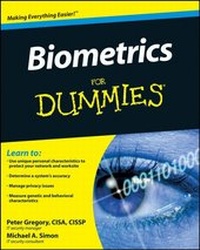
Biometrics For Dummies
1st Edition
Published on 25. July 2008
Book
Paperback/Softback
292 pages
978-0-470-29288-4 (ISBN)
Description
Dig into biometric identification the fun and friendly Dummies way!
Biometrics -- the science of identifying humans based on unique physical characteristics -- is growing in popularity among security experts and security-minded organizations. Once the realm of futurists and sci-fi, biometrics is now commonly used to reliably control whether to let you into a facility or allow you to use a computer system. Here's what it is, what it does, and how to use it.
* No lying eyes -- how scans of the retina and iris establish a person's identity
* "Triple A" gets you there -- understand how to use authentication, authorization, and audit principles
* Security vs. privacy -- how various countries are handling the privacy issues and what can be done to protect citizens' privacy
* Ethics, please -- understand the ethical issues raised by the growing use of biometric information
* Palm reading, 21st century style -- how a scan of the palm, veins in the hand, and sonar imagery establish identity
* Sign here -- what it takes to fully authenticate a signature
* Walk this way -- using gait, speech, linguistic analysis, and other types of behavioral biometrics
* Securing the security -- learn the many vulnerabilities of biometric systems and how to guard against them
Open the book and find:
* Behavioral as well as physiological biometric measures
* Tips for choosing the right biometric system
* What Triple A is and how to use it
* An overview of laws regarding biometrics
* How Heisenberg's Uncertainty Principle affects signatures
* Criteria for setting up an implementation plan
* How facial imaging is used
* A look at where biometrics is heading
Biometrics -- the science of identifying humans based on unique physical characteristics -- is growing in popularity among security experts and security-minded organizations. Once the realm of futurists and sci-fi, biometrics is now commonly used to reliably control whether to let you into a facility or allow you to use a computer system. Here's what it is, what it does, and how to use it.
* No lying eyes -- how scans of the retina and iris establish a person's identity
* "Triple A" gets you there -- understand how to use authentication, authorization, and audit principles
* Security vs. privacy -- how various countries are handling the privacy issues and what can be done to protect citizens' privacy
* Ethics, please -- understand the ethical issues raised by the growing use of biometric information
* Palm reading, 21st century style -- how a scan of the palm, veins in the hand, and sonar imagery establish identity
* Sign here -- what it takes to fully authenticate a signature
* Walk this way -- using gait, speech, linguistic analysis, and other types of behavioral biometrics
* Securing the security -- learn the many vulnerabilities of biometric systems and how to guard against them
Open the book and find:
* Behavioral as well as physiological biometric measures
* Tips for choosing the right biometric system
* What Triple A is and how to use it
* An overview of laws regarding biometrics
* How Heisenberg's Uncertainty Principle affects signatures
* Criteria for setting up an implementation plan
* How facial imaging is used
* A look at where biometrics is heading
More details
Edition
1., Auflage
Language
English
Place of publication
Chichester
United Kingdom
Publishing group
John Wiley and Sons Ltd
Target group
Professional and scholarly
Illustrations
Illustrations
Dimensions
Height: 23.3 cm
Width: 18.7 cm
Thickness: 1.8 cm
Weight
471 gr
ISBN-13
978-0-470-29288-4 (9780470292884)
Schweitzer Classification
Persons
Peter Gregory, CISA, CISSP, is a security and risk manager for a financial services organization and the author of twenty books on security and technology.
Michael A. Simon is a security consultant with experience in the government, military, banking, nonprofit, law enforcement, healthcare, e-commerce, and telecommunications industries.
Michael A. Simon is a security consultant with experience in the government, military, banking, nonprofit, law enforcement, healthcare, e-commerce, and telecommunications industries.
Content
Introduction.
Part I: Getting Started with Biometrics.
Chapter 1: Understanding Biometrics.
Chapter 2: Protecting Assets with Biometrics.
Chapter 3: Biometrics in Our Lives.
Part II: Types of Biometrics.
Chapter 4: Fingerprint and Hand Biometrics.
Chapter 5: Signature Biometrics.
Chapter 6: Retina and Facial Biometrics.
Chapter 7: Other Types of Biometric Identification Schemes.
Part III: Implementing and Using Biometrics.
Chapter 8: Selecting a Biometrics Solution.
Chapter 9: Implementing, Supporting, and Maintaining a Biometrics Solution.
Chapter 10: Securing Biometrics Systems.
Chapter 11: The Future of Biometrics.
Part IV: The Part of Tens.
Chapter 12: Ten Tools Used in Biometrics.
Chapter 13: Ten Biometrics Web Sites.
Chapter 14: Ten Essentials for Biometrics Success.
Chapter 15: Ten Biometrics Scenarios to Plan For.
Chapter 16: Ten Benefits of Biometrics.
Part V: Appendixes.
Appendix A: Comparing Biometrics Solutions.
Appendix B: Controlling Physical Access.
Appendix C: Glossary.
Index.
Part I: Getting Started with Biometrics.
Chapter 1: Understanding Biometrics.
Chapter 2: Protecting Assets with Biometrics.
Chapter 3: Biometrics in Our Lives.
Part II: Types of Biometrics.
Chapter 4: Fingerprint and Hand Biometrics.
Chapter 5: Signature Biometrics.
Chapter 6: Retina and Facial Biometrics.
Chapter 7: Other Types of Biometric Identification Schemes.
Part III: Implementing and Using Biometrics.
Chapter 8: Selecting a Biometrics Solution.
Chapter 9: Implementing, Supporting, and Maintaining a Biometrics Solution.
Chapter 10: Securing Biometrics Systems.
Chapter 11: The Future of Biometrics.
Part IV: The Part of Tens.
Chapter 12: Ten Tools Used in Biometrics.
Chapter 13: Ten Biometrics Web Sites.
Chapter 14: Ten Essentials for Biometrics Success.
Chapter 15: Ten Biometrics Scenarios to Plan For.
Chapter 16: Ten Benefits of Biometrics.
Part V: Appendixes.
Appendix A: Comparing Biometrics Solutions.
Appendix B: Controlling Physical Access.
Appendix C: Glossary.
Index.