

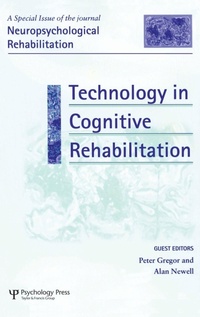
Technology in Cognitive Rehabilitation
A Special Issue of Neuropsychological Rehabilitation
Published on 1. April 2004
Book
Hardback
260 pages
978-1-84169-960-8 (ISBN)
Description
Communication and Information Technology has been used to support older and disabled people for over thirty years and there have been many successes in this field. Until recently, research has largely concentrated on people with physical or sensory dysfunction; computer technology has been increasingly used to support cognitive activities in able bodied people but its use to support people with disabilities has not had much widespread recognition. Yet well-designed C and IT systems have great potential to enhance the quality of life and independence of people with cognitive dysfunction, by: enabling them to retain a higher level of independence and control over their lives, providing appropriate levels of monitoring and supervision of 'at risk' people, without violating privacy, keeping people intellectually and physically active, and providing communications methods to reduce social isolation.
This special issue of Neuropsychological Rehabilitation recognises the potential of information technology to provide support for people with cognitive dysfunction, including the use of computers to provide traditional prostheses, albeit within the cognitive domain. The selection of papers in this issue shows that the help and support available can be far more than the 'artificial replacement of part of the body' (the literal definition of prosthesis) and can include techniques to provide lifestyle support for people who would not be thought of as requiring 'prosthetic support'.
This special issue of Neuropsychological Rehabilitation recognises the potential of information technology to provide support for people with cognitive dysfunction, including the use of computers to provide traditional prostheses, albeit within the cognitive domain. The selection of papers in this issue shows that the help and support available can be far more than the 'artificial replacement of part of the body' (the literal definition of prosthesis) and can include techniques to provide lifestyle support for people who would not be thought of as requiring 'prosthetic support'.
More details
Series
Language
English
Place of publication
Hove
United Kingdom
Publishing group
Taylor & Francis Ltd
Target group
College/higher education
Professional and scholarly
Dimensions
Height: 240 mm
Width: 161 mm
Thickness: 19 mm
Weight
561 gr
ISBN-13
978-1-84169-960-8 (9781841699608)
Copyright in bibliographic data and cover images is held by Nielsen Book Services Limited or by the publishers or by their respective licensors: all rights reserved.
Schweitzer Classification
Other editions
Additional editions
Peter Gregor | Alan Newell
Technology in Cognitive Rehabilitation
A Special Issue of Neuropsychological Rehabilitation
Book
06/2015
1st Edition
Psychology Press Ltd
€78.60
Shipment within 10-20 days
Persons
Peter Gregor, Alan Newell
Content
P. Gregor, A. Newell, Introduction to the Special Issue. E.F. LoPresti, A. Mihailidis, N. Kirsch, Assistive Technology for Cognitive Rehabilitation: State of the Art. T. Manly, J. Heutink, B. Davison, B. Gaynord, E. Greenfield, A. Parr, V. Ridgeway, I.H. Robertson, An Electronic Knot in the Handkerchief: 'Content Free Cueing' and the Maintenance of Attentive Control. E.A. Inglis, A. Szymkowiak, P. Gregor, A.F. Newell, N. Hine, B.A. Wilson, J. Evans, P. Shah, Usable Technology? Challenges in Designing a Memory Aid with Current Electronic Devices. N. Kapur, E.L. Glisky, B.A. Wilson, Technological Memory Aids for People with Memory Deficits. N. Alm, A. Astell, M. Ellis, R. Dye, G. Cowans, J. Campbell, A Cognitive Prosthesis and Communication Support for People with Dementia. A. Mihailidis, J.C. Barbenel, C. Eng, G. Fernie, The Efficacy of an Intelligent Cognitive Orthosis to Facilitate Handwashing by Persons with Moderate to Severe Dementia. D. Gartland, Considerations in the Selection and Use of Technology with People Who Have Cognitive Deficits following Acquired Brain Injury. M.A. Crerar, Aphasia Rehabilitation and the Strange Neglect of Speed. A.A. Rizzo, M. Schultheis, K.A. Kerns, C. Mateer, Analysis of Assets for Virtual Reality Applications in Neuropsychology. A.R. Carmichael, Evaluating Digital 'On-line' Background Noise Suppression: Clarifying Television Dialogue for Older, Hard of Hearing Viewers.