

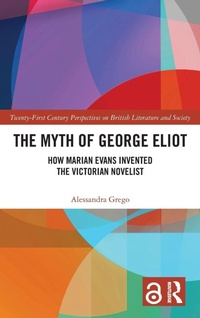
The Myth of George Eliot
How Marian Evans Invented the Victorian Novelist
1st Edition
Will be published approx. on 12. December 2025
Book
Hardback
264 pages
978-1-032-55112-8 (ISBN)
Description
George Eliot is a myth rather than a pseudonym. The writer Marian Evans invented the Victorian novelist as a character with a personality, a political view and a style that was received enthusiastically by the expanding mid-century readership, and just as enthusiastically rejected by the new generation of writers who considered her the last Victorian novelist. "The Myth of George Eliot" proposes that the narrative style and structure of Evans's fiction is the result of her studies, her reflection on the role of literature in the political and ethical life of a nation, and on the novel as the site of a cooperation between writer and reader in the continuous work on inherited traditions. Neither the last Victorian nor the first Modernist, Evans emerges as an author reflecting on the power of collective narratives in an age of democracy.
More details
Series
Language
English
Place of publication
London
United Kingdom
Publishing group
Taylor & Francis Ltd
Target group
College/higher education
Postgraduate
Dimensions
Height: 235 mm
Width: 157 mm
Thickness: 18 mm
Weight
512 gr
ISBN-13
978-1-032-55112-8 (9781032551128)
Copyright in bibliographic data and cover images is held by Nielsen Book Services Limited or by the publishers or by their respective licensors: all rights reserved.
Schweitzer Classification
Other editions
Additional editions
E-Book
12/2025
1st Edition
Routledge
€56.49
Available for download
E-Book
12/2025
1st Edition
Routledge
€56.49
Available for download
Person
Alessandra Grego is Associate Professor of English Literature at John Cabot University in Rome, Italy. She has published "The Spectacle of Monstrosity in the Ballad of the Sad Cafe." Carson McCullers Centenary Collection, ed. by Carlos Dews and Sue B. Walker. 2022. "George Eliot's Use of Scriptural Typology: Incarnation of Ideas," in Myths of Europe, ed. by Richard Littlejohns and Sara Soncini, Amsterdam: Rodopi, 2007. 123- 132. "The Dual Form of Daniel Deronda," Rivista di Studi Vittoriani, vol. 10 (2000): 93-113. With Gabriel Pihas and Daniel Seidel, translation of Orlando, Francesco. Obsolete Objects in the Literary Imagination: Ruins, Relics, Rarities, Rubbish, Uninhabited Places, and Hidden Treasures, Yale University Press, 2006.
Content
List of Abbreviations
Introduction: The Monstrous Author Disembodied
Part I: Myth and Common Sense
Chapter 1: Writing and Translating
Chapter 2: Vanishing
Chapter 3: Surfacing
Part II: Demythologising - Remythologising
Chapter 4. Knights
Chapter 5. Damsels
Chapter 6. Ordinary Sinners
Chapter 7. Parrhesia
Conclusion: Truckling to the Smile of the World
Bibliography
Index
Introduction: The Monstrous Author Disembodied
Part I: Myth and Common Sense
Chapter 1: Writing and Translating
Chapter 2: Vanishing
Chapter 3: Surfacing
Part II: Demythologising - Remythologising
Chapter 4. Knights
Chapter 5. Damsels
Chapter 6. Ordinary Sinners
Chapter 7. Parrhesia
Conclusion: Truckling to the Smile of the World
Bibliography
Index