

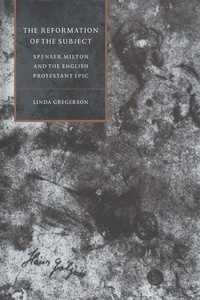
The Reformation of the Subject
Spenser, Milton, and the English Protestant Epic
Published on 14. December 2006
Book
Paperback/Softback
296 pages
978-0-521-03490-6 (ISBN)
Description
The Reformation of the Subject is a study of the cultural contradictions that gave birth to the English Protestant epic. In lucid and theoretically sophisticated language, Linda Gregerson examines the fraught ideological, political and gender conflicts that are woven into the texture of The Faerie Queene and Paradise Lost. She reminds us that Reformation iconoclasts viewed verbal images with the same aversion as visual images, because they too were capable of waylaying the human imagination. Through a series of detailed readings, Gregerson examines the different strategies adopted by Spenser and Milton as they sought to distinguish their poems from idols yet preserve the shaping power that iconoclasts have long attributed to icons. Tracing the transformation of the epic poem into an instrument for the reformation of the political subject, Gregerson thus provides an illuminating contribution to our understanding of the ways in which subjectivities are historically produced.
Reviews / Votes
"Here we have a detailed examination of literary style and achievement in epic poetry that brings Spenser and Milton more clearly into focus." Bibliotheque D'Humanisme "...a worthy 1990s response to the last two English poetic epics." Diane Parkin-Speer, Sixteenth Century JournalMore details
Series
Language
English
Place of publication
Cambridge
United Kingdom
Target group
Professional and scholarly
Product notice
Paperback (trade)
Illustrations
Worked examples or Exercises
Dimensions
Height: 229 mm
Width: 152 mm
Thickness: 18 mm
Weight
484 gr
ISBN-13
978-0-521-03490-6 (9780521034906)
Copyright in bibliographic data and cover images is held by Nielsen Book Services Limited or by the publishers or by their respective licensors: all rights reserved.
Schweitzer Classification
Person
Content
Acknowledgments; Introduction; 1. Emerging likeness: Spenser's mirror sequence of love; 2. The closed image; 3. Narcissus interrupted: specularity and the subject of the Tudor state; 4. The mirror of romance; 5. Fault lines: Milton's mirror of desire; 6. Words made visible: the embodied rhetoric of Satan, Sin and Death; 7. Divine similitude: language in exile; List of works cited; Index.