


The Routledge Handbook of the Psychology of Language Learning and Teaching
1st Edition
Published on 4. October 2024
Book
Paperback/Softback
432 pages
978-1-032-07479-5 (ISBN)
Description
This state-of-the-art volume is the first to capture a hybrid discipline that studies the role and linguistic implications of the human mind in language learning and teaching. This Handbook considers individual as well as collective factors in language learners and teachers from an array of new empirical constructs and theoretical perspectives, including implications for practice and "myths, debates, and disagreements" in the field, and points to future directions for research. This collection of stellar contributions is an essential resource for researchers, advanced students, and teachers working in applied linguistics, second language acquisition, psychology, and education.
More details
Series
Language
English
Place of publication
London
United Kingdom
Publishing group
Taylor & Francis Ltd
Target group
Professional and scholarly
Academic
Illustrations
14 s/w Abbildungen, 14 s/w Zeichnungen, 13 s/w Tabellen
13 Tables, black and white; 14 Line drawings, black and white; 14 Illustrations, black and white
Dimensions
Height: 254 mm
Width: 178 mm
Thickness: 25 mm
Weight
837 gr
ISBN-13
978-1-032-07479-5 (9781032074795)
Copyright in bibliographic data and cover images is held by Nielsen Book Services Limited or by the publishers or by their respective licensors: all rights reserved.
Schweitzer Classification
Other editions
Additional editions
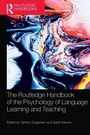
Tammy Gregersen | Sarah Mercer
The Routledge Handbook of the Psychology of Language Learning and Teaching
Book
11/2021
1st Edition
Routledge
€331.90
Shipment within 15-20 days

Tammy Gregersen | Sarah Mercer
The Routledge Handbook of the Psychology of Language Learning and Teaching
E-Book
11/2021
1st Edition
Routledge
€63.49
Available for download

Tammy Gregersen | Sarah Mercer
The Routledge Handbook of the Psychology of Language Learning and Teaching
E-Book
11/2021
1st Edition
Routledge
€63.49
Available for download
Persons
Tammy Gregersen is Professor of TESOL at the American University of Sharjah in the United Arab Emirates.
Sarah Mercer is Professor of Foreign Language Teaching and Head of ELT at the University of Graz, Austria.
Sarah Mercer is Professor of Foreign Language Teaching and Head of ELT at the University of Graz, Austria.
Content
Table of Contents
Part 1: Perspectives on psychology
The cognitive approach- Yuichi Suzuki
Sociocultural theory - Remi Van Compernolle
The humanistic approach - Jane Arnold and Jose Manuel Foncubierta
The complex dynamic approach - Elizabeth Hepford
Positive psychology - Peter MacIntyre and Samantha Ayers-Glassey
Psycholinguistics - Simone E. Pfenninger and Julia Festman
Part 2: Constructs: Teacher and Learner Psychologies
Identity - Ron Darvin and Bonny Norton
Self-efficacy - Kay Irie
Personality - Jean-Marc Dewaele
Motivation - Christine Muir
Engagement - Hayo Reinders & Sachiko Nakamura
Attitudes and beliefs -Amy Thompson
Attributions and mindsets - Xijia Zhang, Nigel Mantou Lou, Kimberly A. Noels and Lia M. Daniels
Emotions - Rebecca Oxford
Wellbeing - Kyle Talbot
Resilience - Phil Hiver and Ana Clara Sanchez Solarte
Self-regulation - Isobel Wang
Vision and goal self-concordance - Alastair Henry
Autonomy and agency - Paula Kalaja and Maria Ruohotie-Lyhty
Willingness to communicate in an L2 - Tomoko Yashima
Part 3: Groups and Communities
Teacher-learner relationships - Christina Gkonou
Group dynamics - Tim Murphey, Yoshifumi Fukada, Tetsuya Fukuda and Joseph Falout
Culture and Intercultural Communication - Tony Johnstone Young, Sara Ganassin and Alina Schartner
Social interaction - Jim King and Sam Morris
Prosocial behaviour and social justice - M. Matilde Olivero
Part 4: Myths, Debates, and Disagreements
Trait and state perspectives on individual difference research - Kata Cszier and Agnes Albert
The social/cognitive Split - Anne Feryok
The mind-body split - Steven G. McCafferty
What counts as evidence? -Yasser Teimouri, Ekaterina Sudina and Luke Plonsky
Language aptitudes - Zhisheng (Edward) Wen
Psychology of learning vs acquisition - Miroslaw Pawlak
Part 1: Perspectives on psychology
The cognitive approach- Yuichi Suzuki
Sociocultural theory - Remi Van Compernolle
The humanistic approach - Jane Arnold and Jose Manuel Foncubierta
The complex dynamic approach - Elizabeth Hepford
Positive psychology - Peter MacIntyre and Samantha Ayers-Glassey
Psycholinguistics - Simone E. Pfenninger and Julia Festman
Part 2: Constructs: Teacher and Learner Psychologies
Identity - Ron Darvin and Bonny Norton
Self-efficacy - Kay Irie
Personality - Jean-Marc Dewaele
Motivation - Christine Muir
Engagement - Hayo Reinders & Sachiko Nakamura
Attitudes and beliefs -Amy Thompson
Attributions and mindsets - Xijia Zhang, Nigel Mantou Lou, Kimberly A. Noels and Lia M. Daniels
Emotions - Rebecca Oxford
Wellbeing - Kyle Talbot
Resilience - Phil Hiver and Ana Clara Sanchez Solarte
Self-regulation - Isobel Wang
Vision and goal self-concordance - Alastair Henry
Autonomy and agency - Paula Kalaja and Maria Ruohotie-Lyhty
Willingness to communicate in an L2 - Tomoko Yashima
Part 3: Groups and Communities
Teacher-learner relationships - Christina Gkonou
Group dynamics - Tim Murphey, Yoshifumi Fukada, Tetsuya Fukuda and Joseph Falout
Culture and Intercultural Communication - Tony Johnstone Young, Sara Ganassin and Alina Schartner
Social interaction - Jim King and Sam Morris
Prosocial behaviour and social justice - M. Matilde Olivero
Part 4: Myths, Debates, and Disagreements
Trait and state perspectives on individual difference research - Kata Cszier and Agnes Albert
The social/cognitive Split - Anne Feryok
The mind-body split - Steven G. McCafferty
What counts as evidence? -Yasser Teimouri, Ekaterina Sudina and Luke Plonsky
Language aptitudes - Zhisheng (Edward) Wen
Psychology of learning vs acquisition - Miroslaw Pawlak