

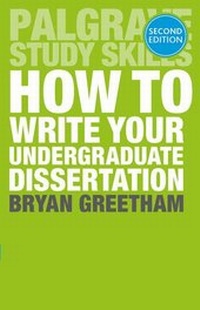
How to Write Your Undergraduate Dissertation
2nd Edition
Published on 13. August 2014
Book
Paperback/Softback
408 pages
978-1-137-38976-3 (ISBN)
Description
Unlike any other book this teaches students how to generate their own ideas and develop them into original research projects. Using examples from all disciplines, it not only teaches students how to plan and research using all the qualitative and quantitative techniques and instruments, but also how to construct arguments and use evidence and language consistently. Throughout it emphasizes that writing is the most difficult form of thinking and dissertations are a test of our ability both to think and write clearly.
More details
Series
Edition
2nd ed. 2014
Language
English
Place of publication
London
United Kingdom
Publishing group
Bloomsbury Publishing PLC
Target group
College/higher education
Edition type
Revised edition
Illustrations
408 p.
Dimensions
Height: 21.6 cm
Width: 13.8 cm
Weight
517 gr
ISBN-13
978-1-137-38976-3 (9781137389763)
DOI
10.1007/978-1-137-38977-0
Schweitzer Classification
Other editions
New editions
Bryan Greetham
How to Write Your Undergraduate Dissertation
Book
03/2019
3rd Edition
Bloomsbury Academic
€22.50
Shipment within 15-20 days
Previous edition
Bryan Greetham
How to Write Your Undergraduate Dissertation
Book
04/2009
Palgrave Macmillan
€17.32
Article exhausted; check for reprint
Person
Bryan Greetham was educated at the universities of Kent and Sussex, UK. He holds a PhD in moral philosophy from the University of Newcastle, Australia. He is currently engaged in research into moral thinking and the Holocaust, and teaches philosophy at the University of Maryland. He is the author of How to Write Better Essays, Thinking Skills for Professionals and Philosophy.
Content
Preface.- Acknowledgements.- 1. Introduction.- PART I: EXAMINERS AND SUPERVISORS 2. Examiners - What Are They Looking For?.- 3. Working With Your Supervisor.- PART II: GENERATING AND DEVELOPING ORIGINAL IDEAS 4. What Activities Suit You Best?.- 5. Types of Research.- 6. What Interests You Most?.- 7. Generating Your Own Ideas 1: Using Trigger Questions.- 8. Generating Your Own Ideas 2: Perspectives and Levels.- 9. Developing Your Ideas 1: Causal Relations.- 10. Developing Your Ideas 2: Conceptual Relations.- 11. Original Questions and Hypotheses 1: Using Analogies.- 12. Original Questions and Hypotheses 2: Working With Your Structures.- PART III: DECIDING ON YOUR PROJECT 13. Searching the Literature 1: Knowing What to Look For.- 14. Searching the Literature 2: How to Search.- 15. Choosing the Topic.- PART IV: ORGANISING YOUR WORK 16. Planning Your Research.- 17. Managing Your Time.- 18. Your Retrieval System.- 19. Reading.- 20. Note-taking.- PART V: DOING YOUR RESEARCH 21. Qualitative and Quantitative Research.- 22. Secondary Sources.- 23. Primary Sources 1: Quantitative Research.- 24. Primary Sources 2: Designing and Distributing Your Questionnaire.- 25. Primary Sources 3: Qualitative Research - Interviews and Focus Groups.- 26. Primary Sources 4: Qualitative Research - Case Studies and Observations.- PART VI: PLANNING YOUR DISSERTATION 27. The Main Components and Introduction.- 28. The Literature Review.- 29. Research Methods, Findings, Conclusions and Appendices.- PART VII: ORGANISING YOUR THINKING 30. Developing Consistent Arguments 1: The Components.- 31. Developing Consistent Arguments 2: The Connections.- 32. Using Evidence 1: Describing It.- 33. Using Evidence 2: Drawing Inferences.- 34. Using Evidence 3: Creating Causal Connections.- 35. Using Language 1: Clarity Jargon.- 36. Using Language 2: Clarity Manipulative Words.- 37. Using Language 3: Consistency.- PART VIII: WRITING YOUR DISSERTATION 38. The First Draft.- 39. Style 1: Finding Your Own Voice.- 40. Style 2: Simplicity and Economy.- PART IX: PLAGIARISM, REFERENCING AND BIBLIOGRAPHIES 41. Plagiarism.- 42. Referencing and Bibliographies.- PART X: EDITING Revision 1: The Structure.- Revision 2: The Content.- Conclusion.