


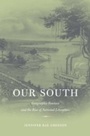
Our South
Geographic Fantasy and the Rise of National Literature
Published on 15. October 2010
Book
Hardback
368 pages
978-0-674-02428-1 (ISBN)
Description
Since the birth of the nation, we have turned to stories about the American South to narrate the rapid ascendency of the United States on the world stage. The idea of a cohesive South, different from yet integral to the United States, arose with the very formation of the nation itself. Its semitropical climate, plantation production, and heterogeneous population once defined the New World from the perspective of Europe. By founding U.S. literature through opposition to the South, writers boldly asserted their nation to stand apart from the imperial world order.
Our South tracks the nation/South juxtaposition in U.S. literature from the founding to the turn of the twentieth century, through genres including travel writing, gothic and romance novels, geography textbooks, transcendentalist prose, and abolitionist address. Even as the southern states became peripheral to U.S. politics and economy, Jennifer Rae Greeson demonstrates that in literature the South remained central to the expanding and evolving idea of the nation.
Claiming the South as our deviant and recalcitrant "other," Americans have projected an anti-imperial imperative of domesticating and civilizing, administering and integrating underdeveloped regions both within our borders and beyond. Our South has been a primal site for thinking about geography and power in the United States.
Our South tracks the nation/South juxtaposition in U.S. literature from the founding to the turn of the twentieth century, through genres including travel writing, gothic and romance novels, geography textbooks, transcendentalist prose, and abolitionist address. Even as the southern states became peripheral to U.S. politics and economy, Jennifer Rae Greeson demonstrates that in literature the South remained central to the expanding and evolving idea of the nation.
Claiming the South as our deviant and recalcitrant "other," Americans have projected an anti-imperial imperative of domesticating and civilizing, administering and integrating underdeveloped regions both within our borders and beyond. Our South has been a primal site for thinking about geography and power in the United States.
Reviews / Votes
A major achievement... With a rich archive extending from the eighteenth century to the twentieth-- at once regional, national, and global-- this is cultural history at its most capacious and compelling. -- Wai Chee Dimock, author of <i>Through Other Continents: American Literature Across Deep Time</i> This is one of the most insightful works of Southern literary and intellectual history of the past two decades-- and its significance transcends the U.S. South. -- Fred Hobson, Professor of English and Lineberger Professor of Humanities, University of North Carolina Impressive in its scope, scale, and originality of construction, Our South offers a new interpretation of the literature of the South within the literary and political history of the United States. A major work. -- Jonathan Arac, author of <i>The Emergence of American Literary Narrative, 1820-1860</i> Wonderfully provocative, very original, deeply learned, [this] book could well change the way scholars approach US culture in the nineteenth century. -- John Stauffer, author of <i>The Black Hearts of Men</i>More details
Language
English
Place of publication
Cambridge, Mass
United States
Target group
College/higher education
Illustrations
18 halftones, 3 maps
Dimensions
Height: 235 mm
Width: 156 mm
ISBN-13
978-0-674-02428-1 (9780674024281)
Copyright in bibliographic data and cover images is held by Nielsen Book Services Limited or by the publishers or by their respective licensors: all rights reserved.
Schweitzer Classification
Other editions
Additional editions
E-Book
10/2010
1st Edition
Harvard University Press
€45.09
Available for download
Person
Jennifer Rae Greeson is Assistant Professor of American Literature at the University of Virginia.