

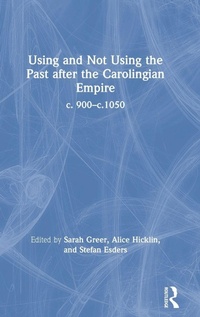
Using and Not Using the Past after the Carolingian Empire
c. 900-c.1050
1st Edition
Published on 29. October 2019
Book
Hardback
308 pages
978-0-367-00251-0 (ISBN)
Description
Using and Not Using the Past after the Carolingian Empire offers a new take on European history from c.900 to c.1050, examining the 'post-Carolingian' period in its own right and presenting it as a time of creative experimentation with new forms of authority and legitimacy.
In the late eighth century, the Frankish king Charlemagne put together a new empire. Less than a century later, that empire had collapsed. The story of Europe following the end of the Carolingian empire has often been presented as a tragedy: a time of turbulence and disintegration, out of which the new, recognisably medieval kingdoms of Europe emerged. This collection offers a different perspective. Taking a transnational approach, the authors contemplate the new social and political order that emerged in tenth- and eleventh-century Europe and examine how those shaping this new order saw themselves in relation to the past. Each chapter explores how the past was used creatively by actors in the regions of the former Carolingian Empire to search for political, legal and social legitimacy in a turbulent new political order.
Advancing the debates on the uses of the past in the early Middle Ages and prompting reconsideration of the narratives that have traditionally dominated modern writing on this period, Using and Not Using the Past after the Carolingian Empire is ideal for students and scholars of tenth- and eleventh-century European history.
In the late eighth century, the Frankish king Charlemagne put together a new empire. Less than a century later, that empire had collapsed. The story of Europe following the end of the Carolingian empire has often been presented as a tragedy: a time of turbulence and disintegration, out of which the new, recognisably medieval kingdoms of Europe emerged. This collection offers a different perspective. Taking a transnational approach, the authors contemplate the new social and political order that emerged in tenth- and eleventh-century Europe and examine how those shaping this new order saw themselves in relation to the past. Each chapter explores how the past was used creatively by actors in the regions of the former Carolingian Empire to search for political, legal and social legitimacy in a turbulent new political order.
Advancing the debates on the uses of the past in the early Middle Ages and prompting reconsideration of the narratives that have traditionally dominated modern writing on this period, Using and Not Using the Past after the Carolingian Empire is ideal for students and scholars of tenth- and eleventh-century European history.
Reviews / Votes
Many of the contributors present unique approaches to their topics; some bring little-known texts to the light; some force a reassessment of well-known sources. What this book does do, and does well, is demonstrate the necessity of reconsidering the traditional historiography of the post-Carolingian world, while providing a multifaceted view of the many different approaches and methodologies that can be used to explore it.Laura Wangerin, Seton Hall University, Early Medieval Europe 2022 30 (4)
More details
Language
English
Place of publication
London
United Kingdom
Publishing group
Taylor & Francis Ltd
Target group
College/higher education
Illustrations
6 s/w Photographien bzw. Rasterbilder, 1 s/w Zeichnung, 5 s/w Tabellen
5 Tables, black and white; 1 Line drawings, black and white; 6 Halftones, black and white
Dimensions
Height: 240 mm
Width: 161 mm
Thickness: 22 mm
Weight
649 gr
ISBN-13
978-0-367-00251-0 (9780367002510)
Copyright in bibliographic data and cover images is held by Nielsen Book Services Limited or by the publishers or by their respective licensors: all rights reserved.
Schweitzer Classification
Other editions
Additional editions
Sarah Greer | Alice Hicklin | Stefan Esders
Using and Not Using the Past after the Carolingian Empire
c. 900-c.1050
Book
10/2019
1st Edition
Routledge
€59.41
Shipment within 15-20 days
Sarah Greer | Alice Hicklin | Stefan Esders
Using and Not Using the Past after the Carolingian Empire
c. 900-c.1050
E-Book
10/2019
1st Edition
Routledge
€63.49
Available for download
Sarah Greer | Alice Hicklin | Stefan Esders
Using and Not Using the Past after the Carolingian Empire
c. 900-c.1050
E-Book
10/2019
1st Edition
Routledge
€63.49
Available for download
Persons
Sarah Greer is a post-doctoral fellow at the University of St Andrews. Her research explores the relationships between memory and power in the long tenth century.
Alice Hicklin is a post-doctoral fellow at the Freie Universitaet Berlin. Her research compares legal and diplomatic practices throughout western Europe in the early middle ages.
Stefan Esders is professor of Late Antique and Early Medieval History at the Freie Universitaet Berlin, specialising in legal history. He has recently co-edited East and West in the Early Middle Ages: The Merovingian Kingdoms in Mediterranean Perspective (2019) with Yaniv Fox, Yitzhak Hen and Laury Sarti.
Alice Hicklin is a post-doctoral fellow at the Freie Universitaet Berlin. Her research compares legal and diplomatic practices throughout western Europe in the early middle ages.
Stefan Esders is professor of Late Antique and Early Medieval History at the Freie Universitaet Berlin, specialising in legal history. He has recently co-edited East and West in the Early Middle Ages: The Merovingian Kingdoms in Mediterranean Perspective (2019) with Yaniv Fox, Yitzhak Hen and Laury Sarti.
Content
1) Introduction; Past Narratives; 2) The Future of History after Empire; 3) Remembering Troubled Pasts: Episcopal Deposition and Succession in Flodoard's History of the Church of Rheims; 4) In the Shadow of Rome: After Empire in the late-tenth-century Chronicle of Benedict of Monte Soratte; 5) Infiltrating the Local Past: Supra-regional Players in Local Hagiography from Trier in the Ninth and Tenth centuries; 6) After the Fall: Lives of Texts and Lives of Modern Scholars in the Historiography of the Post-Carolingian World; Inscribing Memories;7) How Carolingian was Early Medieval Catalonia?; 8) Orchestrating Harmony: Litanies, Queens, and Discord in the Carolingian and Ottonian Empires; 9) Models of marriage charters in a notebook of Ademar of Chabannes (ninth-eleventh century); 10) All in the Family: Creating a Carolingian Genealogy in the Eleventh Century; 11) 'Charles's stirrups hang down from Conrad's saddle': Reminiscences of Carolingian Oath Practice under Conrad II (1024-1039); Recalling Communities; 12) Notions of Belonging. Some Observations on Solidarity in the Late- and Post Carolingian World; 13) Bishops, Canon Law, and the Politics of Belonging in Post-Carolingian Italy, c. 930-c. 960; 14) Migrant Masters and their Books. Italian Scholars and Knowledge Transfer in post-Carolingian Europe; 15) The Dignity of Our Bodies and the Salvation of Our Souls. Scandal, Purity, and the Pursuit of Unity in Late Tenth-Century Monasticism; 16) Law and Liturgy: Excommunication Records, 900-1050