

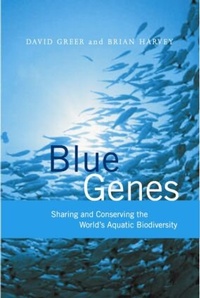
Blue Genes
Sharing and Conserving the World's Aquatic Biodiversity
1st Edition
Will be published approx. on 1. September 2004
Book
Paperback/Softback
248 pages
978-1-84407-106-7 (ISBN)
Description
The advance of genetic sciences has led to a 'blue revolution' in the way we use aquatic biodiversity. By 2020, the world will be eating almost as much farmed as wild fish, marine bacteria could yield the cure for cancer and deep-sea bacteria may be exploited to gobble up oil spills. Science is moving ahead at a staggering speed, and the demand for genetic resources is growing rapidly - yet governance and policy lag far behind.
This groundbreaking work is the first to look at the ownership, governance and trade in aquatic genetic resources. Blue Genes describes the growing demand for aquatic genetic resources and the desperate need to fill the policy vacuum about the management and conservation of aquatic biodiversity, which would help create a foundation for rules dictating access to, and use of, aquatic genetic resources. Special attention is paid to indigenous and local people having the right to access these resources and their role in managing and conserving aquatic biodiversity. The book concludes with policy recommendations specifically tailored to aquatic resources, with the use of six case studies from four continents to illustrate key issues.
This groundbreaking work is the first to look at the ownership, governance and trade in aquatic genetic resources. Blue Genes describes the growing demand for aquatic genetic resources and the desperate need to fill the policy vacuum about the management and conservation of aquatic biodiversity, which would help create a foundation for rules dictating access to, and use of, aquatic genetic resources. Special attention is paid to indigenous and local people having the right to access these resources and their role in managing and conserving aquatic biodiversity. The book concludes with policy recommendations specifically tailored to aquatic resources, with the use of six case studies from four continents to illustrate key issues.
Reviews / Votes
'This is just what the doctor ordered: a sensible, balanced and comprehensive overview of how countries can manage their aquatic resources in the biotechnology age.'Jeffrey A McNeely, Chief Scientist, IUCN
'A wonderfully written and sorely needed guide to the promise of aquatic genetic resources... brimming with important pointers of ways to realize the potential of the little appreciated and frequently abused aquatic genetic resources.'
Thomas Lovejoy, President of the Heinz Center for Science, Economics and the Environment
More details
Language
English
Place of publication
London
United Kingdom
Publishing group
Taylor & Francis Ltd
Target group
Professional and scholarly
Dimensions
Height: 234 mm
Width: 156 mm
Weight
418 gr
ISBN-13
978-1-84407-106-7 (9781844071067)
Copyright in bibliographic data and cover images is held by Nielsen Book Services Limited or by the publishers or by their respective licensors: all rights reserved.
Schweitzer Classification
Other editions
Additional editions
E-Book
06/2013
1st Edition
Routledge
€55.49
Available for download
E-Book
06/2013
1st Edition
Routledge
€55.49
Available for download
Book
09/2004
1st Edition
Earthscan Ltd
€245.12
Article not available at the moment
Persons
David Greer is an independent legal consultant specializing in natural resources and biodiversity management policy. Brian Harvey is a fisheries biologist and President of World Fisheries Trust.
Content
The Gene Rush: Finding New Value in Aquatic Biodiversity * Managing Aquatic Resources: Tools and Policy Gaps * Whose to Share * Ownership and Control of Aquatic Resources * Thinking Locally: Rights of Indigenous and Local Communities * Acting Globally: National Laws on Access to Aquatic Resources * Results that Count: Meaningful Benefits for Fishing Communities * Putting Principles into Practice * Notes * References * Index