

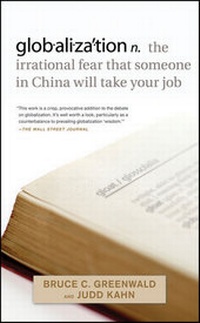
globalization
n. the irrational fear that someone in China will take your job
1st Edition
Published on 15. October 2010
Book
Paperback/Softback
208 pages
978-0-470-63243-7 (ISBN)
Description
In Globalization, authors Bruce Greenwald and Judd Kahn cut through the myths surrounding globalization and look more closely at its real impact, presenting a more accurate picture of the present status of globalization and its future consequences. Page by page, they uncover the real facts about globalization and answer the most important questions it raises, including: Will globalization increase or diminish in economic importance? Do higher living standards depend more on global or local conditions- and What are the actual implications of globalization for financial markets?
More details
Product info
PB
Edition
1., Auflage
Language
English
Place of publication
New York
United States
Product notice
Paperback (trade)
Unsewn / adhesive bound
Illustrations
Drawings: 1 B&W, 0 Color; Tables: 38 B&W, 0 Color
Dimensions
Height: 216 mm
Width: 140 mm
Thickness: 12 mm
Weight
271 gr
ISBN-13
978-0-470-63243-7 (9780470632437)
Schweitzer Classification
Other editions
Additional editions
Bruce C. N. Greenwald | Judd Kahn
globalization
n. the irrational fear that someone in China will take your job
E-Book
12/2008
Wiley
from
€10.99
Available for download
Bruce C. N. Greenwald | Judd Kahn
globalization
the irrational fear that someone in China will take your job
Book
11/2008
Wiley
€28.90
Article exhausted; check different version
Bruce C. N. Greenwald | Judd Kahn
globalization
n. the irrational fear that someone in China will take your job
E-Book
11/2008
Wiley
€10.99
Available for download
Persons
Bruce C. Greenwald, PhD, currently serves as the Robert Heilbrunn Professor of Finance and Asset Management at Columbia University's Graduate School of Business.
Judd Kahn, PhD, is currently COO of Summit Street Capital Management, LLC. They also coauthored Value Investing: From Graham to Buffett and Beyond and Competition Demystified.
Content
Acknowledgments.
Introduction: Just How Global Are We?
Chapter 1: It May Be News, But It Isn't New: A Brief History of Globalization.
Tradable Goods.
From Goods to Services.
Which Services Remain Rooted?
Why So Newsworthy?
Chapter 2: Countries Control Their Fates: How Little Globalization Explains.
Who Calls the Shots?
An Inadvertent Experiment.
The Uneven Course of Manufacturing.
The Recipe for Productivity Growth.
Importance of Incremental Improvements.
Tell Me Again: Why Is China Rising?
Episodic Improvements and Retreats.
Widely Shared Diversions.
What About Free Trade?
Keep It Local.
Chapter 3: Employment Trends for Globalization 3.0: Are All the Good Jobs Going Away?
Recent History as a Guide.
Recent Patterns of Employment and Unemployment in the United States.
The Changing Nature of Work.
The Meaning Is in the Details.
That Giant Sucking Sound Is Coming from.
But Will the Future Be Different?
What about Wages?
Chapter 4: Can We Make Any Money?: What Globalization Does to Profi ts.
Companies Under Globalization 3.0.
Why Some Companies Are Profi table.
Profi ts in Competitive Markets: Low Before Globalization, and Low After.
Profi ts in Protected Markets: Do They Survive?
How to Keep Competitors Out.
The Special Role of Economies of Scale Advantages.
Competitive Advantages in a Global World.
The Future of Profitability.
Chapter 5: International Finance in a Global World: Home Field Advantage.
Flow of Funds.
Foreign Direct Investment: Not Where the Action Is.
Financial Markets and Portfolio Investment: Not Here, Either.
Institutions as Investors: These Do Matter.
Safer at Home: Financial Markets and the Limits of Globalization.
Global Capital Markets and Economic Development: More Headlines Than Production Lines.
Chapter 6: A Genuine Global Economic Problem: Replacing the Consumer of Last Resort.
The Link between Reserve Currencies and Global Financial Stability.
Chronic Surplus Countries and Monetary Mercantilism.
The Global Financial System and Global Economic Stability.
The Situation of the United States.
A Modest Proposal for a New Reserve Currency.
Conclusion: Beyond Economics.
Globalization and Everything Else.
One Last Question.
Notes.
About the Authors.
Index.