

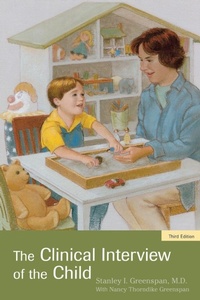
The Clinical Interview of the Child
3rd Edition
Published on 21. June 2003
Book
Paperback/Softback
312 pages
978-1-58562-137-8 (ISBN)
Description
Ideal for both novices and advanced practitioners, the new
edition of Stanley Greenspan's classic guide outlines a practical process
for observing and interviewing children-and organizing and interpreting
their unfolding communications.
Highly acclaimed, The Clinical
Interview of the Child uses actual interviews with children to show
readers how to
* Apply a developmental, biopsychosocial framework for understanding
the inner lives of children at different ages and stages
* Observe and
assess human development, including emotional and cognitive patterns and
perceptual capacities
* Help infants and children to reveal their
feelings, thoughts, and behaviors during the clinical interview
*
Organize and interpret the interview data by constructing a developmental
profile and translating it into DSM-IV-TR diagnostic categories
The
third edition has been expanded and revised extensively, with updated
theoretical and conceptual foundations; information on higher levels of ego
development and reflective and thinking capacities of older children; and a
new section on a developmental biopsychosocial model-the developmental,
individual-difference, relationship-based (DIR) approach.
An
invaluable educational and practical resource, The Clinical Interview of
the Child, Third Edition, is an ideal tool for psychiatrists and
psychologists, pediatricians, educators, social workers, speech
pathologists, occupational therapists, and judges and attorneys dealing with
children and families.
edition of Stanley Greenspan's classic guide outlines a practical process
for observing and interviewing children-and organizing and interpreting
their unfolding communications.
Highly acclaimed, The Clinical
Interview of the Child uses actual interviews with children to show
readers how to
* Apply a developmental, biopsychosocial framework for understanding
the inner lives of children at different ages and stages
* Observe and
assess human development, including emotional and cognitive patterns and
perceptual capacities
* Help infants and children to reveal their
feelings, thoughts, and behaviors during the clinical interview
*
Organize and interpret the interview data by constructing a developmental
profile and translating it into DSM-IV-TR diagnostic categories
The
third edition has been expanded and revised extensively, with updated
theoretical and conceptual foundations; information on higher levels of ego
development and reflective and thinking capacities of older children; and a
new section on a developmental biopsychosocial model-the developmental,
individual-difference, relationship-based (DIR) approach.
An
invaluable educational and practical resource, The Clinical Interview of
the Child, Third Edition, is an ideal tool for psychiatrists and
psychologists, pediatricians, educators, social workers, speech
pathologists, occupational therapists, and judges and attorneys dealing with
children and families.
Reviews / Votes
This book is an outstanding introduction to the theory ofmental development. It contributes greatly to the literature by providing a
model for assessment and treatment based upon a developmental
biopsychosocial framework. -- Elliott Pae, M.D., * Doody's Health Science Book Review * Throughout the text, there are many examples of how [Dr.
Greenspan] handles given situations, what words he speaks, and how he
specifically approaches a given situation. It is at those moments that one
best listens in on an expert at work. For the child and adolescent
psychiatrist just starting out, these vignettes are true pearls to
apply. -- Sonya Marie Vieira, M.D. and A. Reese Albright, M.D. * Journal of the American Academy of Child and Adolescent Psychiatry *
More details
Edition
Third Edition
Language
English
Place of publication
VA
United States
Target group
Professional and scholarly
College/higher education
US School Grade: College Graduate Student and over
Edition type
Revised edition
Product notice
Paperback (trade)
Illustrations
5 Tables, unspecified
Dimensions
Height: 230 mm
Width: 162 mm
Thickness: 20 mm
Weight
503 gr
ISBN-13
978-1-58562-137-8 (9781585621378)
Copyright in bibliographic data and cover images is held by Nielsen Book Services Limited or by the publishers or by their respective licensors: all rights reserved.
Schweitzer Classification
Other editions
Additional editions
Stanley I. Greenspan
The Clinical Interview of the Child
E-Book
05/2008
3rd Edition
American Psychiatric Association Publishing
€64.49
Available for download
Previous edition

Book
01/1994
American Psychological Association
€48.46
Article exhausted; check for reprint
Persons
Stanley I. Greenspan, M.D., is Clinical Professor of
Psychiatry, Behavioral Sciences, and Pediatrics at the George Washington
University Medical School, Chairman of the Interdisciplinary Council on
Developmental and Learning Disorders, and a supervising Child Psychoanalyst
at the Washington Psychoanalytic Institute. He was previously Chief of the
Mental Health Study Center and Director of the Clinical Infant Development
Program at the National Institute of Mental Health. A founder and former
president of ZERO TO THREE: National Center for Infants, Toddlers, and
Families, Dr. Greenspan has been honored with a number of national awards,
including the American Psychiatric Association's Ittleson Prize for
outstanding contributions to Child Psychiatry Research and the American
Orthopsychiatric Association's Ittleson Prize for outstanding contributions
to American mental health-the only individual to receive both Ittleson
awards-and the Strecker Award for outstanding contributions to American
psychiatry. He is the author or editor of more than 35 books and monographs
and 100 articles and chapters.
Nancy Thorndike Greenspan , a
former health economist, writes about children's development and is
currently working on a biography of Max Born, the Nobel Peace Prize winning
physicist and one of the pioneers in the development of quantum mechanics.
She also works on environmental issues.
Psychiatry, Behavioral Sciences, and Pediatrics at the George Washington
University Medical School, Chairman of the Interdisciplinary Council on
Developmental and Learning Disorders, and a supervising Child Psychoanalyst
at the Washington Psychoanalytic Institute. He was previously Chief of the
Mental Health Study Center and Director of the Clinical Infant Development
Program at the National Institute of Mental Health. A founder and former
president of ZERO TO THREE: National Center for Infants, Toddlers, and
Families, Dr. Greenspan has been honored with a number of national awards,
including the American Psychiatric Association's Ittleson Prize for
outstanding contributions to Child Psychiatry Research and the American
Orthopsychiatric Association's Ittleson Prize for outstanding contributions
to American mental health-the only individual to receive both Ittleson
awards-and the Strecker Award for outstanding contributions to American
psychiatry. He is the author or editor of more than 35 books and monographs
and 100 articles and chapters.
Nancy Thorndike Greenspan , a
former health economist, writes about children's development and is
currently working on a biography of Max Born, the Nobel Peace Prize winning
physicist and one of the pioneers in the development of quantum mechanics.
She also works on environmental issues.
Content
About the Authors
Chapter 1. Conceptual Foundations: An
Overview
Chapter 2. Framework for Systematic Observation of the
Child
Chapter 3. Chronological Age- and Phase-Appropriate Illustrations
for Each Observational Category
Chapter 4. Clinical Illustrations of
Interviews With Children
Chapter 5. Conducting the Interview
Chapter
6. Constructing a Formulation Based on a Developmental Approach
Chapter
7. Interviewing the Parents: Selected Comments
Appendix: A Developmental
Biopsychosocial Model for Assessment and
Treatment
References
Index
Chapter 1. Conceptual Foundations: An
Overview
Chapter 2. Framework for Systematic Observation of the
Child
Chapter 3. Chronological Age- and Phase-Appropriate Illustrations
for Each Observational Category
Chapter 4. Clinical Illustrations of
Interviews With Children
Chapter 5. Conducting the Interview
Chapter
6. Constructing a Formulation Based on a Developmental Approach
Chapter
7. Interviewing the Parents: Selected Comments
Appendix: A Developmental
Biopsychosocial Model for Assessment and
Treatment
References
Index