

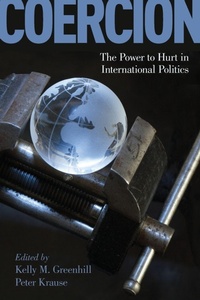
Coercion
The Power to Hurt in International Politics
Published on 22. February 2018
Book
Paperback/Softback
384 pages
978-0-19-084634-3 (ISBN)
Description
From the rising significance of non-state actors to the increasing influence of regional powers, the nature and conduct of international politics has arguably changed dramatically since the height of the Cold War. Yet much of the literature on deterrence and compellence continues to draw (whether implicitly or explicitly) upon assumptions and precepts formulated in-and predicated upon-politics in a state-centric, bipolar world.
Coercion moves beyond these somewhat hidebound premises and examines the critical issue of coercion in the 21st century, with a particular focus on new actors, strategies and objectives in this very old bargaining game. The chapters in this volume examine intra-state, inter-state, and transnational coercion and deterrence as well as both military and non-military instruments of persuasion, thus expanding our understanding of coercion for conflict in the 21st century.
?
Scholars have analyzed the causes, dynamics, and effects of coercion for decades, but previous works have principally focused on a single state employing conventional military means to pressure another state to alter its behavior. In contrast, this volume captures fresh developments, both theoretical and policy relevant. This chapters in this volume focus on tools (terrorism, sanctions, drones, cyber warfare, intelligence, and forced migration), actors (insurgents, social movements, and NGOs) and mechanisms (trilateral coercion, diplomatic and economic isolation, foreign-imposed regime change, coercion of nuclear proliferators, and two-level games) that have become more prominent in recent years, but which have yet to be extensively or systematically addressed in either academic or policy literatures.
Coercion moves beyond these somewhat hidebound premises and examines the critical issue of coercion in the 21st century, with a particular focus on new actors, strategies and objectives in this very old bargaining game. The chapters in this volume examine intra-state, inter-state, and transnational coercion and deterrence as well as both military and non-military instruments of persuasion, thus expanding our understanding of coercion for conflict in the 21st century.
?
Scholars have analyzed the causes, dynamics, and effects of coercion for decades, but previous works have principally focused on a single state employing conventional military means to pressure another state to alter its behavior. In contrast, this volume captures fresh developments, both theoretical and policy relevant. This chapters in this volume focus on tools (terrorism, sanctions, drones, cyber warfare, intelligence, and forced migration), actors (insurgents, social movements, and NGOs) and mechanisms (trilateral coercion, diplomatic and economic isolation, foreign-imposed regime change, coercion of nuclear proliferators, and two-level games) that have become more prominent in recent years, but which have yet to be extensively or systematically addressed in either academic or policy literatures.
Reviews / Votes
"Greenhill and Krause offer an important addition to the study of deterrence and compellence in international relations...This volume is an excellent addition to the study of coercion in international relations and offers new avenues for scholarly debate and research. Highly recommended." -CHOICE"Coercion is central to international politics and this collection does an excellent job of mapping the terrain both conceptually and empirically. Each essay is well done and the topics are well chosen. The volume will be of great benefit to all who study international security." -Robert Jervis, author of How Statesmen Think
"This volume takes a fresh but focused look at coercion in our time. Together the chapters constitute a creative and economical (re-) introduction to an enduring tool of international, and sometimes domestic, politics." -Barry R. Posen, Ford International Professor of Political Science and Director of the Security Studies Program, MIT
"By far, this is the most comprehensive, authoritative, and wide-ranging treatment of the topic of coercion in international politics. Greenhill and Krause have produced a truly extraordinary volume containing a staggering array of exceptional chapters by key scholars in the field. A truly essential text for any student of global affairs." - Erica Chenoweth, Professor, Josef Korbel School of International Studies, University of Denver
More details
Language
English
Place of publication
New York
United States
Target group
Professional and scholarly
Dimensions
Height: 234 mm
Width: 156 mm
Thickness: 23 mm
Weight
652 gr
ISBN-13
978-0-19-084634-3 (9780190846343)
Copyright in bibliographic data and cover images is held by Nielsen Book Services Limited or by the publishers or by their respective licensors: all rights reserved.
Schweitzer Classification
Other editions
Additional editions

Book
02/2018
Oxford University Press Inc
€196.20
Shipment within 15-20 days

E-Book
12/2017
1st Edition
OUP eBook
€41.49
Available for download

E-Book
12/2017
1st Edition
OUP eBook
€41.49
Available for download
Persons
Kelly M. Greenhill is Associate Professor and Director of International Relations at Tufts University and Research Fellow at Harvard University. She is author of Weapons of Mass Migration: Forced Displacement, Coercion and Foreign Policy, winner of the 2011 International Studies Association Best Book of the Year Award, and numerous other books, articles and opinion pieces on international security and foreign policy. As a 2017 National Endowment for the Humanities Fellow, Greenhill is completing a new book on the influence of rumors, conspiracy theories, propaganda and other sources of "extra-factual information" in international politics.
Peter Krause is an assistant professor of political science at Boston College and a Research Affiliate with the MIT Security Studies Program. He is the author of Rebel Power: Why National Movements Compete, Fight and Win (Ithaca: Cornell University Press, 2017) and has published articles on the threat of terrorism, modern territorial conquest, the effectiveness of political violence, U.S. intervention in the Syrian civil war, and the war of ideas in the Middle East. Krause has conducted extensive fieldwork throughout the Middle East over the past decade. He regularly offers his analysis of Middle East politics and political violence with national and local media. You can read more about Peter Krause and his research at peterjpkrause.com.
Peter Krause is an assistant professor of political science at Boston College and a Research Affiliate with the MIT Security Studies Program. He is the author of Rebel Power: Why National Movements Compete, Fight and Win (Ithaca: Cornell University Press, 2017) and has published articles on the threat of terrorism, modern territorial conquest, the effectiveness of political violence, U.S. intervention in the Syrian civil war, and the war of ideas in the Middle East. Krause has conducted extensive fieldwork throughout the Middle East over the past decade. He regularly offers his analysis of Middle East politics and political violence with national and local media. You can read more about Peter Krause and his research at peterjpkrause.com.
Content
Introduction
Kelly M. Greenhill and Peter Krause
Part I: Coercion: A Primer
1. Coercion: An Analytical Overview
Robert J. Art and Kelly M. Greenhill
2. Intelligence and Coercion: A Neglected Connection
Austin Long
Part II: Coercion in an Asymmetric World
3. A Bargaining Theory of Coercion
Todd S. Sechser
4. Airpower, Sanctions, Coercion and Containment: When Foreign Policy Objectives Collide Philip W. Haun
5. Step Aside or Face the Consequences: Explaining the Success and Failure of Compellent
Threats to Remove Foreign Leaders
Alexander B. Downes
Part III: Coercion and Non-state Actors
6. Underestimating Weak States and State Sponsors: The Case for Base State Coercion Keren Fraiman
7. Coercion by Movement: How Power Drove the Success of the Eritrean Insurgency, 1960-1993 Peter Krause
8. Is Technology the Answer? The Limits of Combat Drones in Countering Insurgents James Igoe Walsh
Part IV: Domains and Instruments Other than Force
9. Coercion through Cyberspace: The Stability-Instability Paradox Revisited
Jon R. Lindsay and Erik Gartzke
10. Migration as a Coercive Weapon: New Evidence from the Middle East
Kelly M. Greenhill
11. The Strategy of Coercive Isolation
Timothy W. Crawford
12. Economic Sanctions in Theory and Practice: How Smart Are They?
Daniel Drezner
13. Prices or Power Politics: When and Why States Coercively Compete over Resources
Jonathan Markowitz
Part V: Nuclear Coercion
14. Deliberate Escalation: Nuclear Strategies to Deter or to Stop Conventional Attacks
Jasen J. Castillo
15. Threatening Proliferation: The Goldilocks Principle of Bargaining with Nuclear Latency
Tristan Volpe
Conclusion
Kelly M. Greenhill and Peter Krause
Kelly M. Greenhill and Peter Krause
Part I: Coercion: A Primer
1. Coercion: An Analytical Overview
Robert J. Art and Kelly M. Greenhill
2. Intelligence and Coercion: A Neglected Connection
Austin Long
Part II: Coercion in an Asymmetric World
3. A Bargaining Theory of Coercion
Todd S. Sechser
4. Airpower, Sanctions, Coercion and Containment: When Foreign Policy Objectives Collide Philip W. Haun
5. Step Aside or Face the Consequences: Explaining the Success and Failure of Compellent
Threats to Remove Foreign Leaders
Alexander B. Downes
Part III: Coercion and Non-state Actors
6. Underestimating Weak States and State Sponsors: The Case for Base State Coercion Keren Fraiman
7. Coercion by Movement: How Power Drove the Success of the Eritrean Insurgency, 1960-1993 Peter Krause
8. Is Technology the Answer? The Limits of Combat Drones in Countering Insurgents James Igoe Walsh
Part IV: Domains and Instruments Other than Force
9. Coercion through Cyberspace: The Stability-Instability Paradox Revisited
Jon R. Lindsay and Erik Gartzke
10. Migration as a Coercive Weapon: New Evidence from the Middle East
Kelly M. Greenhill
11. The Strategy of Coercive Isolation
Timothy W. Crawford
12. Economic Sanctions in Theory and Practice: How Smart Are They?
Daniel Drezner
13. Prices or Power Politics: When and Why States Coercively Compete over Resources
Jonathan Markowitz
Part V: Nuclear Coercion
14. Deliberate Escalation: Nuclear Strategies to Deter or to Stop Conventional Attacks
Jasen J. Castillo
15. Threatening Proliferation: The Goldilocks Principle of Bargaining with Nuclear Latency
Tristan Volpe
Conclusion
Kelly M. Greenhill and Peter Krause