

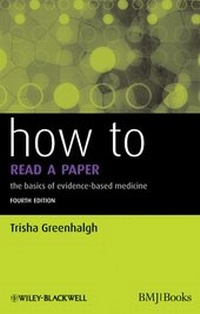
How to Read a Paper
The Basics of Evidence-Based Medicine
4th Edition
Published on 7. May 2010
Book
Paperback/Softback
256 pages
978-1-4443-3436-4 (ISBN)
Description
How to Read a Paper describes the different types of clinical research reporting, and explains how to critically appraise the publications. The book provides the tools to find and evaluate the literature, and implement the findings in an evidence-based, patient-centered way. Written for anyone in the health care professions who has little or no knowledge of evidence-based medicine, it provides a clear understanding of the concepts and how to put them into practice at the basic, clinical level.
Changes for the 4th edition
The fourth edition will include two new chapters on important developments in health care research and delivery, but otherwise retains its original style, size, and scope.
* New chapter on quality improvement - describing papers on quality improvement projects using ebm methods; this will extend the readership to non clinical health care professionals working in hospitals and family practice, and to nurse specialists and practice nurses working in this field
* New chapter on complex interventions - how to set up research projects involving both qualitative and quantitative methodology (known as mixed methods)
* Thorough revision and updating of existing chapters and references
* New illustrations - diagrammatic representations of ebm concepts
Changes for the 4th edition
The fourth edition will include two new chapters on important developments in health care research and delivery, but otherwise retains its original style, size, and scope.
* New chapter on quality improvement - describing papers on quality improvement projects using ebm methods; this will extend the readership to non clinical health care professionals working in hospitals and family practice, and to nurse specialists and practice nurses working in this field
* New chapter on complex interventions - how to set up research projects involving both qualitative and quantitative methodology (known as mixed methods)
* Thorough revision and updating of existing chapters and references
* New illustrations - diagrammatic representations of ebm concepts
Reviews / Votes
"Writing for health students and professionals, and anyone wanting to assess the validity of articles, Greenhalgh (primary health care, Queen Mary, U. of London, UK) explains the principles of evidencebased medicine and how to critically evaluate clinical research papers. She details how to evaluate different types of papers, such as papers on drug treatments and simple interventions, diagnostic and screening tests, those that summarize other papers, guidelines, economic analyses, and qualitative research." (Book News, September 2010) Trisha Greenhalgh is a doctor, not a statistician, and she is writing about a topic, Evidence-Based Medicine (EBM) that might appear at first to be irrelevant to us statisticians. It is not irrelevant. Any statistician who works extensively with health care professionals should embrace the EBM movement." (Journal of Biopharmaceutical Statistics , 2011) "The book does show you how to put your brain into thinking gear and not just absorb information without thinking about it making this an excellent book. If I can react so strongly in this review, then it has to be worth something." (SFCrowsnest.co.uk, July 2010)More details
Series
Edition
4., Auflage
Language
English
Place of publication
Chicester
United Kingdom
Publishing group
John Wiley and Sons Ltd
Target group
Professional and scholarly
Edition type
Revised edition
Illustrations
Illustrations
Dimensions
Height: 21.5 cm
Width: 14.1 cm
Thickness: 13 mm
Weight
328 gr
ISBN-13
978-1-4443-3436-4 (9781444334364)
Schweitzer Classification
Other editions
New editions
Book
12/2024
7th Edition
Wiley-Blackwell
€44.00
Shipment within 15-20 days
Book
12/2017
6th Edition
Wiley-Blackwell
€41.90
Article exhausted; check for reprint
Book
04/2014
5th Edition
Wiley
€41.90
Article exhausted; check for reprint
Additional editions
E-Book
10/2010
4th Edition
BMJ Books
€36.99
Available for download
E-Book
05/2010
4th Edition
BMJ Books
€36.99
Available for download
Previous edition
Book
01/2006
3rd Edition
Wiley-Blackwell
€29.90
Article exhausted; check for reprint
Content
Foreword to the first edition by Professor Sir David Weatherall
1 Why read papers at all? 1.1 Does 'evidence-based medicine' simply mean 'reading papers in medical journals'?
1.2 Why do people often groan when you mention evidence-based medicine?
1.3 Before you start: formulate the problem
2 Searching the literature
2.1 Searching for evidence: key principles
2.2 Medline and other 'raw' databases
2.3 Databases with search filters
2.4 Databases of pre-appraised articles
2.5 Databases of synthesised evidence
2.6& Databases of ongoing research
2.7 Citation searching
2.8 Human contact sources
2.9 Worked examples of search problems
3 Getting your bearings: what is this paper about?
3.1 The science of 'trashing' papers
3.2 Three preliminary questions to get your bearings
3.3 Randomised controlled trials
3.4 Cohort studies
3.5 Case-control studies
3.6 Cross-sectional surveys
3.7 Case reports
3.8 The traditional hierarchy of evidence
3.9 A note on ethics and governance
4 Assessing methodological quality
4.1 Was the study original?
4.2 Who is the study about?
4.3 Was the design of the study sensible?
4.4 Was systematic bias avoided or minimised?
4.5 Was assessment "blind"?
4.6 Were preliminary statistical questions addressed?
5 Statistics for the non-statistician
5.1 How can non-statisticians evaluate statistical tests?
5.2 Have the authors set the scene correctly?
5.3 Paired data, tails, and outliers
5.4& Correlation and causation
5.5 Probability and confidence
5.6 The bottom line (quantifying the risk of benefit and harm)
6 Papers that report trials of drug treatments and other simple interventions?
6.1 'Evidence' and marketing
6.2 Making decisions about therapy
6.3 Surrogate endpoints
6.4 What information to expect in a paper describing a randomised controlled trial
6.5 Getting worthwhile evidence from pharmaceutical representatives
7 Papers that report trials of complex interventions
7.1 'Evidence' and marketing
7.2 Making decisions about therapy
7.3 Surrogate endpoints
7.4 Getting worthwhile evidence from pharmaceutical representatives
8 Papers that report diagnostic or screening tests
8.1 Ten men in the dock
8.2 Validating diagnostic tests against a gold standard
8.3 Ten questions to ask about a paper which claims to validate a diagnostic or screening test
8.4 A note on likelihood ratios
9 Papers that summarise other papers (systematic reviews and meta-analyses)
9.1 When is a review systematic?
9.2 Evaluating systematic reviews
9.3 Meta-analysis for the non-statistician
9.4 Explaining heterogeneity
10 Papers that tell you what to do (guidelines)
10.1 The great guidelines debate
10.2 Do guidelines change clinicians' behaviour?
10.3 Ten questions to ask about a clinical guideline
11 Papers that tell you what things cost (economic analyses)
11.1 What is an economic evaluation?
11.2 Measuring the costs and benefits of health interventions
11.3 Ten questions to ask about an economic evaluation
12 Papers that go beyond numbers (qualitative research)
12.1 What is qualitative research?
12.2 Evaluating papers that describe qualitative research
13 Papers that report questionnaire research
13.1 The rise and rise of questionnaire research
13.2 Ten questions to ask about a paper describing questionnaire research
14 Papers that report quality improvement case studies
14.1 What is quality improvement - and how should we research it?
14.2 Ten questions to ask about a paper describing a quality improvement initiative
15 Getting evidence into practice
15.1 Why are health professionals slow to adopt evidence-based practice?
15.2 How much avoidable suffering is caused by failure to implement evidence?
15.3 How can we influence health professionals' behaviour to promote evidence-based practice?
15.4 What does an 'evidence-based organisation' look like?
15.5 How can we help organisations develop the appropriate structures, systems and values to support evidence-based practice?
15.6 How can we get evidence into policymaking?
Appendix 1 Checklists for finding, appraising and implementing evidence
Appendix 2 Assessing the effects of an intervention
1 Why read papers at all? 1.1 Does 'evidence-based medicine' simply mean 'reading papers in medical journals'?
1.2 Why do people often groan when you mention evidence-based medicine?
1.3 Before you start: formulate the problem
2 Searching the literature
2.1 Searching for evidence: key principles
2.2 Medline and other 'raw' databases
2.3 Databases with search filters
2.4 Databases of pre-appraised articles
2.5 Databases of synthesised evidence
2.6& Databases of ongoing research
2.7 Citation searching
2.8 Human contact sources
2.9 Worked examples of search problems
3 Getting your bearings: what is this paper about?
3.1 The science of 'trashing' papers
3.2 Three preliminary questions to get your bearings
3.3 Randomised controlled trials
3.4 Cohort studies
3.5 Case-control studies
3.6 Cross-sectional surveys
3.7 Case reports
3.8 The traditional hierarchy of evidence
3.9 A note on ethics and governance
4 Assessing methodological quality
4.1 Was the study original?
4.2 Who is the study about?
4.3 Was the design of the study sensible?
4.4 Was systematic bias avoided or minimised?
4.5 Was assessment "blind"?
4.6 Were preliminary statistical questions addressed?
5 Statistics for the non-statistician
5.1 How can non-statisticians evaluate statistical tests?
5.2 Have the authors set the scene correctly?
5.3 Paired data, tails, and outliers
5.4& Correlation and causation
5.5 Probability and confidence
5.6 The bottom line (quantifying the risk of benefit and harm)
6 Papers that report trials of drug treatments and other simple interventions?
6.1 'Evidence' and marketing
6.2 Making decisions about therapy
6.3 Surrogate endpoints
6.4 What information to expect in a paper describing a randomised controlled trial
6.5 Getting worthwhile evidence from pharmaceutical representatives
7 Papers that report trials of complex interventions
7.1 'Evidence' and marketing
7.2 Making decisions about therapy
7.3 Surrogate endpoints
7.4 Getting worthwhile evidence from pharmaceutical representatives
8 Papers that report diagnostic or screening tests
8.1 Ten men in the dock
8.2 Validating diagnostic tests against a gold standard
8.3 Ten questions to ask about a paper which claims to validate a diagnostic or screening test
8.4 A note on likelihood ratios
9 Papers that summarise other papers (systematic reviews and meta-analyses)
9.1 When is a review systematic?
9.2 Evaluating systematic reviews
9.3 Meta-analysis for the non-statistician
9.4 Explaining heterogeneity
10 Papers that tell you what to do (guidelines)
10.1 The great guidelines debate
10.2 Do guidelines change clinicians' behaviour?
10.3 Ten questions to ask about a clinical guideline
11 Papers that tell you what things cost (economic analyses)
11.1 What is an economic evaluation?
11.2 Measuring the costs and benefits of health interventions
11.3 Ten questions to ask about an economic evaluation
12 Papers that go beyond numbers (qualitative research)
12.1 What is qualitative research?
12.2 Evaluating papers that describe qualitative research
13 Papers that report questionnaire research
13.1 The rise and rise of questionnaire research
13.2 Ten questions to ask about a paper describing questionnaire research
14 Papers that report quality improvement case studies
14.1 What is quality improvement - and how should we research it?
14.2 Ten questions to ask about a paper describing a quality improvement initiative
15 Getting evidence into practice
15.1 Why are health professionals slow to adopt evidence-based practice?
15.2 How much avoidable suffering is caused by failure to implement evidence?
15.3 How can we influence health professionals' behaviour to promote evidence-based practice?
15.4 What does an 'evidence-based organisation' look like?
15.5 How can we help organisations develop the appropriate structures, systems and values to support evidence-based practice?
15.6 How can we get evidence into policymaking?
Appendix 1 Checklists for finding, appraising and implementing evidence
Appendix 2 Assessing the effects of an intervention