

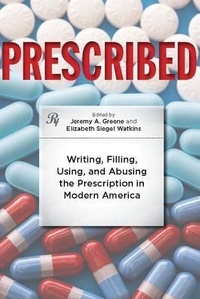
Prescribed
Writing, Filling, Using, and Abusing the Prescription in Modern America
Will be published approx. on 9. July 2012
Book
Hardback
344 pages
978-1-4214-0506-3 (ISBN)
Description
America has had a long love affair with the prescription. It is much more than the written "script" or a manufactured medicine, professionally dispensed and taken, and worth hundreds of millions of dollars a year. As an object, it is uniquely illustrative of the complex relations among the producers, providers, and consumers of medicine in modern America. The tale of the prescription is one of constant struggles over and changes in medical and therapeutic authority. Stakeholders across the biomedical enterprise have alternately upheld and resisted, supported and critiqued, and subverted and transformed the power of the prescription. Who prescribes? What do they prescribe? How do they decide what to prescribe? These questions set a society-wide agenda that changes with the times and profoundly shifts the medical landscape.
Examining drugs individually, as classes, and as part of the social geography of health care, contributors to this volume explore the history of prescribing, including over-the-counter contraceptives, the patient's experience of filling opioid prescriptions, restraints on physician autonomy in prescribing antibiotics, the patient package insert, and other regulatory issues in medicine during postwar America. The first authoritative look at the history of the prescription itself, "Prescribed" is a groundbreaking book that subtly explores the politics of therapeutic authority and the relations between knowledge and practice in modern medicine.
Examining drugs individually, as classes, and as part of the social geography of health care, contributors to this volume explore the history of prescribing, including over-the-counter contraceptives, the patient's experience of filling opioid prescriptions, restraints on physician autonomy in prescribing antibiotics, the patient package insert, and other regulatory issues in medicine during postwar America. The first authoritative look at the history of the prescription itself, "Prescribed" is a groundbreaking book that subtly explores the politics of therapeutic authority and the relations between knowledge and practice in modern medicine.
Reviews / Votes
A powerful guide that should be in any basic health collection... A fine pick for medical, science, and computer collections alike. Midwest Book Review Prescribed provides the reader with a much better understanding of how we have gotten to our current system of managing, and mismanaging, prescription drugs in the United States. -- Scott D. Grimwood Watermark Both the health care professional and the consumer will benefit greatly from this topical book. Prescribed describes how the prescription has progressed from a document written in Latin to an electronic text that is the principal dimension of people's current encounters with physicians, nurse practitioners, and other physician extenders... Highly recommended. Choice This book provides a good overview of the major problems relating to prescriptions and detailed coverage of particular matters for those who want to investigate them further. -- Nano Khilnani Biz India Magazine The emerging field of pharmaceutical history is well served by Prescribed, an excellent book that examines postwar American pharmacy and medicine by focusing on the act of prescribing. -- Gregory Higby Journal of American History This collection may do for the history of epistemology of pharmaceuticals and ideas about drugs what Rosenberg and Golden's Framing Disease did for the history and epistemology of disease. -- Dan Malleck Social History of Medicine The volume is an exceptional collection of stories, which not only reveals the history of the prescription in modern America, but also adds a significant layer to our broader knowledge of pharmaceutical and medical history. -- Mat Savelli Journal of the History of Medicine and Allied Sciences There is no doubt that Prescribed is an excellent contribution to the literature, it deserves a wide readership, and it should be incorporated into many classroom reading lists. These are fascinating, well-told stories that elegantly explain why pharmaceutical studies should be an important element in the study of and instruction in the history of medicine, science, and technology, and in history more generally. Pharmacy in HistoryMore details
Language
English
Place of publication
Baltimore, MD
United States
Target group
College/higher education
Product notice
sewn/stitched
Cloth over boards
Illustrations
4 s/w Photographien bzw. Rasterbilder, 1 s/w Zeichnung
1 Line drawings, black and white; 4 Halftones, black and white
Dimensions
Height: 229 mm
Width: 157 mm
Thickness: 25 mm
Weight
590 gr
ISBN-13
978-1-4214-0506-3 (9781421405063)
DOI
10.1353/book.72073
Copyright in bibliographic data and cover images is held by Nielsen Book Services Limited or by the publishers or by their respective licensors: all rights reserved.
Schweitzer Classification
Other editions
Additional editions
Jeremy A. Greene | Elizabeth Siegel Watkins
Prescribed
Writing, Filling, Using, and Abusing the Prescription in Modern America
Book
07/2012
Johns Hopkins University Press
€35.00
Article not available at the moment
Jeremy A. Greene | Elizabeth Siegel Watkins
Prescribed
Writing, Filling, Using, and Abusing the Prescription in Modern America
E-Book
07/2012
Johns Hopkins University Press
€24.99
Available for download
Persons
Jeremy A. Greene is associate professor of medicine and the history of medicine and the Elizabeth Treide and A. McGehee Harvey Chair in the History of Medicine at the Johns Hopkins University School of Medicine. He is the author of Prescribing by Numbers: Drugs and the Definition of Disease and Generic: The Unbranding of Modern Medicine, both published by Johns Hopkins. Elizabeth Siegel Watkins is a professor, vice chair, and director of graduate studies in the History of Health Sciences Program at the University of California, San Francisco. She is the author of The Estrogen Elixir: A History of Hormone Replacement Therapy in America and On the Pill: A Social History of Oral Contraceptives, 1950-1970, both also published by Johns Hopkins, and the coeditor of Medicating Modern America: Prescription Drugs in History.
Content
List of Abbreviations
Introduction. The Prescription in Perspective
Chapter 1. Goofball Panic: Barbiturates, "Dangerous" and Addictive Drugs, and the Regulation of Medicine in Postwar America
Chapter 2. Pharmacological Restraints: Antibiotic Prescribing and the Limits of Physician Autonomy
Chapter 3. "Eroding the Physician's Control of Therapy": The Postwar Politics of the Prescription
Chapter 4. Deciphering the Prescription: Pharmacists and the Patient Package Insert
Chapter 5. The Right to Write: Prescription and Nurse Practitioners
Chapter 6. The Best Prescription for Women's Health: Feminist Approaches to Well-Woman Care
Chapter 7. "Safer Than Aspirin": The Campaign for Over-the-Counter Oral Contraceptives and Emergency Contraceptive Pills
Chapter 8. The Prescription as Stigma: Opioid Pain Relievers and the Long Walk to the Pharmacy Counter
Chapter 9. Busted for Blockbusters: "Scrip Mills," Quaalude, and Prescribing Power in the 1970s
Chapter 10. The Afterlife of the Prescription: The Sciences of Therapeutic Surveillance
Time Line of Federal Regulations and Rulings Related to the Prescription
Notes
List of Contributors
Index
Introduction. The Prescription in Perspective
Chapter 1. Goofball Panic: Barbiturates, "Dangerous" and Addictive Drugs, and the Regulation of Medicine in Postwar America
Chapter 2. Pharmacological Restraints: Antibiotic Prescribing and the Limits of Physician Autonomy
Chapter 3. "Eroding the Physician's Control of Therapy": The Postwar Politics of the Prescription
Chapter 4. Deciphering the Prescription: Pharmacists and the Patient Package Insert
Chapter 5. The Right to Write: Prescription and Nurse Practitioners
Chapter 6. The Best Prescription for Women's Health: Feminist Approaches to Well-Woman Care
Chapter 7. "Safer Than Aspirin": The Campaign for Over-the-Counter Oral Contraceptives and Emergency Contraceptive Pills
Chapter 8. The Prescription as Stigma: Opioid Pain Relievers and the Long Walk to the Pharmacy Counter
Chapter 9. Busted for Blockbusters: "Scrip Mills," Quaalude, and Prescribing Power in the 1970s
Chapter 10. The Afterlife of the Prescription: The Sciences of Therapeutic Surveillance
Time Line of Federal Regulations and Rulings Related to the Prescription
Notes
List of Contributors
Index