

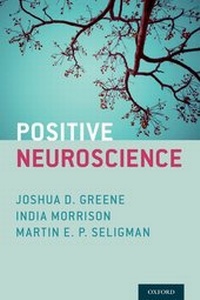
Positive Neuroscience
Published on 7. June 2016
Book
Hardback
256 pages
978-0-19-997792-5 (ISBN)
Description
How do we thrive in our behaviors and experiences? Positive neuroscience research illuminates the brain mechanisms that enable human flourishing. Supported by the John Templeton Foundation's Positive Neuroscience Project, which Martin E. P. Seligman established in 2008, Positive Neuroscience provides an intersection between neuroscience and positive psychology.
In this edited volume, leading researchers describe the neuroscience of social bonding, altruism, and the capacities for resilience and creativity. Part I (Social Bonds) describes the mechanisms that enable humans to connect with one another. Part II (Altruism) focuses on the neural mechanisms underlying the human ability and willingness to confer costly benefits on others. Part III (Resilience and Creativity) examines the mechanisms by which human brains overcome adversity, create, and
discover. Specific topics include: a newly discovered nerve type that appears to be specialized for emotional communication; the effects of parenting on the male brain; how human altruism differs from that of other primates; the neural features of extraordinary altruists who have donated kidneys to
strangers; and distinctive patterns of brain wiring that endow some people with exceptional musical abilities. Accessible to a broad academic audience, from advanced undergraduates to senior scholars, these subjects have generated a fascinating and highly convergent set of ideas and results, shaping our understanding of human nature.
In this edited volume, leading researchers describe the neuroscience of social bonding, altruism, and the capacities for resilience and creativity. Part I (Social Bonds) describes the mechanisms that enable humans to connect with one another. Part II (Altruism) focuses on the neural mechanisms underlying the human ability and willingness to confer costly benefits on others. Part III (Resilience and Creativity) examines the mechanisms by which human brains overcome adversity, create, and
discover. Specific topics include: a newly discovered nerve type that appears to be specialized for emotional communication; the effects of parenting on the male brain; how human altruism differs from that of other primates; the neural features of extraordinary altruists who have donated kidneys to
strangers; and distinctive patterns of brain wiring that endow some people with exceptional musical abilities. Accessible to a broad academic audience, from advanced undergraduates to senior scholars, these subjects have generated a fascinating and highly convergent set of ideas and results, shaping our understanding of human nature.
Reviews / Votes
"The field of positive neuroscience is a relatively new one, and this volume brings together work in this field. The chapters themselves are readily accessible and will be of interest to a broad range of readers. This is likely to be an important volume that will spur the growth of this most interesting and important field." --Steven Maier, PhD, Distinguished Professor of Psychology and Director of the Center for Neuroscience, University of Colorado at Boulder"This is a foundational reference source for the field of Positive Neuroscience, edited and written by those who conducted the seminal studies in the field. This is a must-have for any researcher interested in the neural mechanisms associated with positive psychology." --Turhan Canli, PhD, Professor of Integrative Neuroscience and Director of SCAN (Social, Cognitive, and Affective Neuroscience) Center, Stony Brook University"This is a terrific edited work. The editors and contributors are excellent, and the volume is well organized and covers the right topics. I think that this will be a benchmark in the field." --Stephen G. Post, PhD, Professor of Bioethics, Stony Brook University and author of Altruism & Health: Perspectives from Empirical Research (OUP 2007)"the research reported in this book is truly cutting edge." -- volume 61, issue 52 of PsycCRITIQUES "The field of positive neuroscience is a relatively new one, and this volume brings together work in this field. The chapters themselves are readily accessible and will be of interest to a broad range of readers. This is likely to be an important volume that will spur the growth of this most interesting and important field." --Steven Maier, PhD, Distinguished Professor of Psychology and Director of the Center for Neuroscience, University of Colorado at Boulder"This is a foundational reference source for the field of Positive Neuroscience, edited and written by those who conducted the seminal studies in the field. This is a must-have for any researcher interested in the neural mechanisms associated with positive psychology." --Turhan Canli, PhD, Professor of Integrative Neuroscience and Director of SCAN (Social, Cognitive, and Affective Neuroscience) Center, Stony Brook University"This is a terrific edited work. The editors and contributors are excellent, and the volume is well organized and covers the right topics. I think that this will be a benchmark in the field." --Stephen G. Post, PhD, Professor of Bioethics, Stony Brook University and author of Altruism & Health: Perspectives from Empirical Research (OUP 2007)More details
Other editions
Additional editions
Joshua D. Greene | India Morrison | Martin E. P. Seligman
Positive Neuroscience
E-Book
05/2016
1st Edition
OUP eBook
€69.99
Available for download
Joshua D. Greene | India Morrison | Martin E. P. Seligman
Positive Neuroscience
E-Book
05/2016
1st Edition
OUP eBook
€69.99
Available for download
Persons
Joshua D. Greene, PhD, is Professor of Psychology, a member of the Center for Brain Science faculty, and the director of the Moral Cognition Lab at Harvard University.
India Morrison, PhD, is Assistant Professor in the Department of Clinical and Experimental Medicine at Linköping University, Sweden, and co-founder of the Group for Research in Affective Somatosensation and Pain (GRASP).
Martin E.P. Seligman, PhD, is Director of the Penn Positive Psychology Center and Zellerbach Family Professor of Psychology in the Penn Department of Psychology, and Director of the Penn Master of Applied Positive Psychology program (MAPP).
India Morrison, PhD, is Assistant Professor in the Department of Clinical and Experimental Medicine at Linköping University, Sweden, and co-founder of the Group for Research in Affective Somatosensation and Pain (GRASP).
Martin E.P. Seligman, PhD, is Director of the Penn Positive Psychology Center and Zellerbach Family Professor of Psychology in the Penn Department of Psychology, and Director of the Penn Master of Applied Positive Psychology program (MAPP).