

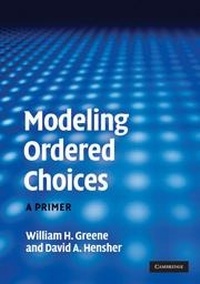
Modeling Ordered Choices
A Primer
Will be published approx. on 8. April 2010
Book
Paperback/Softback
382 pages
978-0-521-14237-3 (ISBN)
Description
It is increasingly common for analysts to seek out the opinions of individuals and organizations using attitudinal scales such as degree of satisfaction or importance attached to an issue. Examples include levels of obesity, seriousness of a health condition, attitudes towards service levels, opinions on products, voting intentions, and the degree of clarity of contracts. Ordered choice models provide a relevant methodology for capturing the sources of influence that explain the choice made amongst a set of ordered alternatives. The methods have evolved to a level of sophistication that can allow for heterogeneity in the threshold parameters, in the explanatory variables (through random parameters), and in the decomposition of the residual variance. This book brings together contributions in ordered choice modeling from a number of disciplines, synthesizing developments over the last fifty years, and suggests useful extensions to account for the wide range of sources of influence on choice.
Reviews / Votes
'An outstanding and timely resource on ordered-response choice modeling that takes readers through the history of such models, and develops a clear taxonomy to position the many generalizations and variants of the standard ordered-response model. Bill Greene and David Hensher have done a masterful job in navigating through, and weaving together, the maze of developments and applications in a diversity of fields. The objective perspectives of the literature provide rich guidance for both the researcher as well as the practitioner. This book is literally a one-stop reference resource on ordered-choice modeling that is at once comprehensive, lucid, insightful, and accessible. A 'must-have' in the bookshelves of anyone wanting to learn about and apply ordered-choice modeling techniques!' Chandra Bhat, University of Texas, Austin 'Theorists and practicing researchers will want to have this text in their working library. It is very well researched, employing examples and interpretation for ordered choice models ranging from the basic to the newest state-of-art methods. I highly recommend this text without reservations.' Joseph M. Hilbe, Arizona State UniversityMore details
Language
English
Place of publication
Cambridge
United Kingdom
Target group
Professional and scholarly
Product notice
Paperback (trade)
Illustrations
63 Tables, unspecified; 33 Line drawings, unspecified
Dimensions
Height: 246 mm
Width: 172 mm
Thickness: 20 mm
Weight
746 gr
ISBN-13
978-0-521-14237-3 (9780521142373)
Copyright in bibliographic data and cover images is held by Nielsen Book Services Limited or by the publishers or by their respective licensors: all rights reserved.
Schweitzer Classification
Other editions
Additional editions
E-Book
06/2010
1st Edition
Cambridge University Press
€44.49
Available for download
Book
04/2010
Cambridge University Press
€173.20
Shipment within 15-20 days
Persons
William H. Greene is Professor of Economics and Toyota Motor Corp. Professor at the Stern School of Business, New York University. David A. Hensher is Professor of Management and Director of the Institute of Transport and Logistics at the University of Sydney.
Content
List of tables; List of figures; Preface; 1. Introduction: random utility and ordered choice models; 2. Modeling binary choices; 3. A model for ordered choices; 4. Antecedents and contemporary counterparts; 5. Estimation, inference and analysis using the ordered choice model; 6. Specification issues in ordered choice models; 7. Accommodating individual heterogeneity; 8. Parameter variation and a generalized ordered choice model; 9. Ordered choice modeling with panel and time series data; 10. Bivariate and multivariate ordered choice models; 11. Two part and sample selection models; 12. Semiparametric and nonparametric estimators and analyses; References; Index.