

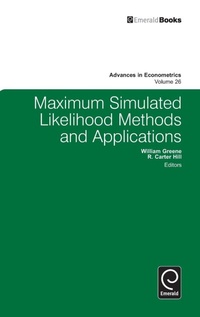
Maximum Simulated Likelihood Methods and Applications
Published on 3. December 2010
Book
Hardback
363 pages
978-0-85724-149-8 (ISBN)
Description
This volume is a collection of methodological developments and applications of simulation-based methods that were presented at a workshop at Louisiana State University in November, 2009. The first two papers are extensions of the GHK simulator: one reconsiders the computation of the probabilities in a discrete choice model while another example uses an adaptive version of sparse-grids integration (SGI) instead of simulation. Two studies are focused specifically on the methodology: the first compares the performance of the maximum-simulated likelihood (MSL) approach with a proposed composite marginal likelihood (CML) approach in multivariate ordered-response situations, while the second examines methods of testing for the presence of heterogeneity in the heterogeneity model. Further topics examined include: education savings accounts, parent contributions and education attainment; estimating the effect of exchange rate flexibility on financial account openness; estimating a fractional response model with a count endogenous regressor; and modelling and forecasting volatility in a bayesian approach.
More details
Series
Language
English
Place of publication
Bingley
United Kingdom
Publishing group
Emerald Publishing Limited
Target group
Professional and scholarly
Dimensions
Height: 240 mm
Width: 161 mm
Thickness: 25 mm
Weight
722 gr
ISBN-13
978-0-85724-149-8 (9780857241498)
Copyright in bibliographic data and cover images is held by Nielsen Book Services Limited or by the publishers or by their respective licensors: all rights reserved.
Schweitzer Classification
Other editions
Additional editions
William Greene | R. Carter Hill
Maximum Simulated Likelihood Methods and Applications
E-Book
12/2010
Emerald Publishing Limited
€135.99
Available for download
Persons
Content
List of Contributors.
Introduction.
MCMC perspectives on simulated likelihood estimation.
The panel probit model: Adaptive integration on sparse grids.
A comparison of the maximum simulated likelihood and composite marginal likelihood estimation approaches in the context of the multivariate ordered-response model.
Pretest Estimation in the Random Parameters Logit Model.
Simulated maximum likelihood estimation of continuous time stochastic volatility models.
Education savings accounts, parent contributions, and education attainment.
Estimating the effect of exchange rate flexibility on financial account openness.
Estimating a Fractional Response Model with a count endogenous regressor and an application to female labor supply.
Alternative random effects panel gamma SML estimation with heterogeneity in random and one-sided error.
Modeling and forecasting volatility in a bayesian approach.
Advances in Econometrics.
Advances in Econometrics.
Copyright page.
Introduction.
MCMC perspectives on simulated likelihood estimation.
The panel probit model: Adaptive integration on sparse grids.
A comparison of the maximum simulated likelihood and composite marginal likelihood estimation approaches in the context of the multivariate ordered-response model.
Pretest Estimation in the Random Parameters Logit Model.
Simulated maximum likelihood estimation of continuous time stochastic volatility models.
Education savings accounts, parent contributions, and education attainment.
Estimating the effect of exchange rate flexibility on financial account openness.
Estimating a Fractional Response Model with a count endogenous regressor and an application to female labor supply.
Alternative random effects panel gamma SML estimation with heterogeneity in random and one-sided error.
Modeling and forecasting volatility in a bayesian approach.
Advances in Econometrics.
Advances in Econometrics.
Copyright page.