

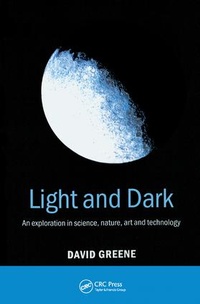
Light and Dark
An exploration in science, nature, art and technology
1st Edition
Published on 27. July 2017
Book
Hardback
242 pages
978-1-138-42988-8 (ISBN)
Description
An entertaining, instructive, diverse, and unusual book, Light and Dark: An Exploration in Science, Nature, Art and Technology encompasses a wide range of topics not normally found in one book.
With more than 100 diagrams, graphs, and figures, the subjects discussed include the history of artificial lighting, eclipse cycles, light-sensitive eyeglasses, rainbows, art, bioluminescence, the clock setting at the South Pole, zebra stripe patterns, lighthouses, color perception, the harvest moon, and how information and speech can be conveyed by light from the sun or a laser.
The book encourages readers to take a more careful look at many familiar phenomena, such as the variations in the duration of twilight through the year and the ability of human vision to misinterpret patterns of lines under certain conditions. It describes the anatomical peculiarities of four-eyed fish and explains how the Jewish calendar contrives to follow both solar and lunar cycles. It also presents the reasons why tortoise shell cats are almost always female. Readers are informed where they can see 19th century military equipment that could convey messages rapidly over vast differences.
With more than 100 diagrams, graphs, and figures, the subjects discussed include the history of artificial lighting, eclipse cycles, light-sensitive eyeglasses, rainbows, art, bioluminescence, the clock setting at the South Pole, zebra stripe patterns, lighthouses, color perception, the harvest moon, and how information and speech can be conveyed by light from the sun or a laser.
The book encourages readers to take a more careful look at many familiar phenomena, such as the variations in the duration of twilight through the year and the ability of human vision to misinterpret patterns of lines under certain conditions. It describes the anatomical peculiarities of four-eyed fish and explains how the Jewish calendar contrives to follow both solar and lunar cycles. It also presents the reasons why tortoise shell cats are almost always female. Readers are informed where they can see 19th century military equipment that could convey messages rapidly over vast differences.
More details
Language
English
Place of publication
London
United Kingdom
Publishing group
Taylor & Francis Ltd
Target group
Professional and scholarly
Professional Practice & Development
Dimensions
Height: 229 mm
Width: 152 mm
Weight
610 gr
ISBN-13
978-1-138-42988-8 (9781138429888)
Copyright in bibliographic data and cover images is held by Nielsen Book Services Limited or by the publishers or by their respective licensors: all rights reserved.
Schweitzer Classification
Other editions
Additional editions
E-Book
04/2016
CRC Press
€41.99
Available for download
E-Book
04/2016
CRC Press
€41.99
Available for download
Book
09/2002
1st Edition
Institute of Physics Publishing
€57.16
Shipment within 10-20 days
Person
David Greene
Content
PREFACE 1 ESSENTIAL, USEFUL AND FRIVOLOUS LIGHT 1.1 Light for life 1.2 Wonder and worship 1.3 Artificial illumination 1.4 Light in art and entertainment 2 PATTERNS OF SUNLIGHT 2.1 The year 2.2 Equinoxes and eccentricity 2.3 The length of a day 2.4 The length of daylight 2.5 The length of a second 3 MONTHS AND MOONLIGHT 3.1 The lunar month and the lunar orbit 3.2 The lunar nodes and their rotation 3.3 The lunar day 3.4 The length of moonlight 3.5 Eclipses and Saros cycles 3.6 Tides 4 HISTORY, DATES AND TIMES 4.1 Solar calendars 4.2 The Roman Catholic Church and the development of astronomy 4.3 The start of the year 4.4 Lunar and other calendars 4.5 Time zones 4.6 The International Date Line 5 LIGHT AND THE ATMOSPHERE 5.1 Scattered light and twilight 5.2 Polarization of light 5.3 Rainbows 5.4 Cloudy skies 5.5 Halos 6 SEEING THE LIGHT 6.1 The human eye 6.2 Colour vision and colour blindness 6.3 Polarization sensitivity 6.4 Speed of response 6.5 Optical illusions 7 ZOOLOGICAL DIVERSIONS 7.1 Colour vision in animals 7.2 Zebras 7.3 Piebald coats and unusual goats 7.4 Jellicle cats are black and white 7.5 Cephalopods 17.6 Lighting up for a mate or a meal 7.7 More anatomical oddities 8 INFORMATION IN LIGHT 8.1 Lighthouses 8.2 Semaphores for optical telegraphy 8.3 Morse, Mance and the heliograph 8.4 Bell and the photophone 9 LIGHT IN THE ERA OF ELECTRONICS 9.1 Electronics 1900-1960 9.2 New semiconductors for optoelectronics 9.3 Optoelectronic semiconductor devices 9.4 Bright light from cool solids 10 OPTICAL COMMUNICATION TODAY 10.1 Waveguides and optical fibres 10.2 The transparency of glass 110.3 Optical fibres 10.4 Optical amplification 10.5 Conveying sound by light 10.6 The long and the short of optical communication