

January Moon
The Northern Cheyenne Breakout from Fort Robinson, 1878-1879
Published on 30. April 2020
Book
Hardback
344 pages
978-0-8061-6478-6 (ISBN)
Description
Historian Jerome A. Greene is renowned for his memorable chronicles of egregious events involving American Indians and the U.S. military, including Sand Creek, Washita, and Wounded Knee. Now, in January Moon, Greene draws from extensive research and fieldwork to explore a signal - and appallingly brutal - event in American history: the desperate flight of Chief Dull Knife's Northern Cheyenne Indians from imprisonment at Fort Robinson, Nebraska.
In the wake of the Great Sioux War of 1876-77, the U.S. government expelled most Northern Cheyennes from their northern plains homeland to Indian Territory, in present-day Oklahoma. Following mounting hardships, many of those people, under Chiefs Dull Knife and Little Wolf, broke away, seeking to return north. While Little Wolf's band managed initially to elude pursuing U.S. troops, Dull Knife's people were captured in 1878 and ushered into a makeshift barrack prison at Camp (later Fort) Robinson, where they spent months waiting for government officials to decide their fate. It is here that Greene's riveting narrative edges toward its climax.
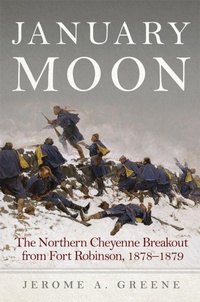
On the night of January 9, 1879, in a bloody struggle with troops, Dull Knife's people staged a massive breakout from their barrack prison in a last-ditch bid for freedom. Greene paints a vivid picture of their frantic escape, which took place under an unusually brilliant moon that doomed many of those fleeing by silhouetting them against the snow. A climactic engagement at Antelope Creek proved especially devastating, and the helpless people were nearly annihilated.
In gripping detail, Greene follows the survivors' dreadful experiences into their aftermath, including creation of the Northern Cheyenne Reservation. Carrying the story to the present day, he describes Cheyenne tribal events commemorating the breakout - all designed to ensure that the injustices of nineteenth-century U.S. government policy will never be forgotten.
In the wake of the Great Sioux War of 1876-77, the U.S. government expelled most Northern Cheyennes from their northern plains homeland to Indian Territory, in present-day Oklahoma. Following mounting hardships, many of those people, under Chiefs Dull Knife and Little Wolf, broke away, seeking to return north. While Little Wolf's band managed initially to elude pursuing U.S. troops, Dull Knife's people were captured in 1878 and ushered into a makeshift barrack prison at Camp (later Fort) Robinson, where they spent months waiting for government officials to decide their fate. It is here that Greene's riveting narrative edges toward its climax.
On the night of January 9, 1879, in a bloody struggle with troops, Dull Knife's people staged a massive breakout from their barrack prison in a last-ditch bid for freedom. Greene paints a vivid picture of their frantic escape, which took place under an unusually brilliant moon that doomed many of those fleeing by silhouetting them against the snow. A climactic engagement at Antelope Creek proved especially devastating, and the helpless people were nearly annihilated.
In gripping detail, Greene follows the survivors' dreadful experiences into their aftermath, including creation of the Northern Cheyenne Reservation. Carrying the story to the present day, he describes Cheyenne tribal events commemorating the breakout - all designed to ensure that the injustices of nineteenth-century U.S. government policy will never be forgotten.
Reviews / Votes
Greene's January Moon should prompt more research into aftermath of the Great Sioux War (and other Indian conflicts of the late 19th century) and the effects of the disreputable reservation system, the concentration of tribes far from their Native homelands and the failure of the federal government to protect and treat America's indigenous people with the respect they deserved as human beings and fellow Americans.-True West magazine "Greene's January Moon should prompt more research into aftermath of the Great Sioux War (and other Indian conflicts of the late 19th century) and the effects of the disreputable reservation system, the concentration of tribes far from their Native homelands and the failure of the federal government to protect and treat America's indigenous people with the respect they deserved as human beings and fellow Americans." -True WestMore details
Language
English
Place of publication
Oklahoma
United States
Target group
Professional and scholarly
Product notice
sewn/stitched
Cloth over boards
Illustrations
24 black & white and 3 colour illustrations, 6 maps
Dimensions
Height: 236 mm
Width: 161 mm
Thickness: 32 mm
Weight
652 gr
ISBN-13
978-0-8061-6478-6 (9780806164786)
Copyright in bibliographic data and cover images is held by Nielsen Book Services Limited or by the publishers or by their respective licensors: all rights reserved.
Schweitzer Classification
Person
Jerome A. Greene is retired as Research Historian for the National Park Service. He is the author of numerous books, including Stricken Field: The Little Bighorn since 1876, Battles and Skirmishes of the Great Sioux War, 1876-1877: The Military View; Lakota and Cheyenne: Indian Views of the Great Sioux War, 1876-1877; and Morning Star Dawn: The Powder River Expedition and the Northern Cheyennes, 1876, all published by the University of Oklahoma Press.