

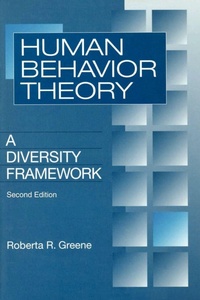
Human Behavior Theory
A Diversity Framework
1st Edition
Published on 31. December 1994
Book
Paperback/Softback
319 pages
978-0-202-36090-4 (ISBN)
Description
In recent years, advocates for civil rights for minorities, women, and gays and lesbians have become more informed consumers of mental health services. As a result, social work practitioners need to prepare themselves to serve diverse constituencies for who previously held behavioral and cultural assumptions have proven not to be universally applicable. The purpose of Greene's book is to help students and practitioners better understand how social workers have used human behavior theories to more competently address variations in group and community membership within the social worker-client encounter.
The book's approach is largely thematic. Most of the chapters explore how particular assumptions of a human behavior theory--psychoanalytic theory, psychodynamic/ego psychology theory, systems theory, behavioral theory, symbolic interaction theory, feminist theory, constructionist theory, small group theory, and an ecological perspective --have been used to answer issues related to cultural diversity. The challenges and limitations of each theory's applications across varying client constituencies are discussed throughout. What sorts of new conceptual issues for the practitioner of family services are raised in work with minority families, for example, or with lesbian families? How does a specific theory help, or not help, in group-specific interventions and evaluations?
Intended as a companion volume to the widely adopted human behavior text by Greene and Ephross, Greene's new book fills the need for a wide, synthetic reading of the recent literature.
The book's approach is largely thematic. Most of the chapters explore how particular assumptions of a human behavior theory--psychoanalytic theory, psychodynamic/ego psychology theory, systems theory, behavioral theory, symbolic interaction theory, feminist theory, constructionist theory, small group theory, and an ecological perspective --have been used to answer issues related to cultural diversity. The challenges and limitations of each theory's applications across varying client constituencies are discussed throughout. What sorts of new conceptual issues for the practitioner of family services are raised in work with minority families, for example, or with lesbian families? How does a specific theory help, or not help, in group-specific interventions and evaluations?
Intended as a companion volume to the widely adopted human behavior text by Greene and Ephross, Greene's new book fills the need for a wide, synthetic reading of the recent literature.
More details
Series
Language
English
Place of publication
Somerset
United States
Publishing group
Taylor & Francis Inc
Target group
College/higher education
Dimensions
Height: 229 mm
Width: 152 mm
Thickness: 19 mm
Weight
522 gr
ISBN-13
978-0-202-36090-4 (9780202360904)
Copyright in bibliographic data and cover images is held by Nielsen Book Services Limited or by the publishers or by their respective licensors: all rights reserved.
Schweitzer Classification
Other editions
Additional editions
E-Book
09/2017
1st Edition
Routledge
€64.49
Available for download
E-Book
09/2017
Routledge
€64.49
Available for download

Book
12/1994
1st Edition
AldineTransaction
€155.99
Article not available at the moment
Person
Roberta R. Greene is the Louis and Ann Wolens Centennial Chair in Gerontology and Social Welfare at the University of Texas at Austin. She has authored numerous books and journal articles dealing with the application of conceptual frameworks to social work practice. She is a member of the editorial board of the Journal of Social Work Education.
Content
1: Social Work Practice Within a Diversity Framework; 2: A Diversity Framework for Human Behavior: Conceptual and Historical Reformulations; 3: The Social Work Interview: Legacy of Carl Rogers and Sigmund Freud; 4: Symbolic Interactionism: Social Work Assessment, Meanings, and Language; 5: Erikson's Eight Stages of Development: Different Lenses; 6: Role Theory and Social Work Practice; 7: A Constructionist Approach With Diverse Populations; 8: Social Learning Theory: Empirical Applications to Culturally Diverse Practice; 9: A Systems Approach: Addressing Diverse Family Forms; 10: Small Group Theory and Social Work Practice: Promoting Diversity and Social Justice or Recreating Inequities?; 11: Working With Natural Social Networks: An Ecological Approach; 12: Power Factors in Social Work Practice; Epilogue: Power and the Social Work Profession