

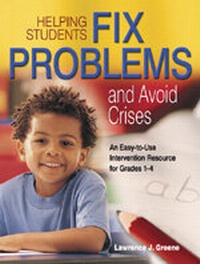
Helping Students Fix Problems and Avoid Crises
An Easy-to-Use Intervention Resource for Grades 1-4
1st Edition
Published on 3. August 2005
Book
Hardback
200 pages
978-1-4129-0469-8 (ISBN)
Description
"Provides a sequential method for teaching the skills children need to help themselves. . . I can see where this book will be one that is dog-eared and never just sitting on the shelf."
Mary Ann Sweet, Counselor
Tomball Elementary School, TX
"This book offers real steps for helping empower kids. The lessons are designed in such a way that all children within a classroom would benefit, whether they are the child for whom the lesson was designed or the one for whom the lesson will build empathy, compassion, and understanding. Most books out there are not user friendly, providing off-the-shelf lessons. Mr. Greene has taken a truly easy-to-use methodical approach to problems kids face that can become a pivotal point in turning them around at an earlier age."
Beverly Eidmann, Principal
Manzanita Elementary School, CA
"Very practical and usable units, easy to understand and carry out. . . . Child-centered and internally empowering for the student."
Robert DiGiulio, Author and Educator
Johnson State College, VT
Turn classroom problems into life skills opportunities!
For every teacher who has been at a loss to help the student who seemed helpless, this is a resource that cannot be missed. In Helping Students Fix Problems and Avoid Crises, Lawrence J. Greene details instructional principles to help educators model and mentor effective life skills behaviors for their students.
For the child who doesn't have friends, does poorly in sports, has difficulty learning, or who steals, lies, or bullies, Greene provides solid, proven methods to help these learners discover and practice better life skills.
Helping Students Fix Problems and Avoid Crises includes:
Insightful stories for teachers and students illustrating each problem
Practical activities and exercises illustrating techniques to help students address each problem
Supplemental reproducible exercises
Encouraging follow-up and application exercises
Greene divides each problematic issue into two sections: for educators, he looks at the dynamics and implications of each problem, and for students, he provides classroom scripts and exercises to bring their own awareness to their problems. This essential classroom resource also includes illuminating ten-minute read-aloud stories, strategic thinking questions, optional activities, and reproducible exercises!
Mary Ann Sweet, Counselor
Tomball Elementary School, TX
"This book offers real steps for helping empower kids. The lessons are designed in such a way that all children within a classroom would benefit, whether they are the child for whom the lesson was designed or the one for whom the lesson will build empathy, compassion, and understanding. Most books out there are not user friendly, providing off-the-shelf lessons. Mr. Greene has taken a truly easy-to-use methodical approach to problems kids face that can become a pivotal point in turning them around at an earlier age."
Beverly Eidmann, Principal
Manzanita Elementary School, CA
"Very practical and usable units, easy to understand and carry out. . . . Child-centered and internally empowering for the student."
Robert DiGiulio, Author and Educator
Johnson State College, VT
Turn classroom problems into life skills opportunities!
For every teacher who has been at a loss to help the student who seemed helpless, this is a resource that cannot be missed. In Helping Students Fix Problems and Avoid Crises, Lawrence J. Greene details instructional principles to help educators model and mentor effective life skills behaviors for their students.
For the child who doesn't have friends, does poorly in sports, has difficulty learning, or who steals, lies, or bullies, Greene provides solid, proven methods to help these learners discover and practice better life skills.
Helping Students Fix Problems and Avoid Crises includes:
Insightful stories for teachers and students illustrating each problem
Practical activities and exercises illustrating techniques to help students address each problem
Supplemental reproducible exercises
Encouraging follow-up and application exercises
Greene divides each problematic issue into two sections: for educators, he looks at the dynamics and implications of each problem, and for students, he provides classroom scripts and exercises to bring their own awareness to their problems. This essential classroom resource also includes illuminating ten-minute read-aloud stories, strategic thinking questions, optional activities, and reproducible exercises!
Reviews / Votes
"Provides a sequential method for teaching the skills children need to help themselves. . . I can see where this book will be one that is dog-eared and never just sitting on the shelf." -- Mary Ann Sweet, Counselor "This book offers real steps for helping empower kids. The lessons are designed so that all children within a classroom would benefit, whether they are the child for whom the lesson was designed or the one for whom the lesson will build empathy, compassion, and understanding. Most books are not user friendly, providing off-the-shelf lessons. Mr. Greene has taken a truly easy-to-use methodical approach to problems kids face that can become a pivotal point in turning them around at an earlier age." -- Beverly Eidmann, Principal "Very practical and usable units, easy to understand and carry out. . . . Child-centered and internally empowering for the student." -- Robert DiGiulio, Author and Educator "I appreciate the book's informal tone and the flow of material. It is very readable; free of complicated psychobabble and excessive jargon. Although teachers get classroom management in the education curriculum, the strategies are laced with common sense that often gets passed over in the general education curriculum. (The) writing is clear: stories are useful and appropriate to the content area discussed, table of contents is comprehensive; exercises are helpful." -- Kevin Fall "A welcome intervention guide for teachers in the early grades. This book is a valuable tool with ideas that can be implemented within language arts, social studies, or health curriculum." -- Professionally Speaking, September 2006More details
Language
English
Place of publication
Thousand Oaks
United States
Publishing group
SAGE Publications Inc
Target group
Professional and scholarly
Interest Age: 0 years
Product notice
Cloth over boards
Dimensions
Height: 279 mm
Width: 216 mm
Weight
709 gr
ISBN-13
978-1-4129-0469-8 (9781412904698)
Copyright in bibliographic data and cover images is held by Nielsen Book Services Limited or by the publishers or by their respective licensors: all rights reserved.
Schweitzer Classification
Other editions
Additional editions
Lawrence J. Greene
Helping Students Fix Problems and Avoid Crises
An Easy-to-Use Intervention Resource for Grades 1-4
Book
08/2005
1st Edition
Corwin Press Inc
€40.60
Shipment within 10-20 days
Person
Lawrence J. Greene, a graduate of the Stanford University Graduate School of Education, is a nationally recognized author, educational therapist, consultant, and curriculum developer who has worked with more than ten thousand strug-gling students during a clinical career spanning thirty years. He has written eighteen books, and he has trained thousands of teachers in graduate programs at the university level. His educational curricula are currently used in elemen-tary schools, middle schools, high schools, colleges, and universities throughout the world, and his books have been translated into languages ranging from Chinese to Spanish. Other Books by Lawrence J. Greene Kids Who Hate School Kids Who Underachieve Learning Disabilities and Your Child Getting Smarter Think Smart, Study Smart Smarter Kids Teachers' Desk Reference Guide to Learning Problems Improving Your Child's Schoolwork The Life-Smart Kid Finding Help When Your Child Is Struggling in School Roadblocks to Learning Winning the Study Game Study Wise Study Max: Improving Study Skills in Grades 9-12 The Resistant Learner Strategies for Success (forthcoming)
Content
Introduction
Being Attuned
Can I Really Do It?
How the Program Works
Acknowledgments
About the Author
Unit 1: The Child Who Doesn't Have Friends
For Educators: Examining the Dynamics and Implications of Social Rejection
Struggling With Seemingly Insoluble Problems
The Nuts and Bolts of Self-Esteem
Identifying and Expressing Feelings
Concept and Application
Developing Analytical Thinking Skills
Key Objectives for Enhancing Students' Awareness
Can Children Be Taught to Be More Empathetic?
Examining the Story
The Questions That Follow the Story
Cause-and-Effect Principles
Brainstorming
Getting Started
For Students: The Child Who Doesn't Have Friends
The Story
Oral Questions
Optional Activity: Careful Reading and Analysis of the Story
Supplemental Reproducible Exercises
Follow-Up and Application
Additional Concrete Reinforcements
Unit 2: The Child Who Has Difficulty Learning
For Educators: Examining the Emotional Implications of Learning Problems
The Effects of Learning Differences
Conduct Commonly Associated With Learning Problems
Classroom Scripts
Restrictive Assessment Criteria
Identifying and Applying Multiple Intelligences
Learning Preferences
Identifying Preferred Learning Modalities
Learning Modality Inventory
Interpreting the Survey
Using Dominant and Preferred Learning Modalities
Examining the Story
The Questions That Follow the Story
For Students: The Child Who Has Difficulty Learning
The Story
Oral Questions
Optional Activity: Careful Reading and Analysis of the Story
Supplemental Reproducible Exercises
Follow-Up and Application
Concrete Reinforcements
Unit 3: The Child Who Steals
For Educators: Examining the Dynamics and Implications of Stealing
Common Explanations for Stealing
An Alternative to the Traditional Adult Responses to Stealing
Examining the Story
The Questions That Follow the Story
For Students: The Child Who Steals
The Story
Oral Questions
Optional Activity: Careful Reading and Analysis of the Story
Supplemental Reproducible Exercises
Follow-Up and Application
Concrete Reinforcements
Unit 4: The Child Who Tells Lies
For Educators: Examining the Dynamics and Implications of Lying
Training Children to Be Truthful
Expanding the List of Explanations for Lying
Traditional Adult Responses to Lying
The Role of the Teacher
Examining the Story
The Questions That Follow the Story
For Students: The Child Who Tells Lies
The Story
Oral Questions
Optional Activity: Careful Reading and Analysis of the Story
Supplemental Reproducible Exercises
Follow-Up and Application
Concrete Reinforcements
Unit 5: The Child Who Is a Bully
For Educators: Examining the Dynamics and Implications of Bullying
Power as a Surrogate Social Acceptance
Training Children to Be Kind
The Role of the Teacher
Examining the Story
The Questions That Follow the Story
For Students: The Child Who Is a Bully
The Story
Oral Questions
Optional Activity: Careful Reading and Analysis of the Story
Supplemental Reproducible Exercises
Follow-Up and Application
Concrete Reinforcements
Unit 6: The Child Who Does Poorly in Sports
For Educators: Examining the Implications of Being Poorly Coordinated
The Ethos of Sports
The Consequences of Poor Coordination
Antidotes for Athletic Insufficiencies
Examining the Story
The Questions That Follow the Story
For Students: The Child Who Does Poorly in Sports
The Story
Oral Questions
Optional Activity: Careful Reading and Analysis of the Story
Supplemental Reproducible Exercises
Follow-up and Application
Concrete Reinforcements
Appendix 1: Psychological Overlay and Learning Differences
Understanding Psychological Overlay
Identifying the Symptoms of Psychological Overlay
Behaviors and Attitudes That May Indicate Psychological Overlay
Appendix 2: Psychological Problems
Red Flag Symptoms of a Possible Psychological Problem
Referral and Intervention
Index
Being Attuned
Can I Really Do It?
How the Program Works
Acknowledgments
About the Author
Unit 1: The Child Who Doesn't Have Friends
For Educators: Examining the Dynamics and Implications of Social Rejection
Struggling With Seemingly Insoluble Problems
The Nuts and Bolts of Self-Esteem
Identifying and Expressing Feelings
Concept and Application
Developing Analytical Thinking Skills
Key Objectives for Enhancing Students' Awareness
Can Children Be Taught to Be More Empathetic?
Examining the Story
The Questions That Follow the Story
Cause-and-Effect Principles
Brainstorming
Getting Started
For Students: The Child Who Doesn't Have Friends
The Story
Oral Questions
Optional Activity: Careful Reading and Analysis of the Story
Supplemental Reproducible Exercises
Follow-Up and Application
Additional Concrete Reinforcements
Unit 2: The Child Who Has Difficulty Learning
For Educators: Examining the Emotional Implications of Learning Problems
The Effects of Learning Differences
Conduct Commonly Associated With Learning Problems
Classroom Scripts
Restrictive Assessment Criteria
Identifying and Applying Multiple Intelligences
Learning Preferences
Identifying Preferred Learning Modalities
Learning Modality Inventory
Interpreting the Survey
Using Dominant and Preferred Learning Modalities
Examining the Story
The Questions That Follow the Story
For Students: The Child Who Has Difficulty Learning
The Story
Oral Questions
Optional Activity: Careful Reading and Analysis of the Story
Supplemental Reproducible Exercises
Follow-Up and Application
Concrete Reinforcements
Unit 3: The Child Who Steals
For Educators: Examining the Dynamics and Implications of Stealing
Common Explanations for Stealing
An Alternative to the Traditional Adult Responses to Stealing
Examining the Story
The Questions That Follow the Story
For Students: The Child Who Steals
The Story
Oral Questions
Optional Activity: Careful Reading and Analysis of the Story
Supplemental Reproducible Exercises
Follow-Up and Application
Concrete Reinforcements
Unit 4: The Child Who Tells Lies
For Educators: Examining the Dynamics and Implications of Lying
Training Children to Be Truthful
Expanding the List of Explanations for Lying
Traditional Adult Responses to Lying
The Role of the Teacher
Examining the Story
The Questions That Follow the Story
For Students: The Child Who Tells Lies
The Story
Oral Questions
Optional Activity: Careful Reading and Analysis of the Story
Supplemental Reproducible Exercises
Follow-Up and Application
Concrete Reinforcements
Unit 5: The Child Who Is a Bully
For Educators: Examining the Dynamics and Implications of Bullying
Power as a Surrogate Social Acceptance
Training Children to Be Kind
The Role of the Teacher
Examining the Story
The Questions That Follow the Story
For Students: The Child Who Is a Bully
The Story
Oral Questions
Optional Activity: Careful Reading and Analysis of the Story
Supplemental Reproducible Exercises
Follow-Up and Application
Concrete Reinforcements
Unit 6: The Child Who Does Poorly in Sports
For Educators: Examining the Implications of Being Poorly Coordinated
The Ethos of Sports
The Consequences of Poor Coordination
Antidotes for Athletic Insufficiencies
Examining the Story
The Questions That Follow the Story
For Students: The Child Who Does Poorly in Sports
The Story
Oral Questions
Optional Activity: Careful Reading and Analysis of the Story
Supplemental Reproducible Exercises
Follow-up and Application
Concrete Reinforcements
Appendix 1: Psychological Overlay and Learning Differences
Understanding Psychological Overlay
Identifying the Symptoms of Psychological Overlay
Behaviors and Attitudes That May Indicate Psychological Overlay
Appendix 2: Psychological Problems
Red Flag Symptoms of a Possible Psychological Problem
Referral and Intervention
Index